
🩺 Nursing Question of the Day
Challenge yourself with one exam-style nursing question every day.
✅ Think carefully • ✅ Choose your answer • ✅ Then scroll down to check the explanation.
📝 Today’s Question:
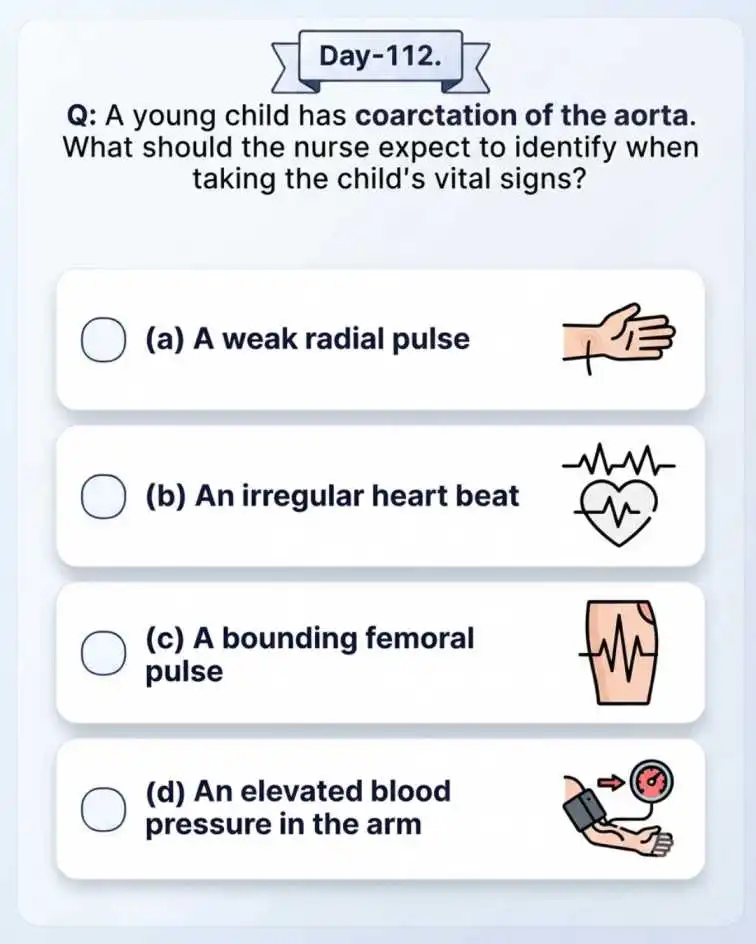
Q: A young child has coarctation of the aorta. What should the nurse expect to identify when taking the child vital signs?
👆 Comment your answer and then tap an option to check your answer.
Don’t forget to Comment your answer below.
Vital Signs in Coarctation of the Aorta
Why is this the correct answer?
Coarctation of the aorta is a congenital narrowing of a portion of the aorta. The aorta is the largest artery in the body and carries oxygen-rich blood from the heart to the rest of the body.
When the aorta becomes narrowed, blood has difficulty passing through the narrowed area. Blood pressure builds up before the narrowing, especially in the upper part of the body.
As a result, the child may have high blood pressure in the arms, while blood pressure in the legs is lower.
This is why the nurse should compare blood pressure and pulses in both the upper and lower extremities. A noticeable difference between arm and leg blood pressure is an important clue.
Heart → narrowed aorta → lower body
Pressure builds up before the narrowing → higher arm BP
Less blood reaches the legs → lower leg BP / weaker leg pulses
Understanding the Medical Terms
Coarctation: This means narrowing or constriction of a tube or vessel. The word comes from Latin coarctare, meaning “to make narrow” or “to compress.”
Aorta: The aorta is the body’s largest artery. The name comes from Greek aortē, meaning something “lifted” or “suspended,” referring to the major vessel arising from the heart.
Artery: An artery is a blood vessel that carries blood away from the heart. The term comes from Greek artēria.
Blood pressure: This is the force of blood pushing against the walls of blood vessels. It is especially important in coarctation because the pressure differs above and below the narrowed area.
Radial pulse: The radial pulse is felt at the wrist on the thumb side. It represents blood flow through the radial artery.
Femoral pulse: The femoral pulse is felt in the groin and represents blood flow through the femoral artery supplying the lower limb.
Why are the other options incorrect?
This is not the classic finding. Because the narrowing is usually beyond the vessels supplying the upper limbs, the arm pulses may be relatively strong while pulses in the legs are weaker.
An irregular heartbeat is not the characteristic vital-sign finding of coarctation. The important clue is the difference in blood pressure and pulse strength between the upper and lower body.
This is the opposite of what is expected. Because blood flow to the lower body is reduced beyond the narrowing, the femoral pulse is typically weak or delayed.
This is correct. The narrowing causes pressure to build up proximal to the obstruction, producing higher blood pressure in the upper extremities.
What should the nurse assess?
The nurse should measure blood pressure in the arms and legs when appropriate and compare the pulses of the upper and lower extremities.
A classic pattern is higher arm blood pressure with weaker or delayed femoral pulses. The nurse should also observe for cool lower extremities, decreased exercise tolerance, headache, or other signs related to reduced blood flow.
Coarctation = “High Above, Low Below.”
High BP in the arms + weak pulses in the legs.
If you see coarctation of the aorta, immediately think: higher blood pressure in the arms + weak or delayed femoral pulses. The key answer here is elevated arm blood pressure.
Concept clarity • Easy recall • Nursing success
Previous Nursing Questions
Missed a previous question? Try these exam-style nursing MCQs. Click below to see the correct answer and detailed explanation.
Nurse is caring for a patient with suspected diverticulitis. The nurse would be most prudent in questioning which of the following diagnostic tests ordered:
See Answer & Explanation →A postoperative client asks the nurse why it is so important to deep-breathe and cough after surgery. When formulating a response, the nurse incorporates the understanding that retained pulmonary secretions in a postoperative client can lead to which condition?
See Answer & Explanation →An elderly client is diagnosed with interstitial cystitis. Which finding differentiates interstitial cystitis from other forms of cystitis?
See Answer & Explanation →A congenital renal disorder in which the kidneys are fused with a renal parenchymal or fibrous isthmus is:
See Answer & Explanation →A physician prescribes laboratory studies for an infant of a HIV positive woman to determine the presence of HIV antigen. The nurse anticipates that which laboratory study will be prescribed?
See Answer & Explanation →A six-year-old boy is admitted to the hospital in diabetic ketoacidosis. Which manifestation should the nurse expect to observe?
See Answer & Explanation →A client’s membranes rupture while her labor is being augmented with an oxytocin infusion. A nurse observes variable decelerations in the fetal heart rate on the fetal monitor strip. What action should the nurse take next?
See Answer & Explanation →A 38-year-old woman returns from a subtotal thyroidectomy for the treatment of hyperthyroidism. On assessment, which immediate priority should the nurse include?
See Answer & Explanation →What is the most appropriate initial nursing intervention for a hypertensive patient with obesity who reports difficulty eating balanced meals due to work?
See Answer & Explanation →The nurse is providing medication instructions to a client with breast cancer who is receiving cyclophosphamide. The nurse should tell the client to take which action?
See Answer & Explanation →Ready to Test Your Nursing Knowledge?
Practice nursing MCQs, take mock tests, attempt quizzes, and prepare for competitive nursing exams — all in one place.
Don’t forget to comment the answer below.