
🩺 Nursing Question of the Day
Challenge yourself with one exam-style nursing question every day.
✅ Think carefully • ✅ Choose your answer • ✅ Then scroll down to check the explanation.
📝 Today’s Question:
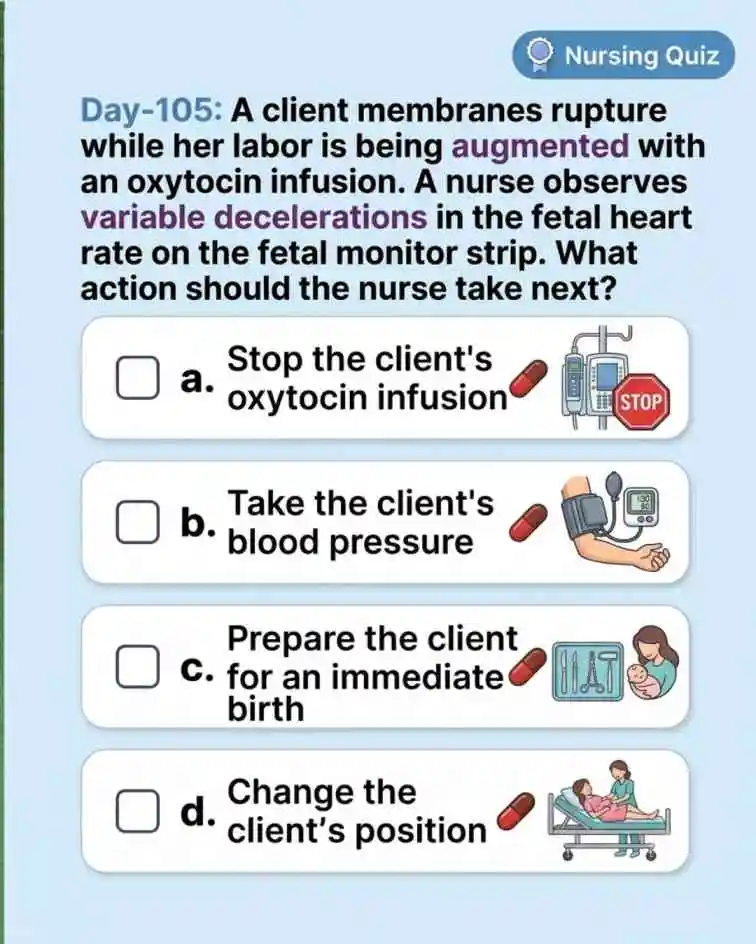
Q: A client membranes rupture while her labor is being augmented with an oxytocin infusion. A nurse observes variable decelerations in the fetal heart rate on the fetal monitor strip. What action should the nurse take next?(a)(b)(c)(d)
👆 Comment your answer and then tap an option to check your answer.
Don’t forget to Comment your answer below.
👶 Variable Decelerations During Labor
Variable decelerations usually suggest umbilical cord compression. The first nursing action is to change the mother’s position to help relieve pressure on the cord and improve blood flow to the fetus.
🔎 What Are Variable Decelerations?
A deceleration means a temporary decrease in the fetal heart rate. Variable decelerations can begin and end at different times in relation to uterine contractions.
They are most commonly caused by compression of the umbilical cord. When the cord is squeezed, blood flow and oxygen delivery to the fetus can temporarily decrease.
Because the membranes have ruptured, there is less fluid surrounding the fetus. This can make cord compression more likely.
Variable = Cord compression.
Cord compression → Change position first.
🩺 Why Does Changing Position Help?
A simple position change can take pressure off the umbilical cord. The nurse may reposition the client, commonly using a side-lying position, while continuing to assess the fetal heart rate.
The goal is to improve uteroplacental blood flow and reduce cord compression.
If the decelerations continue or become concerning, additional interventions may be needed according to the clinical situation and facility protocol.
🔬 Know the Medical Terms
Oxytocin: The name comes from Greek roots meaning “quick birth.” It is a hormone and medication that stimulates uterine contractions. During labor, it may be given by IV infusion to strengthen or regulate contractions.
Augmentation: Means strengthening or improving something that has already started. Labor augmentation means helping an existing labor pattern become more effective.
Umbilical cord: The cord connecting the fetus to the placenta. It carries oxygen and nutrients toward the fetus and carries waste products away.
Rupture of membranes: This means the amniotic sac surrounding the fetus has broken and the amniotic fluid is released.
Fetal heart rate: The number of times the fetal heart beats per minute. Monitoring it helps the healthcare team assess fetal well-being during labor.
❌ Why Not the Other Options?
Option A – Stop the oxytocin: Oxytocin may need to be reduced or stopped if there is excessive uterine activity or another concerning fetal pattern. However, with isolated variable decelerations, the first action is generally to reposition the client to relieve possible cord compression.
Option B – Take blood pressure: Blood pressure is important to monitor during labor, but it does not directly correct the likely cause of variable decelerations.
Option C – Prepare for immediate birth: Variable decelerations do not automatically mean that immediate delivery is required. The nurse should first try appropriate corrective measures and reassess the fetal response.
📚 Quick Fetal Heart Rate Guide
Early decelerations → Head compression
Usually occur with contractions and are generally associated with fetal head
compression during labor.
Variable decelerations → Cord compression
They can appear suddenly and vary in timing and shape.
Late decelerations → Uteroplacental insufficiency
These occur after the contraction begins to peak and may indicate reduced
placental oxygen delivery.
When you see variable decelerations, immediately think “cord compression.” The simple first move is change the mother’s position and reassess the fetal heart rate.
Concept clarity • Easy recall • Nursing success
Previous Nursing Questions
Missed a previous question? Try these exam-style nursing MCQs. Click below to see the correct answer and detailed explanation.
What is the most appropriate initial nursing intervention for a hypertensive patient with obesity who reports difficulty eating balanced meals due to work?
See Answer & Explanation →The nurse is providing medication instructions to a client with breast cancer who is receiving cyclophosphamide. The nurse should tell the client to take which action?
See Answer & Explanation →A patient with chronic hypertension is found to have increased thickness of the left ventricular wall on echocardiogram. Which cellular adaptation best explains this finding?
See Answer & Explanation →A mother with severe preeclampsia gives birth to a premature infant. Which assessment finding should the nurse prioritize to identify potential complications associated with this high-risk scenario?
See Answer & Explanation →A nurse is reviewing documentation for a topical medication. Which entry would most likely indicate a potential error in the administration record?
See Answer & Explanation →A nurse is caring for an elderly patient who is struggling with poor appetite. Which intervention is most appropriate to promote healthy physiologic responses related to nutrition?
See Answer & Explanation →Ready to Test Your Nursing Knowledge?
Practice nursing MCQs, take mock tests, attempt quizzes, and prepare for competitive nursing exams — all in one place.
Don’t forget to comment the answer below.