
🩺 Nursing Question of the Day
Challenge yourself with one exam-style nursing question every day.
✅ Think carefully • ✅ Choose your answer • ✅ Then scroll down to check the explanation.
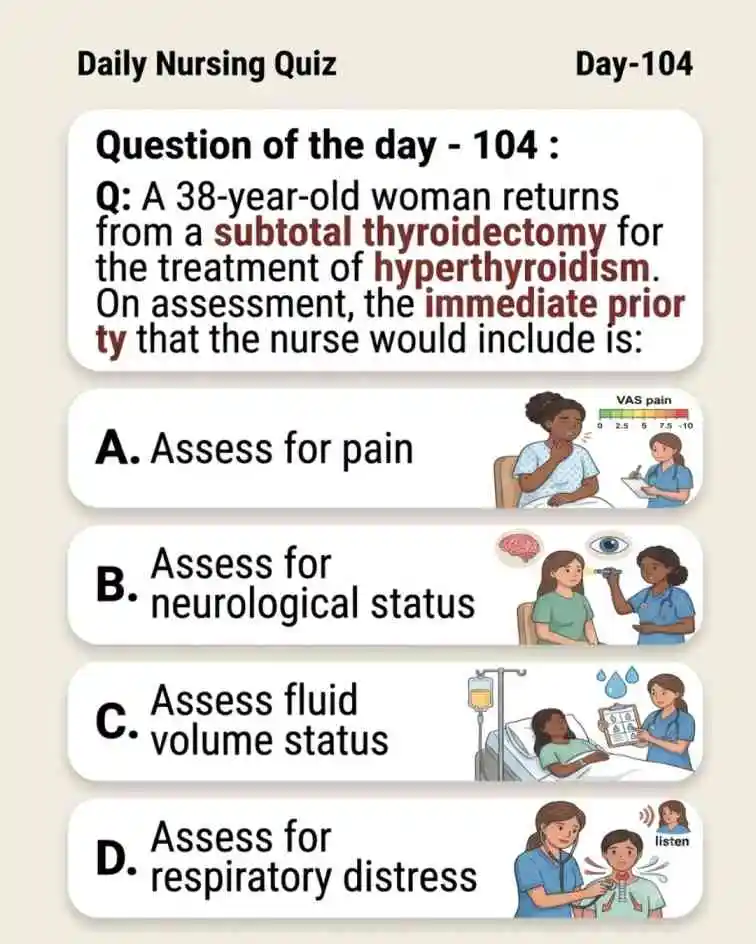
📝 Today’s Question:
Q: A 38-year-old woman returns from a subtotal for the treatment of thyroidectomy hyperthyroidism. On assessment immediate priority that the nurse would include in:
👆 Comment your answer and then tap an option to check your answer.
Don’t forget to Comment your answer below.
🦋 Priority After Thyroidectomy
After a thyroidectomy, the first priority is airway and breathing. Swelling or bleeding around the neck can quickly compress the airway and cause serious respiratory difficulty.
🚨 Why Is Breathing the Priority?
A thyroidectomy is surgery in which part or all of the thyroid gland is removed. The thyroid is located in the front of the neck, very close to the airway.
After surgery, neck swelling or a hematoma can develop. Blood collecting under the surgical area can put pressure on the trachea.
Even a small amount of swelling in this area can become dangerous because there is limited space around the airway.
Difficulty breathing • noisy breathing • stridor • increasing neck swelling • restlessness • falling oxygen saturation • difficulty speaking or swallowing
🔎 Know the Medical Terms
Thyroid: The name comes from the Greek word thyreos, meaning “shield,” because the thyroid cartilage was thought to resemble a shield. The thyroid gland produces hormones that help regulate metabolism.
Thyroidectomy: thyroid + -ectomy. The suffix -ectomy means surgical removal. Therefore, thyroidectomy means surgical removal of the thyroid gland or part of it.
Subtotal: Means only part of the organ is removed, leaving some thyroid tissue behind.
Respiratory distress: respiratory relates to breathing, while distress means difficulty or suffering. Together, it means difficulty breathing effectively.
Hematoma: A collection of blood outside a blood vessel, usually within tissues. After neck surgery, a hematoma can compress the airway.
Stridor: A harsh, high-pitched breathing sound caused by narrowing of the upper airway. After thyroid surgery, new stridor is an important warning sign.
❌ Why Not the Other Options?
Option A – Assess for pain: Pain assessment is important after surgery, but pain is not the immediate life-threatening concern compared with a blocked airway.
Option B – Assess neurological status: Neurological assessment is useful, but it is not the first priority immediately after thyroid surgery.
Option C – Assess fluid volume status: Fluid balance is important in postoperative care, but airway compromise can become life-threatening much faster.
🩺 One More Important Complication
The nurse should also watch for hypocalcemia because the parathyroid glands are located close to the thyroid and may be injured or temporarily affected during surgery.
Tingling around the mouth, muscle cramps, or spasms can suggest low calcium and require prompt attention.
Thyroid surgery → Think NECK → Think AIRWAY first.
Swelling or hematoma can press on the airway.
After neck surgery, always think “Can the patient breathe?” before focusing on pain, fluids, or other routine assessments.
Concept clarity • Easy recall • Nursing success
Previous Nursing Questions
Missed a previous question? Try these exam-style nursing MCQs. Click below to see the correct answer and detailed explanation.
What is the most appropriate initial nursing intervention for a hypertensive patient with obesity who reports difficulty eating balanced meals due to work?
See Answer & Explanation →The nurse is providing medication instructions to a client with breast cancer who is receiving cyclophosphamide. The nurse should tell the client to take which action?
See Answer & Explanation →A patient with chronic hypertension is found to have increased thickness of the left ventricular wall on echocardiogram. Which cellular adaptation best explains this finding?
See Answer & Explanation →A mother with severe preeclampsia gives birth to a premature infant. Which assessment finding should the nurse prioritize to identify potential complications associated with this high-risk scenario?
See Answer & Explanation →A nurse is reviewing documentation for a topical medication. Which entry would most likely indicate a potential error in the administration record?
See Answer & Explanation →A nurse is caring for an elderly patient who is struggling with poor appetite. Which intervention is most appropriate to promote healthy physiologic responses related to nutrition?
See Answer & Explanation →Ready to Test Your Nursing Knowledge?
Practice nursing MCQs, take mock tests, attempt quizzes, and prepare for competitive nursing exams — all in one place.
Don’t forget to comment the answer below.