
🩺 Nursing Question of the Day
Challenge yourself with one exam-style nursing question every day.
✅ Think carefully • ✅ Choose your answer • ✅ Then scroll down to check the explanation.
📝 Today’s Question:
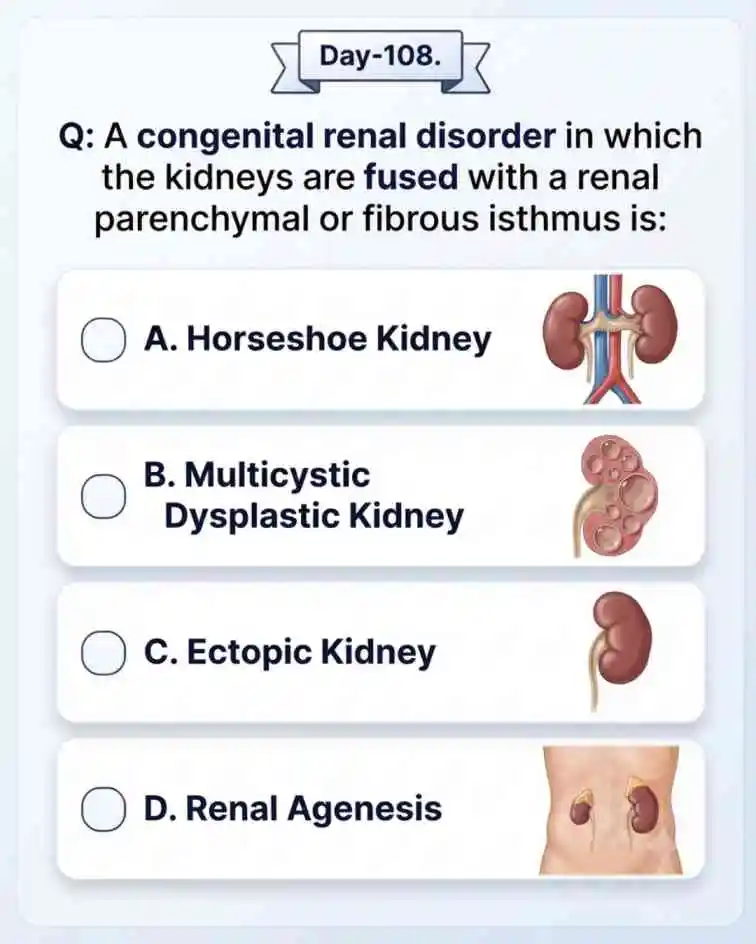
Q: A congenital renal disorder in which the kidneys are fused with a renal parenchymal or fibrous isthmus is:
👆 Comment your answer and then tap an option to check your answer.
Don’t forget to Comment your answer below.
Congenital Fusion of the Kidneys
Why is this the correct answer?
Normally, the right and left kidneys develop separately. In a horseshoe kidney, the kidneys become fused during development, producing a shape that resembles a horseshoe.
The connecting part is called the isthmus. It may contain functioning renal tissue (renal parenchyma) or may be made mainly of fibrous tissue.
The fused kidneys usually remain lower than their normal position because the isthmus can prevent their normal upward movement during development.
Understanding the Medical Terms
Horseshoe kidney: The name comes from its characteristic horseshoe-like shape. It is a congenital renal fusion anomaly.
Congenital: Means a condition present from birth. The word comes from Latin roots meaning “born together.”
Renal: Means related to the kidney. It comes from the Latin word renes, meaning kidney.
Parenchyma: The functional tissue of an organ. In the kidney, renal parenchyma contains the structures responsible for filtering blood and forming urine.
Isthmus: A narrow connecting portion between two larger structures. The word comes from Greek isthmos, meaning a narrow passage or neck of land.
Why are the other options incorrect?
Nursing Points
Many people with a horseshoe kidney have no symptoms and discover it incidentally. However, the abnormal position and drainage of the kidneys can increase the risk of urinary tract infection, kidney stones, and urinary obstruction.
Nursing care focuses on monitoring urinary symptoms, hydration, infection signs, pain, and renal function when complications are present.
Horseshoe = Two kidneys joined together.
If you see “fused kidneys + isthmus”, immediately think Horseshoe Kidney.
The key phrase is “kidneys fused by a renal parenchymal or fibrous isthmus.” That description is characteristic of a horseshoe kidney.
Concept clarity • Easy recall • Nursing success
Previous Nursing Questions
Missed a previous question? Try these exam-style nursing MCQs. Click below to see the correct answer and detailed explanation.
A physician prescribes laboratory studies for an infant of a HIV positive woman to determine the presence of HIV antigen. The nurse anticipates that which laboratory study will be prescribed?
See Answer & Explanation →A six-year-old boy is admitted to the hospital in diabetic ketoacidosis. Which manifestation should the nurse expect to observe?
See Answer & Explanation →A client’s membranes rupture while her labor is being augmented with an oxytocin infusion. A nurse observes variable decelerations in the fetal heart rate on the fetal monitor strip. What action should the nurse take next?
See Answer & Explanation →A 38-year-old woman returns from a subtotal thyroidectomy for the treatment of hyperthyroidism. On assessment, which immediate priority should the nurse include?
See Answer & Explanation →What is the most appropriate initial nursing intervention for a hypertensive patient with obesity who reports difficulty eating balanced meals due to work?
See Answer & Explanation →The nurse is providing medication instructions to a client with breast cancer who is receiving cyclophosphamide. The nurse should tell the client to take which action?
See Answer & Explanation →A patient with chronic hypertension is found to have increased thickness of the left ventricular wall on echocardiogram. Which cellular adaptation best explains this finding?
See Answer & Explanation →Ready to Test Your Nursing Knowledge?
Practice nursing MCQs, take mock tests, attempt quizzes, and prepare for competitive nursing exams — all in one place.
Don’t forget to comment the answer below.