
🩺 Nursing Question of the Day
Challenge yourself with one exam-style nursing question every day.
✅ Think carefully • ✅ Choose your answer • ✅ Then scroll down to check the explanation.
📝 Today’s Question:
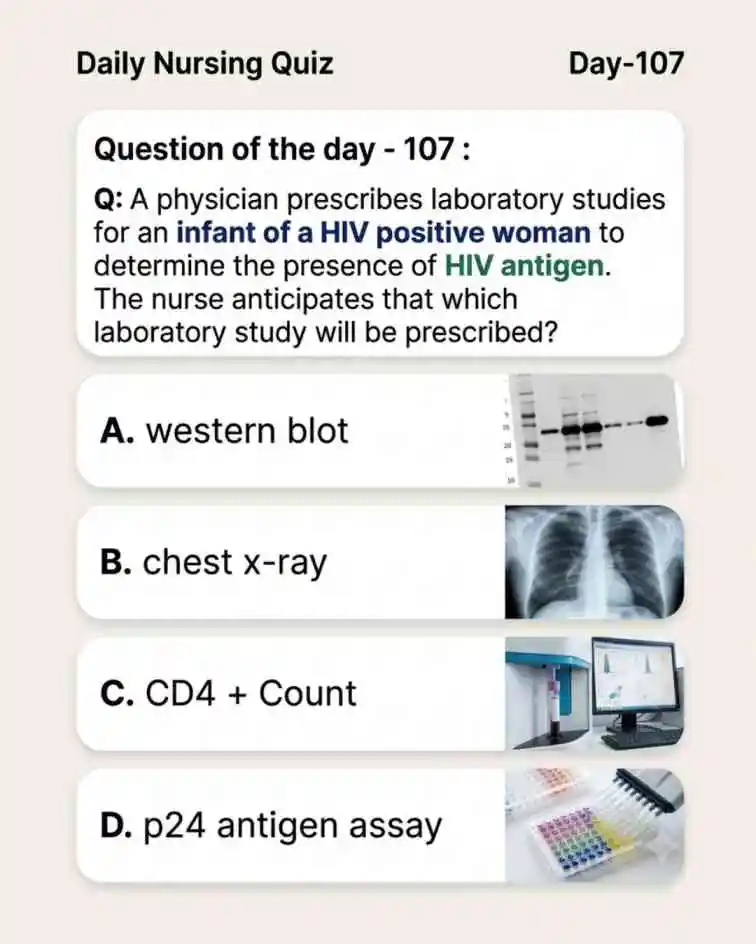
Q: A physician prescribes laboratory studies for an infant of a HIV positive woman to determine the presence of HIV antigen. The nurse anticipates that which laboratory study will be prescribed?
👆 Comment your answer and then tap an option to check your answer.
Don’t forget to Comment your answer below.
Detecting HIV Infection in an Infant
Why is this the correct answer?
When a baby is born to an HIV-positive mother, the important question is whether the baby is actually infected with HIV.
There is a special problem when testing young infants: maternal HIV antibodies can cross the placenta and enter the baby’s bloodstream. These antibodies may remain in the infant for many months even when the infant is not infected.
Therefore, simply finding HIV antibodies in a young infant does not necessarily mean that the infant has HIV infection.
The p24 antigen assay looks for a component of the HIV virus itself rather than relying only on antibodies made by the mother.
p24 is a protein that forms part of the HIV viral core. If p24 antigen is detected, it provides evidence of the presence of HIV viral material in the blood.
Maternal antibodies → may be present in the baby’s blood even without infection
p24 antigen → looks for a part of the HIV virus itself
Understanding the Important Medical Terms
HIV: HIV stands for Human Immunodeficiency Virus. “Human” refers to humans, “immunodeficiency” means weakness or reduced function of the immune system, and “virus” refers to an infectious organism that needs living cells to reproduce.
Antigen: An antigen is a substance that can be recognized by the immune system. The word comes from the idea of something that generates an antibody response. In this test, the antigen being searched for is a component of HIV.
p24: The “p” refers to protein, while “24” refers to its approximate molecular mass of 24 kilodaltons. p24 is a major structural protein of the HIV capsid, which forms the viral core.
Antibody: An antibody is a protein produced by the immune system to recognize a specific foreign substance. In an infant born to an HIV-positive mother, maternal antibodies can cross the placenta and remain in the baby’s circulation.
Vertical transmission: This means transmission of an infection from mother to child during pregnancy, childbirth, or breastfeeding. HIV can be transmitted from mother to infant, although effective prevention and treatment greatly reduce this risk.
Assay: An assay is a laboratory test or analytical procedure used to detect or measure a particular substance.
Why is antibody testing complicated in a newborn?
During pregnancy, maternal IgG antibodies can cross the placenta. This is normally a helpful process because maternal antibodies provide the newborn with temporary passive protection against many infections.
However, in an HIV-positive mother, HIV-specific antibodies can also cross the placenta. Therefore, an infant may have detectable HIV antibodies without actually being infected.
A positive HIV antibody result in a young exposed infant does not automatically prove that the infant has HIV infection because the antibodies may have come from the mother.
For this reason, modern infant diagnosis relies on virologic testing, such as HIV nucleic acid testing, according to the infant’s age and current clinical guidelines. The classic exam question specifically asking for an assay that detects HIV antigen points to the p24 antigen assay.
Why are the other options incorrect?
Western blot is an antibody-based laboratory technique that was historically used to confirm HIV infection after an initial antibody screening test. It does not directly detect HIV antigen, and maternal antibodies make antibody-based interpretation problematic in young infants.
A chest X-ray is an imaging study used to examine the lungs and chest structures. It may be useful when investigating respiratory problems or certain infections, but it does not detect HIV antigen.
CD4 cells are a type of white blood cell that plays an important role in immune function. A CD4+ count helps assess the condition of the immune system, but it does not directly determine whether an infant has HIV infection.
This is the best answer because it detects the p24 protein of HIV, rather than depending on the presence of antibodies that may have been transferred from the mother.
What should the nurse remember?
- Maternal HIV antibodies can cross the placenta.
- Antibody tests can therefore be difficult to interpret in young infants.
- Direct detection of viral components or viral nucleic acid is more useful for diagnosing infection in exposed infants.
- Follow the recommended infant HIV testing schedule and prevention protocol.
- Maintain strict confidentiality and provide supportive, nonjudgmental care to the mother and infant.
“p24 = Part of the Virus.”
If the question asks for an HIV antigen, think p24.
In an infant born to an HIV-positive mother, remember the key problem: maternal antibodies can confuse antibody-based testing. If the question specifically asks for an HIV antigen, the classic answer is p24 antigen assay.
Concept clarity • Easy recall • Nursing success
Previous Nursing Questions
Missed a previous question? Try these exam-style nursing MCQs. Click below to see the correct answer and detailed explanation.
A six-year-old boy is admitted to the hospital in diabetic ketoacidosis. Which manifestation should the nurse expect to observe?
See Answer & Explanation →A client’s membranes rupture while her labor is being augmented with an oxytocin infusion. A nurse observes variable decelerations in the fetal heart rate on the fetal monitor strip. What action should the nurse take next?
See Answer & Explanation →A 38-year-old woman returns from a subtotal thyroidectomy for the treatment of hyperthyroidism. On assessment, which immediate priority should the nurse include?
See Answer & Explanation →What is the most appropriate initial nursing intervention for a hypertensive patient with obesity who reports difficulty eating balanced meals due to work?
See Answer & Explanation →The nurse is providing medication instructions to a client with breast cancer who is receiving cyclophosphamide. The nurse should tell the client to take which action?
See Answer & Explanation →A patient with chronic hypertension is found to have increased thickness of the left ventricular wall on echocardiogram. Which cellular adaptation best explains this finding?
See Answer & Explanation →A mother with severe preeclampsia gives birth to a premature infant. Which assessment finding should the nurse prioritize to identify potential complications associated with this high-risk scenario?
See Answer & Explanation →Ready to Test Your Nursing Knowledge?
Practice nursing MCQs, take mock tests, attempt quizzes, and prepare for competitive nursing exams — all in one place.
Don’t forget to comment the answer below.