
🩺 Nursing Question of the Day
Challenge yourself with one exam-style nursing question every day.
✅ Think carefully • ✅ Choose your answer • ✅ Then scroll down to check the explanation.
📝 Today’s Question:
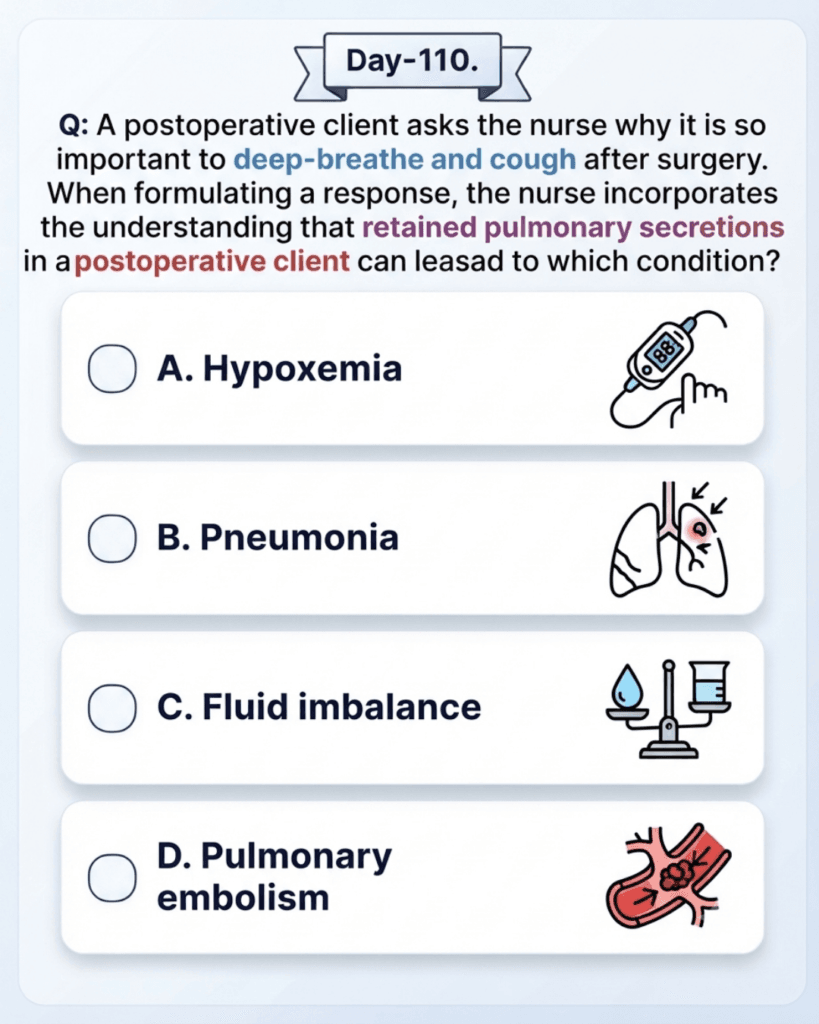
Q: A postoperative client asks the nurse why it is so important to deep-breathe and cough after surgery. When formulating a response, the nurse incorporates the understanding that retained pulmonary secretions in a postoperative client can lead to which condition?
👆 Comment your answer and then tap an option to check your answer.
Don’t forget to Comment your answer below.
Why Deep Breathing and Coughing Are Important After Surgery
Why is this the correct answer?
Normally, the lungs continuously produce a small amount of mucus. Deep breathing and coughing help move these secretions upward so they can be cleared from the airways.
After surgery, the client may avoid taking deep breaths because of pain, especially after abdominal or chest surgery. Anesthesia, bed rest, and weakness can also reduce normal coughing and lung expansion.
When secretions are retained, they can collect inside the airways. These secretions can block small air passages and provide a place where microorganisms can grow.
This can lead to a lung infection called pneumonia. Therefore, deep breathing and coughing exercises are taught after surgery to help keep the lungs expanded and clear of secretions.
Surgery → shallow breathing + weak cough
↓
Secretions remain in the lungs
↓
Microorganisms can multiply
↓
Pneumonia
Understanding the Medical Terms
Postoperative: “Post” means after, and “operative” refers to an operation or surgery. So, postoperative simply means after surgery.
Pulmonary: This means related to the lungs. It comes from the Latin word pulmo, meaning “lung.”
Secretions: These are substances produced and released by cells or glands. In the respiratory system, mucus is a normal secretion that helps protect the airways.
Retained: This means something is kept or remains instead of being removed. Retained pulmonary secretions are mucus and other airway secretions that are not effectively cleared.
Pneumonia: Pneumonia is an infection and inflammation of the lung tissue. The term comes from the Greek word pneumōn, meaning “lung.”
Hypoxemia: “Hypo” means low, “ox” refers to oxygen, and “-emia” means a condition in the blood. Hypoxemia means low oxygen level in the blood.
Pulmonary embolism: An embolus is something that travels through the bloodstream and blocks a blood vessel. A pulmonary embolism occurs when a blockage, usually a blood clot, travels to and obstructs a blood vessel in the lungs.
Why are the other options incorrect?
Hypoxemia means low oxygen in the blood. Retained secretions can contribute to poor ventilation and oxygenation, so hypoxemia can occur as a consequence. However, the main complication the question is asking about from retained pulmonary secretions is pneumonia.
This is correct. Retained secretions provide a place for microorganisms to grow and can interfere with normal airway clearance. This increases the risk of a postoperative lung infection.
Fluid imbalance refers to too much or too little fluid in the body. It is not the typical complication caused by retained pulmonary secretions. Fluid balance is more closely related to fluid intake, output, blood loss, kidney function, and IV therapy.
A pulmonary embolism is usually caused by a blood clot that travels to the lungs, often from a deep vein in the leg. It is associated with immobility and venous thrombosis, not directly with retained lung secretions.
Why does coughing help?
Coughing is the body’s natural way of clearing material from the airways. A deep breath followed by a strong cough helps move mucus from the smaller airways toward the mouth, where it can be expelled.
Deep breathing also helps the lungs expand fully. This reduces the chance of small areas of the lung becoming poorly ventilated or collapsing.
That is why nurses encourage postoperative clients to perform deep-breathing and coughing exercises, use an incentive spirometer when prescribed, change position, and get out of bed and walk as soon as it is safe.
“Secretions that stay → infection can stay.”
After surgery, think Deep breathe + Cough → Clear secretions → Prevent pneumonia.
When a question connects postoperative retained respiratory secretions with a complication, think pneumonia. If the question instead describes sudden chest pain, sudden shortness of breath, tachycardia, or a clot risk, think about pulmonary embolism.
Concept clarity • Easy recall • Nursing success
Previous Nursing Questions
Missed a previous question? Try these exam-style nursing MCQs. Click below to see the correct answer and detailed explanation.
An elderly client is diagnosed with interstitial cystitis. Which finding differentiates interstitial cystitis from other forms of cystitis?
See Answer & Explanation →A congenital renal disorder in which the kidneys are fused with a renal parenchymal or fibrous isthmus is:
See Answer & Explanation →A physician prescribes laboratory studies for an infant of a HIV positive woman to determine the presence of HIV antigen. The nurse anticipates that which laboratory study will be prescribed?
See Answer & Explanation →A six-year-old boy is admitted to the hospital in diabetic ketoacidosis. Which manifestation should the nurse expect to observe?
See Answer & Explanation →A client’s membranes rupture while her labor is being augmented with an oxytocin infusion. A nurse observes variable decelerations in the fetal heart rate on the fetal monitor strip. What action should the nurse take next?
See Answer & Explanation →A 38-year-old woman returns from a subtotal thyroidectomy for the treatment of hyperthyroidism. On assessment, which immediate priority should the nurse include?
See Answer & Explanation →What is the most appropriate initial nursing intervention for a hypertensive patient with obesity who reports difficulty eating balanced meals due to work?
See Answer & Explanation →The nurse is providing medication instructions to a client with breast cancer who is receiving cyclophosphamide. The nurse should tell the client to take which action?
See Answer & Explanation →A patient with chronic hypertension is found to have increased thickness of the left ventricular wall on echocardiogram. Which cellular adaptation best explains this finding?
See Answer & Explanation →Ready to Test Your Nursing Knowledge?
Practice nursing MCQs, take mock tests, attempt quizzes, and prepare for competitive nursing exams — all in one place.
Don’t forget to comment the answer below.