
🩺 Nursing Question of the Day
Challenge yourself with one exam-style nursing question every day.
✅ Think carefully • ✅ Choose your answer • ✅ Then scroll down to check the explanation.
📝 Today’s Question:
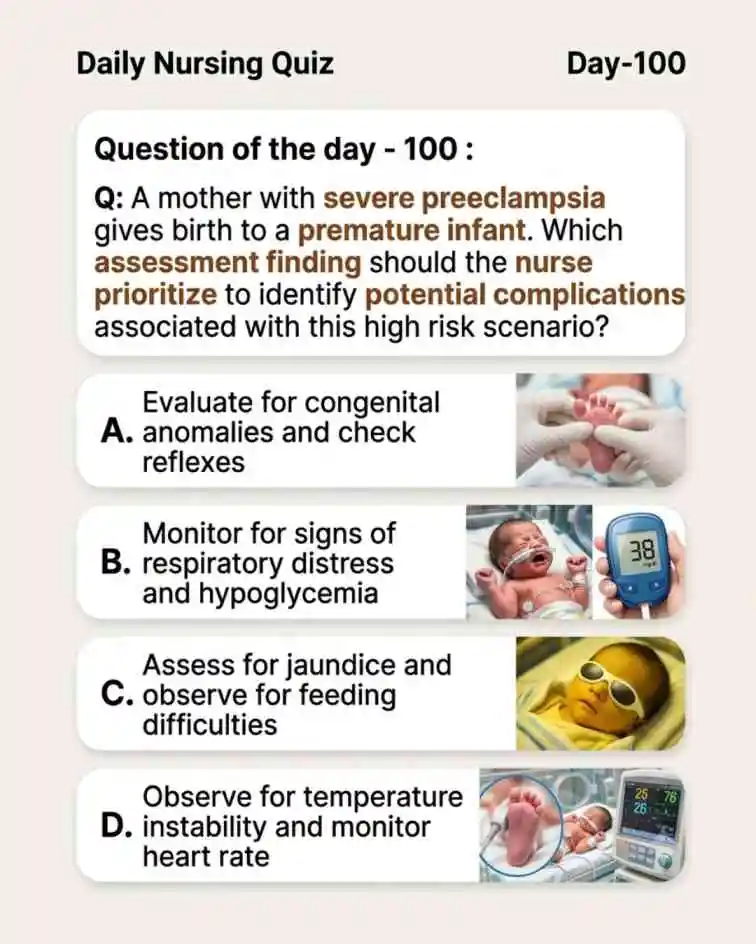
Q: A mother with severe preeclampsia gives birth to a premature infant. Which assessment finding should the nurse prioritize to identify potential complications associated with this high risk scenario?
👆 Comment your answer and then tap an option to check your answer.
Don’t forget to Comment your answer below.
👶 Premature Infant Born After Severe Preeclampsia
A premature infant born after severe preeclampsia is at increased risk for breathing problems and low blood glucose. These problems can become serious quickly, so they deserve early and careful assessment.
🌸 Why is this the priority?
Preeclampsia is a pregnancy disorder in which the mother develops high blood pressure with signs of organ involvement. Severe preeclampsia can affect blood flow through the placenta and may lead to premature birth.
A premature baby has organs that are not fully mature. The lungs and the systems that control blood glucose are especially important during the first hours after birth.
Premature lungs may not produce enough surfactant. Surfactant is a substance that helps keep the tiny air sacs of the lungs open. Without enough surfactant, the baby may have difficulty expanding the lungs and maintaining oxygenation.
Hypoglycemia means abnormally low blood glucose. Premature and stressed newborns may have limited glucose stores and may have difficulty maintaining a normal glucose level after birth.
🔎 Important Medical Terms
Preeclampsia: The word relates to a condition that occurs before seizures (eclampsia). It is characterized mainly by pregnancy-related hypertension with other signs of maternal organ involvement.
Premature: From Latin roots meaning “before maturity.” A premature infant is born before the normal period of pregnancy is completed.
Respiratory: From Latin respirare, meaning “to breathe again.” It relates to breathing and gas exchange.
Distress: Means a state of difficulty or suffering. In a newborn, respiratory distress means the baby is struggling to breathe effectively.
Hypoglycemia: hypo = low, glyc = sugar, and -emia = in the blood. So, hypoglycemia literally means low sugar in the blood.
🩺 What should the nurse look for?
For respiratory distress, watch for rapid breathing, grunting, nasal flaring, chest retractions, cyanosis, and low oxygen saturation.
For hypoglycemia, the baby may show jitteriness, poor feeding, lethargy, weak cry, abnormal temperature, apnea, or seizures.
The nurse should therefore monitor respiratory status, oxygen saturation and blood glucose according to the newborn’s risk and clinical condition.
❌ Why are the other options less appropriate?
Option A – Congenital anomalies and reflexes: A newborn assessment should include physical examination and reflexes, but these are not the most urgent complications specifically associated with prematurity in this scenario.
Option C – Jaundice and feeding difficulties: Premature infants can certainly develop jaundice and feeding problems. However, immediate respiratory compromise and hypoglycemia can threaten the infant more quickly.
Option D – Temperature instability and heart rate: Premature infants are at risk for hypothermia and heart-rate abnormalities, so these are important assessments. But respiratory distress and hypoglycemia are particularly important early complications requiring close monitoring.
Premature baby = “Lungs + Sugar first.”
Immature lungs → respiratory distress.
Limited glucose reserves → hypoglycemia.
When a question combines severe preeclampsia + premature birth, immediately think about complications of prematurity. The first priorities are usually breathing, oxygenation, glucose, and temperature, with special attention to respiratory distress and hypoglycemia.
Concept clarity • Easy recall • Nursing success
Previous Nursing Questions
Missed a previous question? Try these exam-style nursing MCQs. Click below to see the correct answer and detailed explanation.
The nurse is watching the cardiac monitor, and a client’s rhythm suddenly changes. There are no P waves; instead, there are fibrillatory waves before each QRS complex. How should the nurse correctly interpret the client’s heart rhythm?
See Answer & Explanation →A neonate born to a diabetic mother shows an initial blood glucose value of less than 20 mg/dL. The lab test confirms the report. What should be the next course of action in this case?
See Answer & Explanation →A patient’s ABG result showed a pH of 7.28, HCO3− of 18 mEq/L, and a PaCO2 of 30 mmHg. What may be the most likely condition?
See Answer & Explanation →Which of the following is NOT classified as Group-2 pulmonary hypertension as per WHO criteria?
See Answer & Explanation →A 62-year-old male, 8 hours post-abdominal surgery, complains of severe suprapubic discomfort. On examination, the bladder is palpable and distended. Despite a strong urge to urinate, he is unable to pass urine. What is the most appropriate term for this postoperative condition?
See Answer & Explanation →Ready to Test Your Nursing Knowledge?
Practice nursing MCQs, take mock tests, attempt quizzes, and prepare for competitive nursing exams — all in one place.
Don’t forget to comment the answer below.