
🩺 Nursing Question of the Day
Challenge yourself with one exam-style nursing question every day.
✅ Think carefully • ✅ Choose your answer • ✅ Then scroll down to check the explanation.
📝 Today’s Question:
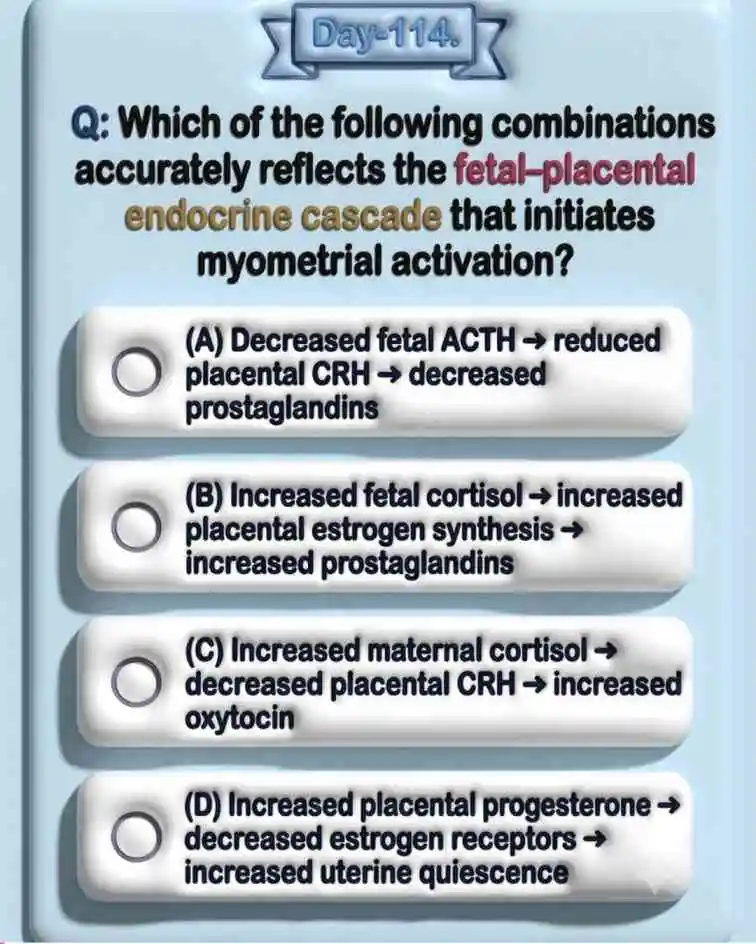
Q: Which of the following combinations accurately reflects the fetal–placental endocrine cascade that initiates myometrial activation?
👆 Comment your answer and then tap an option to check your answer.
Don’t forget to Comment your answer below.
Fetal–Placental Endocrine Cascade Before Labour
Why is this the correct answer?
Near the end of pregnancy, the fetal hypothalamic–pituitary–adrenal (HPA) axis becomes increasingly active. The fetal adrenal gland produces more cortisol.
This fetal cortisol contributes to changes in the placenta, including increased activity of placental corticotropin-releasing hormone (CRH). Placental CRH helps promote hormonal changes that prepare the uterus for labour.
One important result is a shift toward greater estrogen activity. Estrogen increases the excitability of the uterine muscle, increases oxytocin receptor expression, and supports the production of prostaglandins.
Prostaglandins help promote cervical ripening and increase myometrial activity. In simple words, the hormonal environment changes from maintaining pregnancy to preparing the uterus for contractions.
So the key exam pathway is: Fetal cortisol → placental endocrine changes → increased estrogen effect → increased prostaglandins → myometrial activation.
Understanding the Important Medical Terms
Fetal: Refers to the fetus, the developing baby after the embryonic period. “Fetus” comes from Latin fetus, meaning “offspring” or “bringing forth.”
Cortisol: A steroid hormone produced by the adrenal cortex. It is involved in stress responses, metabolism, and fetal maturation. The word is related to the adrenal cortex, where the hormone is produced.
Placenta: The temporary organ that connects the mother and fetus and allows exchange of oxygen, nutrients, waste products, and hormones. “Placenta” comes from Latin placenta, meaning “flat cake,” describing its shape.
Estrogen: A group of hormones important in female reproductive function. Near labour, increased estrogen effect helps make the uterus more responsive to contractions and supports prostaglandin production.
Prostaglandins: Locally acting lipid-derived substances that have many effects in the body. During labour, they help with cervical ripening and promote uterine contractions. “Prostaglandin” was originally named because these substances were first associated with the prostate gland, although they are produced in many tissues.
Why are the other options incorrect?
This is the opposite of the endocrine trend that supports labour. Increasing fetal endocrine activity, rather than decreasing it, contributes to the cascade leading toward labour.
This describes the overall hormonal direction toward increased uterine readiness and myometrial activation. The pathway also involves placental CRH between fetal cortisol and downstream placental changes.
This is incorrect because decreased placental CRH does not represent the normal direction of the labour-promoting cascade. Also, the key initiating endocrine signal emphasized in this fetal–placental pathway is increased fetal cortisol.
Progesterone generally helps maintain uterine quiescence during pregnancy. Near labour, the important change is increased estrogen effect and increased uterine responsiveness, not increased progesterone-driven quiescence.
How Does This Lead to Myometrial Activation?
The myometrium is the muscular layer of the uterus. “Myo-” comes from Greek mys, meaning “muscle,” while “metrium” refers to the uterus.
As labour approaches, estrogen increases the number and activity of oxytocin receptors and promotes communication between uterine muscle cells. Prostaglandins also increase uterine contractility and help the cervix become ready for labour.
Therefore, the uterus becomes much more responsive to contraction-producing signals. This is why the endocrine cascade is described as producing myometrial activation.
Fetal cortisol → Placental changes → Estrogen effect → Prostaglandins → Labour.
Think: “Cortisol helps turn the uterus ON.”
When you see fetal cortisol + estrogen + prostaglandins together, think of the hormonal cascade that prepares the uterus for labour and myometrial activation.
Concept clarity • Easy recall • Nursing success
Previous Nursing Questions
Missed a previous question? Try these exam-style nursing MCQs. Click below to see the correct answer and detailed explanation.
Terbutaline is prescribed for a client with bronchitis. The nurse understands that this medication should be used with caution if which medical condition is present in the client?
See Answer & Explanation →A young child has coarctation of the aorta. What should the nurse expect to identify when taking the child vital signs?
See Answer & Explanation →Nurse is caring for a patient with suspected diverticulitis. The nurse would be most prudent in questioning which of the following diagnostic tests ordered:
See Answer & Explanation →A postoperative client asks the nurse why it is so important to deep-breathe and cough after surgery. When formulating a response, the nurse incorporates the understanding that retained pulmonary secretions in a postoperative client can lead to which condition?
See Answer & Explanation →An elderly client is diagnosed with interstitial cystitis. Which finding differentiates interstitial cystitis from other forms of cystitis?
See Answer & Explanation →A congenital renal disorder in which the kidneys are fused with a renal parenchymal or fibrous isthmus is:
See Answer & Explanation →A physician prescribes laboratory studies for an infant of a HIV positive woman to determine the presence of HIV antigen. The nurse anticipates that which laboratory study will be prescribed?
See Answer & Explanation →A six-year-old boy is admitted to the hospital in diabetic ketoacidosis. Which manifestation should the nurse expect to observe?
See Answer & Explanation →A client’s membranes rupture while her labor is being augmented with an oxytocin infusion. A nurse observes variable decelerations in the fetal heart rate on the fetal monitor strip. What action should the nurse take next?
See Answer & Explanation →A 38-year-old woman returns from a subtotal thyroidectomy for the treatment of hyperthyroidism. On assessment, which immediate priority should the nurse include?
See Answer & Explanation →What is the most appropriate initial nursing intervention for a hypertensive patient with obesity who reports difficulty eating balanced meals due to work?
See Answer & Explanation →Ready to Test Your Nursing Knowledge?
Practice nursing MCQs, take mock tests, attempt quizzes, and prepare for competitive nursing exams — all in one place.
Don’t forget to comment the answer below.