
🩺 Nursing Question of the Day
Challenge yourself with one exam-style nursing question every day.
✅ Think carefully • ✅ Choose your answer • ✅ Then scroll down to check the explanation.
📝 Today’s Question:
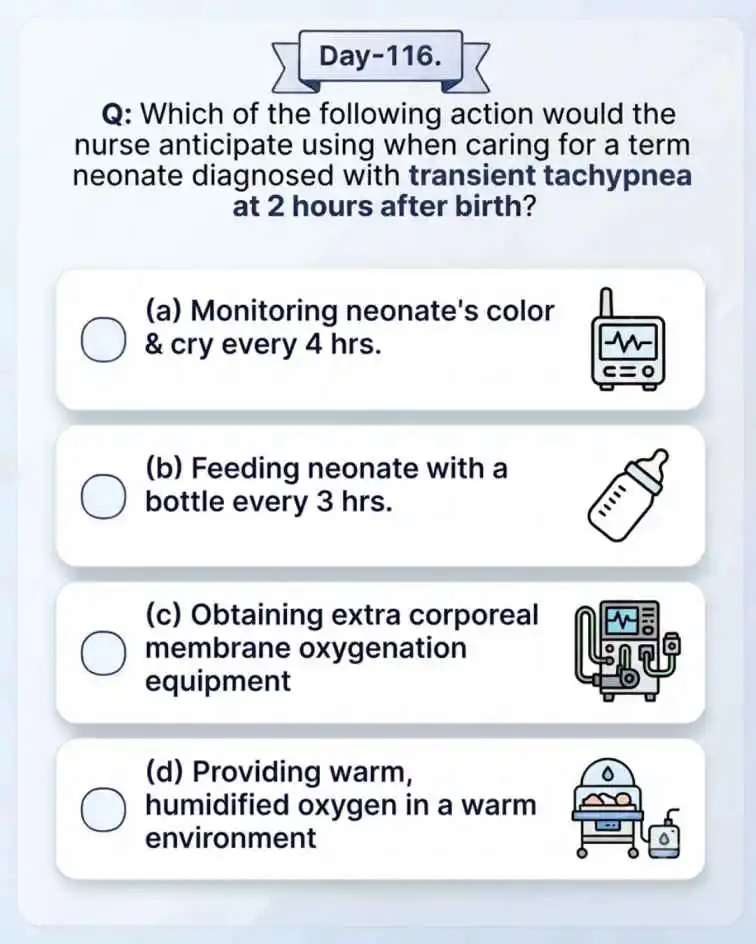
Q: Which of the following action would the nurse anticipate using when caring for a term neonate diagnosed with transient tachypnea at 2 hours after birth?
👆 Comment your answer and then tap an option to check your answer.
Don’t forget to Comment your answer below.
Nursing Care of a Neonate with Transient Tachypnea
Why is this the correct answer?
Transient tachypnea of the newborn (TTN) is a temporary breathing problem caused mainly by delayed clearance of fetal lung fluid after birth. The baby develops rapid breathing, usually within the first few hours of life.
Treatment is mainly supportive. The nurse may provide supplemental oxygen as prescribed, maintain a warm environment, and closely monitor respiratory status. Warm, humidified oxygen helps support oxygenation while the newborn’s lungs clear the excess fluid.
TTN usually improves as the lung fluid is absorbed. Therefore, the priority is to maintain adequate oxygenation, temperature, and respiratory function while observing the neonate closely.
Understanding Important Terms
Transient: Something temporary or short-lasting. TTN usually resolves as the excess lung fluid is absorbed.
Tachypnea: Abnormally rapid breathing. In a newborn, a respiratory rate above 60 breaths/minute is generally considered tachypnea.
Humidified oxygen: Oxygen containing added moisture. Humidification helps prevent drying and irritation of the newborn’s delicate airways.
Why are the other options incorrect?
This is not enough for a newborn with respiratory distress. The baby’s respiratory rate, effort, oxygen saturation, color, and overall condition require closer and more frequent assessment.
Rapid breathing can interfere with safe oral feeding and increase the risk of aspiration. Feeding decisions depend on the baby’s respiratory status and ability to coordinate sucking, swallowing, and breathing.
ECMO is an advanced life-support therapy used for severe, life-threatening respiratory or cardiac failure. It is not routine treatment for uncomplicated TTN.
How Does TTN Occur?
Before birth, the fetal lungs contain fluid. Normally, this fluid is cleared around the time of birth through hormonal changes and absorption into the circulation and lymphatic system. If clearance is delayed, some fluid remains in the lungs, making breathing faster and more difficult.
This is why TTN is sometimes called “wet lung”. The condition is usually temporary and commonly improves within the first 24–72 hours.
TTN = Temporary Wet Lungs → Support Breathing + Keep Baby Warm.
For a term newborn with uncomplicated TTN, think supportive care and oxygenation. Warm, humidified oxygen is the best choice among these options.
Concept clarity • Easy recall • Nursing success
Previous Nursing Questions
Missed a previous question? Try these exam-style nursing MCQs. Click below to see the correct answer and detailed explanation.
During the health teaching session, a pregnant woman asked the nurse the significance of proper nutrition during pregnancy. What is the best response by the nurse?
See Answer & Explanation →Which of the following combinations accurately reflects the fetal–placental endocrine cascade that initiates myometrial activation?
See Answer & Explanation →Terbutaline is prescribed for a client with bronchitis. The nurse understands that this medication should be used with caution if which medical condition is present in the client?
See Answer & Explanation →A young child has coarctation of the aorta. What should the nurse expect to identify when taking the child vital signs?
See Answer & Explanation →Nurse is caring for a patient with suspected diverticulitis. The nurse would be most prudent in questioning which of the following diagnostic tests ordered:
See Answer & Explanation →A postoperative client asks the nurse why it is so important to deep-breathe and cough after surgery. When formulating a response, the nurse incorporates the understanding that retained pulmonary secretions in a postoperative client can lead to which condition?
See Answer & Explanation →An elderly client is diagnosed with interstitial cystitis. Which finding differentiates interstitial cystitis from other forms of cystitis?
See Answer & Explanation →A congenital renal disorder in which the kidneys are fused with a renal parenchymal or fibrous isthmus is:
See Answer & Explanation →A physician prescribes laboratory studies for an infant of a HIV positive woman to determine the presence of HIV antigen. The nurse anticipates that which laboratory study will be prescribed?
See Answer & Explanation →A six-year-old boy is admitted to the hospital in diabetic ketoacidosis. Which manifestation should the nurse expect to observe?
See Answer & Explanation →A client’s membranes rupture while her labor is being augmented with an oxytocin infusion. A nurse observes variable decelerations in the fetal heart rate on the fetal monitor strip. What action should the nurse take next?
See Answer & Explanation →Ready to Test Your Nursing Knowledge?
Practice nursing MCQs, take mock tests, attempt quizzes, and prepare for competitive nursing exams — all in one place.
Don’t forget to comment the answer below.