
🩺 Nursing Question of the Day
Challenge yourself with one exam-style nursing question every day.
✅ Think carefully • ✅ Choose your answer • ✅ Then scroll down to check the explanation.
📝 Today’s Question:
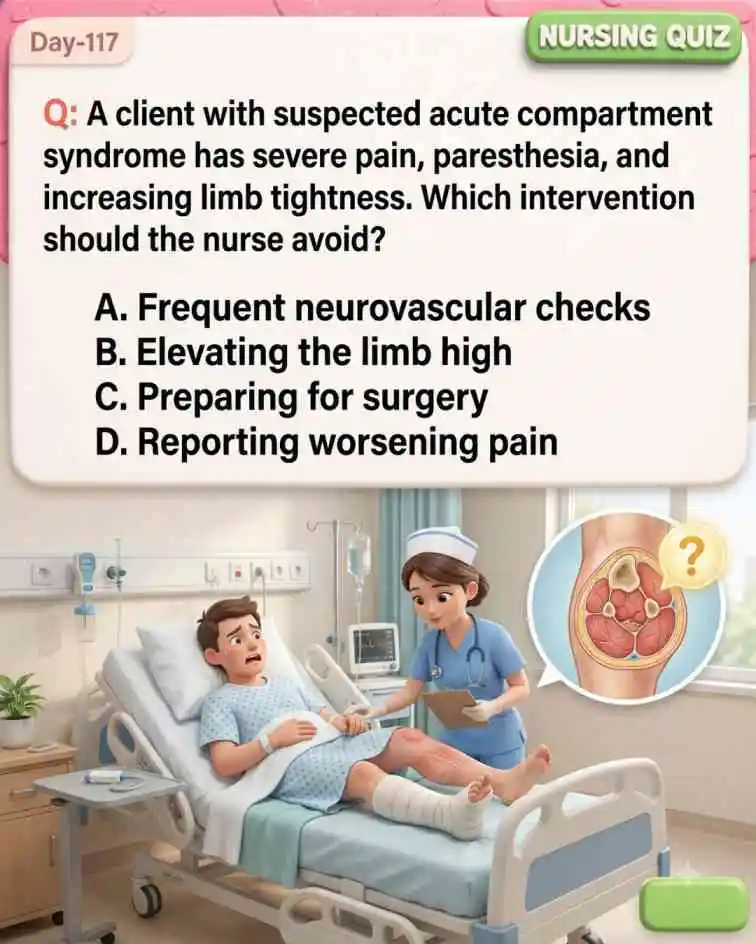
Q: A client with suspected acute compartment syndrome has severe pain, paresthesia, and increasing limb tightness. Which intervention should the nurse avoid?
👆 Comment your answer and then tap an option to check your answer.
Don’t forget to Comment your answer below.
Nursing Care in Acute Compartment Syndrome
Why should this intervention be avoided?
Acute compartment syndrome occurs when pressure rapidly increases inside a closed muscle compartment. This pressure can compress blood vessels and nerves, reducing tissue perfusion. Severe pain, paresthesia, swelling, and a tight or firm limb are important warning signs.
The affected limb is generally maintained at approximately heart level, rather than elevated high. Excessive elevation can decrease the arterial pressure reaching the injured area and may further compromise circulation.
Acute compartment syndrome is a surgical emergency. If pressure remains dangerously elevated, an urgent fasciotomy may be required to release the pressure and protect muscles and nerves from permanent damage.
Understanding Important Terms
Compartment: A space within a limb surrounded by fascia that contains muscles, nerves, and blood vessels.
Paresthesia: An abnormal sensation such as tingling, pins-and-needles, or numbness, often caused by nerve compression or reduced blood supply.
Fasciotomy: A surgical procedure in which the fascia is opened to release increased pressure within a compartment.
Why are the other options appropriate?
Appropriate. The nurse should closely assess pain, sensation, movement, skin color, temperature, pulses, and capillary refill to detect worsening tissue perfusion.
Appropriate. Severe acute compartment syndrome may require urgent fasciotomy to decompress the affected compartment and prevent permanent tissue injury.
Appropriate. Severe pain that is increasing or disproportionate to the injury is an important early warning sign and should be reported immediately.
Compartment syndrome = Pressure problem → Keep limb at heart level, not high.
In suspected compartment syndrome, think “pain + tightness + paresthesia = emergency.” Avoid high elevation and prepare for urgent evaluation and possible fasciotomy.
Concept clarity • Easy recall • Nursing success
Previous Nursing Questions
Missed a previous question? Try these exam-style nursing MCQs. Click below to see the correct answer and detailed explanation.
Which of the following action would the nurse anticipate using when caring for a term neonate diagnosed with transient tachypnea at 2 hours after birth?
See Answer & Explanation →During the health teaching session, a pregnant woman asked the nurse the significance of proper nutrition during pregnancy. What is the best response by the nurse?
See Answer & Explanation →Which of the following combinations accurately reflects the fetal–placental endocrine cascade that initiates myometrial activation?
See Answer & Explanation →Terbutaline is prescribed for a client with bronchitis. The nurse understands that this medication should be used with caution if which medical condition is present in the client?
See Answer & Explanation →A young child has coarctation of the aorta. What should the nurse expect to identify when taking the child vital signs?
See Answer & Explanation →Nurse is caring for a patient with suspected diverticulitis. The nurse would be most prudent in questioning which of the following diagnostic tests ordered:
See Answer & Explanation →A postoperative client asks the nurse why it is so important to deep-breathe and cough after surgery. When formulating a response, the nurse incorporates the understanding that retained pulmonary secretions in a postoperative client can lead to which condition?
See Answer & Explanation →An elderly client is diagnosed with interstitial cystitis. Which finding differentiates interstitial cystitis from other forms of cystitis?
See Answer & Explanation →A congenital renal disorder in which the kidneys are fused with a renal parenchymal or fibrous isthmus is:
See Answer & Explanation →A physician prescribes laboratory studies for an infant of a HIV positive woman to determine the presence of HIV antigen. The nurse anticipates that which laboratory study will be prescribed?
See Answer & Explanation →A six-year-old boy is admitted to the hospital in diabetic ketoacidosis. Which manifestation should the nurse expect to observe?
See Answer & Explanation →Ready to Test Your Nursing Knowledge?
Practice nursing MCQs, take mock tests, attempt quizzes, and prepare for competitive nursing exams — all in one place.
Don’t forget to comment the answer below.