
🩺 Nursing Question of the Day
Challenge yourself with one exam-style nursing question every day.
✅ Think carefully • ✅ Choose your answer • ✅ Then scroll down to check the explanation.
📝 Today’s Question:
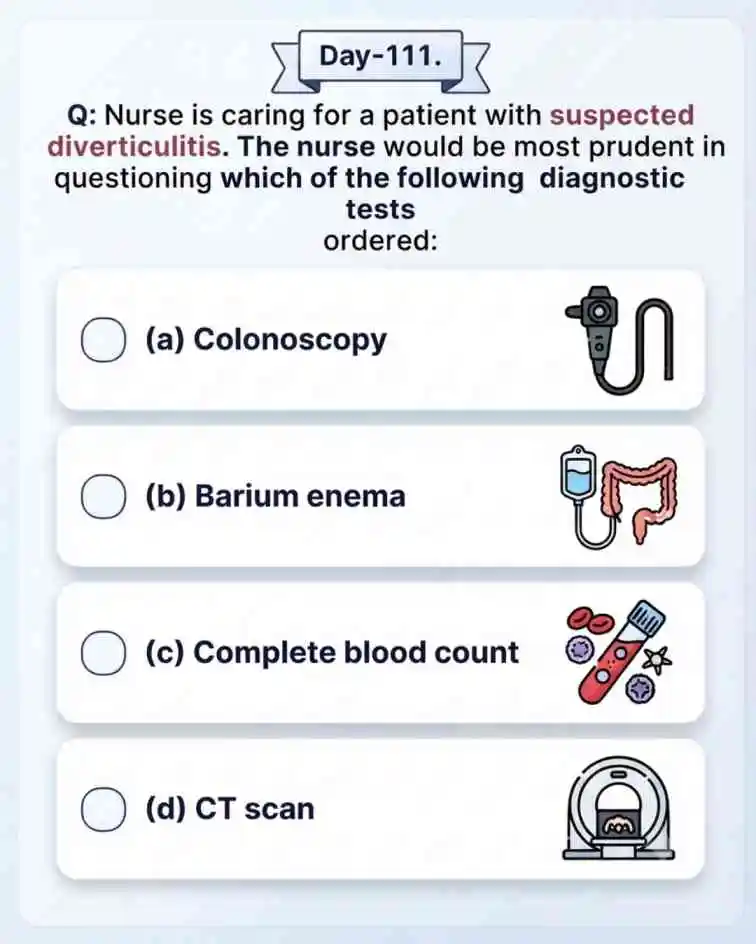
Q: Nurse is caring for a patient with suspected diverticulitis. The nurse would be most prudent in questioning which of the following diagnostic tests ordered:
👆 Comment your answer and then tap an option to check your answer.
Don’t forget to Comment your answer below.
Diagnostic Testing in Suspected Diverticulitis
Why is this the correct answer?
Diverticulitis occurs when small pouches in the wall of the colon become inflamed and may also become infected.
During an acute attack, the bowel wall can become swollen, irritated, and fragile. A barium enema involves putting contrast material into the rectum so that the colon can be outlined on an X-ray.
The pressure and manipulation involved in the procedure can place stress on an inflamed bowel. If a diverticulum has become very inflamed or weakened, there is concern about perforation.
Therefore, in this exam question, the nurse should question the order for a barium enema during suspected acute diverticulitis.
Acute diverticulitis → inflamed and fragile bowel
↓
Avoid procedures that may increase bowel pressure or injury
↓
Question the barium enema
Understanding the Medical Terms
Diverticulitis: “Diverticulum” comes from the Latin divertere, meaning “to turn aside.” A diverticulum is a small pouch that projects from the bowel wall. The ending -itis means inflammation. So, diverticulitis means inflammation of a diverticulum.
Barium: Barium is a contrast material used to make parts of the gastrointestinal tract easier to see on X-ray images.
Enema: An enema is the introduction of fluid into the rectum, usually for diagnostic or therapeutic purposes.
Perforation: Perforation means a hole or tear through the wall of an organ. Bowel perforation is a serious complication because intestinal contents can leak into the abdominal cavity.
Colonoscopy: “Colon” refers to the large intestine, while -scopy comes from Greek skopein, meaning “to look at or examine.” It involves viewing the inside of the colon with a flexible camera.
Why are the other options incorrect?
Colonoscopy is also generally avoided during the acute phase because an inflamed bowel has a risk of perforation. However, in this question, barium enema is the intended answer. Colonoscopy may be considered later, after the acute inflammation has settled, when clinically appropriate.
This is the correct answer. During acute diverticulitis, introducing contrast into the colon can increase pressure on an already inflamed bowel and may increase the risk of perforation.
A CBC is appropriate. It can show an increased white blood cell count, which may support the presence of inflammation or infection. It does not place mechanical pressure on the bowel.
CT of the abdomen and pelvis is commonly used when acute diverticulitis is suspected. It can help identify bowel inflammation and complications such as an abscess or perforation.
What should the nurse remember?
The nurse should watch for symptoms such as left lower abdominal pain, fever, nausea, vomiting, and changes in bowel habits.
Increasing abdominal pain, abdominal rigidity, fever, tachycardia, or signs of peritonitis may indicate a serious complication and require prompt attention.
“Acute diverticulitis + bowel pressure = danger.”
In this question, remember: Question the Barium Enema.
For this classic exam question, Barium enema is the intended answer. Also remember that colonoscopy is generally avoided during the acute inflammatory phase, but the key answer here is B.
Concept clarity • Easy recall • Nursing success
Previous Nursing Questions
Missed a previous question? Try these exam-style nursing MCQs. Click below to see the correct answer and detailed explanation.
A postoperative client asks the nurse why it is so important to deep-breathe and cough after surgery. When formulating a response, the nurse incorporates the understanding that retained pulmonary secretions in a postoperative client can lead to which condition?
See Answer & Explanation →An elderly client is diagnosed with interstitial cystitis. Which finding differentiates interstitial cystitis from other forms of cystitis?
See Answer & Explanation →A congenital renal disorder in which the kidneys are fused with a renal parenchymal or fibrous isthmus is:
See Answer & Explanation →A physician prescribes laboratory studies for an infant of a HIV positive woman to determine the presence of HIV antigen. The nurse anticipates that which laboratory study will be prescribed?
See Answer & Explanation →A six-year-old boy is admitted to the hospital in diabetic ketoacidosis. Which manifestation should the nurse expect to observe?
See Answer & Explanation →A client’s membranes rupture while her labor is being augmented with an oxytocin infusion. A nurse observes variable decelerations in the fetal heart rate on the fetal monitor strip. What action should the nurse take next?
See Answer & Explanation →A 38-year-old woman returns from a subtotal thyroidectomy for the treatment of hyperthyroidism. On assessment, which immediate priority should the nurse include?
See Answer & Explanation →What is the most appropriate initial nursing intervention for a hypertensive patient with obesity who reports difficulty eating balanced meals due to work?
See Answer & Explanation →The nurse is providing medication instructions to a client with breast cancer who is receiving cyclophosphamide. The nurse should tell the client to take which action?
See Answer & Explanation →Ready to Test Your Nursing Knowledge?
Practice nursing MCQs, take mock tests, attempt quizzes, and prepare for competitive nursing exams — all in one place.
Don’t forget to comment the answer below.