
🩺 Nursing Question of the Day
Challenge yourself with one exam-style nursing question every day.
✅ Think carefully • ✅ Choose your answer • ✅ Then scroll down to check the explanation.
📝 Today’s Question:
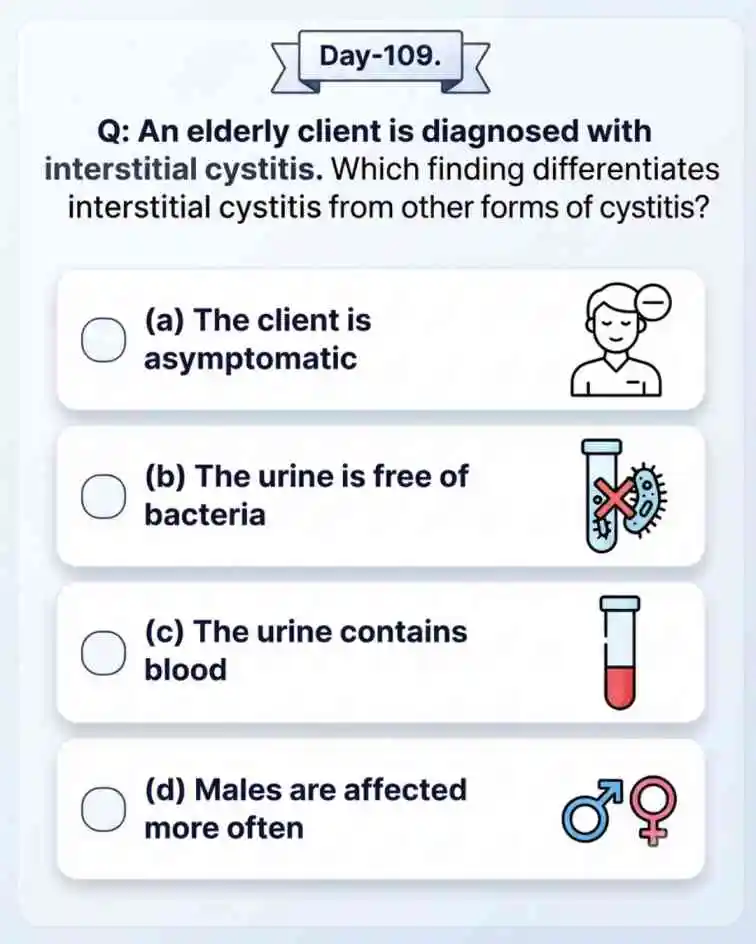
Q: An elderly client is diagnosed with interstitial cystitis. Which finding differentiates interstitial cystitis from other forms cystitis?
👆 Comment your answer and then tap an option to check your answer.
Don’t forget to Comment your answer below.
Interstitial Cystitis: Key Finding
Why is this the correct answer?
The most important difference is that interstitial cystitis is usually not caused by a bacterial infection. Therefore, urine culture is typically negative for bacteria.
The client may still have symptoms such as bladder pain, urinary frequency, urgency, and pain that becomes worse as the bladder fills. The symptoms can look very similar to a urinary tract infection, but there is no usual bacterial cause.
This is why a person may repeatedly complain of cystitis-like symptoms even though routine urine cultures do not show bacteria.
Understanding the Medical Terms
Interstitial: The word comes from Latin roots meaning “between.” It refers to the tissue spaces between cells or structures. In this condition, inflammation involves tissues of the bladder wall.
Cystitis: “Cyst” comes from Greek kystis, meaning bladder or sac, while -itis means inflammation. Therefore, cystitis literally means inflammation of the bladder.
Bacteria: Bacteria are microscopic single-celled organisms. Many infections of the urinary tract are caused by bacteria, but interstitial cystitis is not considered a typical bacterial urinary infection.
Urine culture: A laboratory test in which a urine sample is examined to see whether microorganisms, especially bacteria, grow in the sample.
Why are the other options incorrect?
This is incorrect. Interstitial cystitis is generally associated with bladder-related symptoms. Pain, urgency, and increased urinary frequency are common complaints.
This is the key finding. The symptoms may resemble a urinary infection, but routine urine cultures do not demonstrate the bacterial infection expected in ordinary cystitis.
Blood in the urine, called hematuria, can occur in some people with interstitial cystitis, but it is not the finding that best distinguishes it from other forms of cystitis.
This is incorrect. Interstitial cystitis is much more commonly recognized in women than in men, although men can also develop the condition.
What should the nurse remember?
The nurse should recognize the pattern of chronic bladder pain + urinary urgency/frequency + no evidence of bacterial infection.
Care may include helping the client identify foods or drinks that worsen symptoms, encouraging an individualized bladder-management plan, providing prescribed pain relief, and offering emotional support because chronic bladder symptoms can significantly affect daily life.
Interstitial cystitis = Cystitis symptoms, but no bacteria.
Think: “Symptoms without the usual bug.”
When cystitis-like symptoms are present but the urine culture is negative for bacteria, think about interstitial cystitis.
Concept clarity • Easy recall • Nursing success
Previous Nursing Questions
Missed a previous question? Try these exam-style nursing MCQs. Click below to see the correct answer and detailed explanation.
A congenital renal disorder in which the kidneys are fused with a renal parenchymal or fibrous isthmus is:
See Answer & Explanation →A physician prescribes laboratory studies for an infant of a HIV positive woman to determine the presence of HIV antigen. The nurse anticipates that which laboratory study will be prescribed?
See Answer & Explanation →A six-year-old boy is admitted to the hospital in diabetic ketoacidosis. Which manifestation should the nurse expect to observe?
See Answer & Explanation →A client’s membranes rupture while her labor is being augmented with an oxytocin infusion. A nurse observes variable decelerations in the fetal heart rate on the fetal monitor strip. What action should the nurse take next?
See Answer & Explanation →A 38-year-old woman returns from a subtotal thyroidectomy for the treatment of hyperthyroidism. On assessment, which immediate priority should the nurse include?
See Answer & Explanation →What is the most appropriate initial nursing intervention for a hypertensive patient with obesity who reports difficulty eating balanced meals due to work?
See Answer & Explanation →The nurse is providing medication instructions to a client with breast cancer who is receiving cyclophosphamide. The nurse should tell the client to take which action?
See Answer & Explanation →A patient with chronic hypertension is found to have increased thickness of the left ventricular wall on echocardiogram. Which cellular adaptation best explains this finding?
See Answer & Explanation →Ready to Test Your Nursing Knowledge?
Practice nursing MCQs, take mock tests, attempt quizzes, and prepare for competitive nursing exams — all in one place.
Don’t forget to comment the answer below.