
🩺 Nursing Question of the Day
Challenge yourself with one exam-style nursing question every day.
✅ Think carefully • ✅ Choose your answer • ✅ Then scroll down to check the explanation.
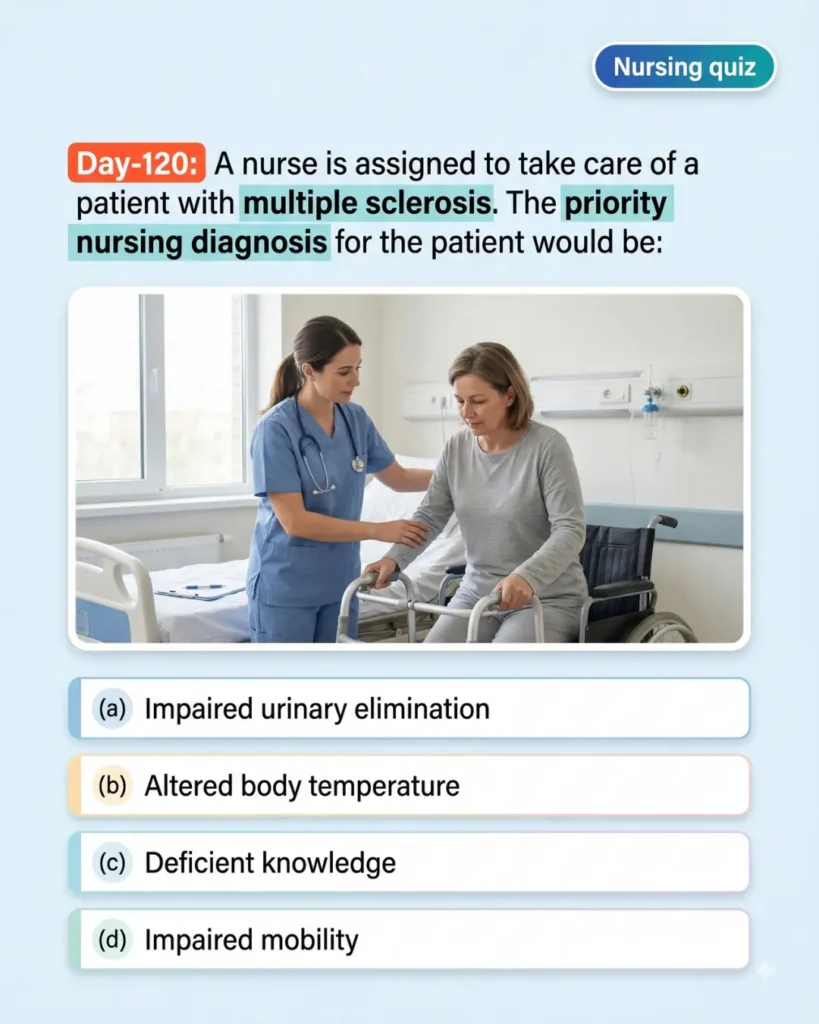
📝 Today’s Question:
Q: A nurse is assigned to take of a patient with multiple sclerosis. The priority nursing diagnosis for the patient would be:
👆 Comment your answer and then tap an option to check your answer.
Don’t forget to Comment your answer below.
Priority Nursing Diagnosis in Multiple Sclerosis
Why is this the priority?
Multiple sclerosis (MS) is a chronic neurological disease in which immune-mediated damage affects the myelin of nerve fibers in the central nervous system. When motor pathways are affected, nerve signals to the muscles become impaired.
As a result, the patient may develop muscle weakness, spasticity, tremors, poor coordination, fatigue, and balance problems. These changes can interfere with walking and other daily activities and increase the risk of falls and injury.
Therefore, impaired mobility is a major nursing concern. The nurse should assess mobility and strength, maintain safety, encourage appropriate activity and range-of-motion exercises, and assist with mobility devices when needed.
Understanding Important Terms
Multiple sclerosis: A chronic disease involving immune-mediated damage to myelin in the central nervous system, disrupting normal nerve transmission.
Impaired mobility: A limitation in independent, purposeful physical movement. In MS, it may result from weakness, spasticity, poor balance, or coordination problems.
Spasticity: Abnormally increased muscle tone that can cause stiffness and difficulty moving normally.
Why are the other options less appropriate?
Urinary problems are common in MS because nerve damage can affect bladder control. However, without specific findings indicating severe urinary dysfunction, impaired mobility is the more prominent general nursing concern.
Heat sensitivity can occur in MS and increased body temperature may temporarily worsen symptoms, but it is not usually the primary nursing diagnosis in an otherwise typical MS presentation.
Patient education is important, but a physiological and functional problem such as impaired mobility takes priority over a learning need.
How Does MS Cause Mobility Problems?
Myelin acts like an insulating covering around many nerve fibers and helps nerve impulses travel efficiently. When myelin is damaged, nerve signals may become slowed or disrupted.
When motor pathways are affected, the patient may have weakness, stiffness, fatigue, poor coordination, and balance difficulties. These problems can make walking and transferring difficult and increase the risk of falls.
MS → Myelin damage → Motor problems → Mobility impaired.
When a general MS nursing-diagnosis question asks for the major functional problem, think weakness + spasticity + poor coordination + balance problems = impaired mobility.
Concept clarity • Easy recall • Nursing success
Previous Nursing Questions
Missed a previous question? Try these exam-style nursing MCQs. Click below to see the correct answer and detailed explanation.
False fixed belief which can be explained as arising from other abnormal experience called:
See Answer & Explanation →The phase in which lining cells of the ovarian follicle are stimulated by luteinizing hormone to develop the corpus luteum, to produce progesterone and estrogen is:
See Answer & Explanation →A client with suspected acute compartment syndrome has severe pain, paresthesia, and increasing limb tightness. Which intervention should the nurse avoid?
See Answer & Explanation →Which of the following action would the nurse anticipate using when caring for a term neonate diagnosed with transient tachypnea at 2 hours after birth?
See Answer & Explanation →During the health teaching session, a pregnant woman asked the nurse the significance of proper nutrition during pregnancy. What is the best response by the nurse?
See Answer & Explanation →Which of the following combinations accurately reflects the fetal–placental endocrine cascade that initiates myometrial activation?
See Answer & Explanation →Terbutaline is prescribed for a client with bronchitis. The nurse understands that this medication should be used with caution if which medical condition is present in the client?
See Answer & Explanation →A young child has coarctation of the aorta. What should the nurse expect to identify when taking the child vital signs?
See Answer & Explanation →Nurse is caring for a patient with suspected diverticulitis. The nurse would be most prudent in questioning which of the following diagnostic tests ordered:
See Answer & Explanation →A postoperative client asks the nurse why it is so important to deep-breathe and cough after surgery. When formulating a response, the nurse incorporates the understanding that retained pulmonary secretions in a postoperative client can lead to which condition?
See Answer & Explanation →An elderly client is diagnosed with interstitial cystitis. Which finding differentiates interstitial cystitis from other forms of cystitis?
See Answer & Explanation →Ready to Test Your Nursing Knowledge?
Practice nursing MCQs, take mock tests, attempt quizzes, and prepare for competitive nursing exams — all in one place.
Don’t forget to comment the answer below.