
🩺 Nursing Question of the Day
Challenge yourself with one exam-style nursing question every day.
✅ Think carefully • ✅ Choose your answer • ✅ Then scroll down to check the explanation.
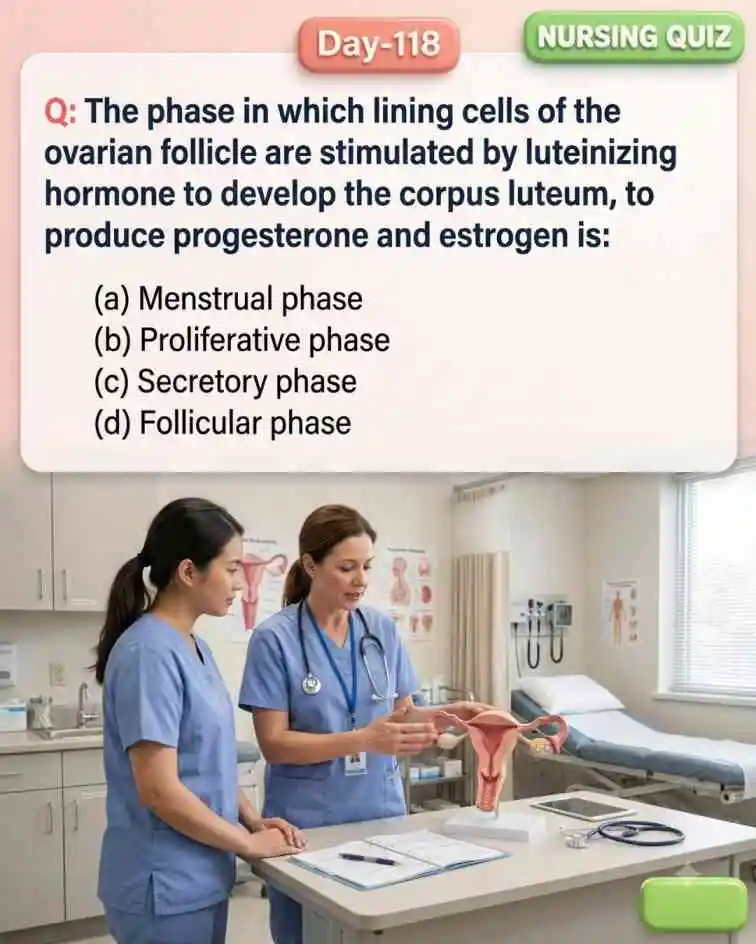
📝 Today’s Question:
Q: The phase in which lining cells of the ovarian follicle are stimulated by luteinizing hormone to develop the corpus luteum, to produce progesterone and estrogen is:
👆 Comment your answer and then tap an option to check your answer.
Don’t forget to Comment your answer below.
Secretory Phase and Corpus Luteum
Why is this the correct answer?
The secretory phase is the second major phase of the uterine cycle and occurs after ovulation. Following ovulation, the ruptured ovarian follicle develops into the corpus luteum under the influence of luteinizing hormone (LH).
The corpus luteum secretes mainly progesterone and also estrogen. Progesterone acts on the endometrium, making the uterine glands more active and preparing the uterus for possible implantation of a fertilized ovum.
Therefore, the key association is: Ovulation → Corpus luteum → Progesterone → Secretory endometrium.
Understanding Important Terms
Secretory phase: The post-ovulatory phase of the uterine cycle in which progesterone makes the endometrium glandular and receptive to possible implantation.
Corpus luteum: A temporary endocrine structure formed from the ruptured ovarian follicle after ovulation. It produces mainly progesterone and some estrogen.
Progesterone: A hormone that prepares and helps maintain the endometrium for possible implantation and early pregnancy.
Why are the other options incorrect?
This is the phase when the functional layer of the endometrium is shed because ovarian hormone levels have fallen. It is not the phase associated with the progesterone-dominant action of the corpus luteum.
This phase occurs before ovulation and is mainly influenced by estrogen. Estrogen stimulates rebuilding and proliferation of the endometrium after menstruation.
After ovulation, the corpus luteum produces mainly progesterone and some estrogen. These hormones cause the endometrium to become secretory and suitable for possible implantation.
The follicular phase is an ovarian-cycle phase in which ovarian follicles develop. It occurs before ovulation and is mainly associated with follicular growth and increasing estrogen production.
How Does the Secretory Phase Work?
After ovulation, the ruptured follicle becomes the corpus luteum. LH supports its function, allowing it to produce progesterone. Progesterone causes the endometrial glands to secrete nutrient-rich substances and makes the uterine lining suitable for implantation.
If fertilization and implantation do not occur, the corpus luteum eventually degenerates. Progesterone and estrogen levels then fall, leading to breakdown of the endometrium and the beginning of menstruation.
Corpus luteum → Progesterone → Secretory endometrium.
When you see corpus luteum + progesterone + preparation of the endometrium, think Secretory phase.
Concept clarity • Easy recall • Nursing success
Previous Nursing Questions
Missed a previous question? Try these exam-style nursing MCQs. Click below to see the correct answer and detailed explanation.
A client with suspected acute compartment syndrome has severe pain, paresthesia, and increasing limb tightness. Which intervention should the nurse avoid?
See Answer & Explanation →Which of the following action would the nurse anticipate using when caring for a term neonate diagnosed with transient tachypnea at 2 hours after birth?
See Answer & Explanation →During the health teaching session, a pregnant woman asked the nurse the significance of proper nutrition during pregnancy. What is the best response by the nurse?
See Answer & Explanation →Which of the following combinations accurately reflects the fetal–placental endocrine cascade that initiates myometrial activation?
See Answer & Explanation →Terbutaline is prescribed for a client with bronchitis. The nurse understands that this medication should be used with caution if which medical condition is present in the client?
See Answer & Explanation →A young child has coarctation of the aorta. What should the nurse expect to identify when taking the child vital signs?
See Answer & Explanation →Nurse is caring for a patient with suspected diverticulitis. The nurse would be most prudent in questioning which of the following diagnostic tests ordered:
See Answer & Explanation →A postoperative client asks the nurse why it is so important to deep-breathe and cough after surgery. When formulating a response, the nurse incorporates the understanding that retained pulmonary secretions in a postoperative client can lead to which condition?
See Answer & Explanation →An elderly client is diagnosed with interstitial cystitis. Which finding differentiates interstitial cystitis from other forms of cystitis?
See Answer & Explanation →A congenital renal disorder in which the kidneys are fused with a renal parenchymal or fibrous isthmus is:
See Answer & Explanation →A physician prescribes laboratory studies for an infant of a HIV positive woman to determine the presence of HIV antigen. The nurse anticipates that which laboratory study will be prescribed?
See Answer & Explanation →Ready to Test Your Nursing Knowledge?
Practice nursing MCQs, take mock tests, attempt quizzes, and prepare for competitive nursing exams — all in one place.
Don’t forget to comment the answer below.