
🩺 Nursing Question of the Day
Challenge yourself with one exam-style nursing question every day.
✅ Think carefully • ✅ Choose your answer • ✅ Then scroll down to check the explanation.
📝 Today’s Question:
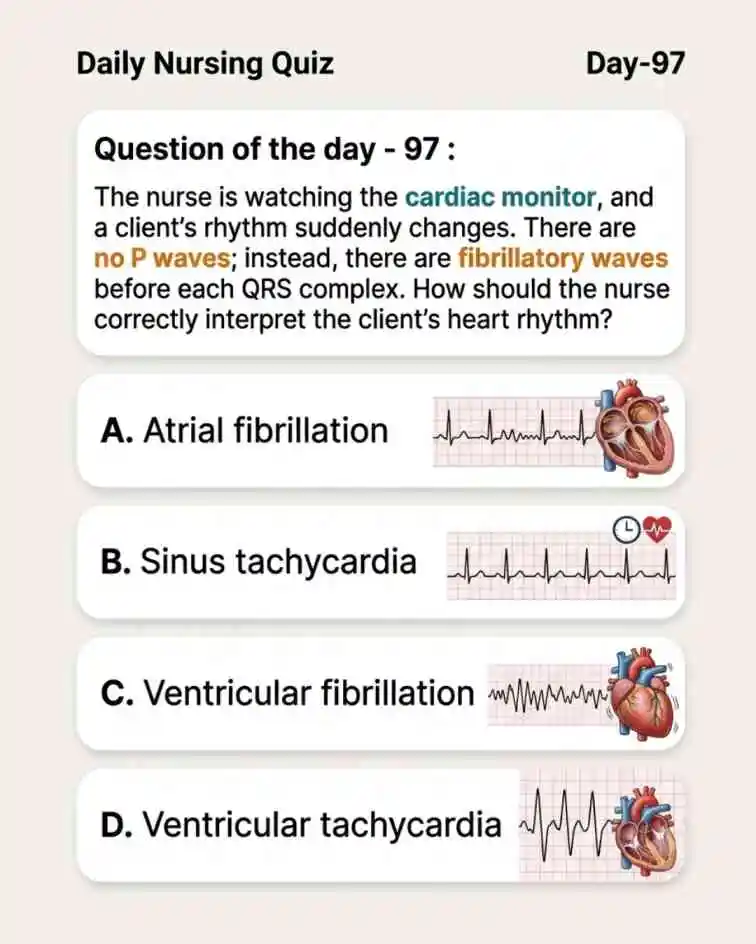
Q: The nurse is watching the cardiac monitor, and a client’s rhythm suddenly changes. There are no P waves; instead, there are fibrillatory waves before each QRS complex. How should the nurse cor-rectly interpret the client’s heart rhythm?
👆 Comment your answer and then tap an option to check your answer.
Don’t forget to Comment your answer below.
❤️ Recognizing Atrial Fibrillation on ECG
The key clue is no normal P waves + fibrillatory waves before the QRS complexes. This is characteristic of atrial fibrillation (AF).
🔍 What Is Happening to the Heart?
In a normal heartbeat, the atria receive an organized electrical signal that produces a clear P wave on the ECG.
In atrial fibrillation, the electrical activity in the atria becomes chaotic. Instead of one organized atrial impulse, many small electrical impulses occur rapidly and irregularly.
📈 The ECG Clues
The most useful findings to remember are:
- P waves: Absent
- Fibrillatory waves: Present
- QRS complexes: Usually narrow, unless another conduction problem exists
- R–R intervals: Irregularly irregular
The phrase “irregularly irregular” is very important. The heartbeats do not follow a predictable pattern.
❤️ Why Are the P Waves Missing?
The P wave represents normal electrical depolarization of the atria. During atrial fibrillation, the atria are not depolarizing in one organized wave.
Instead, they are activated chaotically, producing tiny irregular electrical waves called fibrillatory waves.
Fibrillation comes from the Latin word fibrilla, meaning a small fiber. In medicine, it describes very rapid, disorganized activity of muscle fibers.
❌ Why the Other Rhythms Are Wrong
Sinus means the rhythm originates from the sinoatrial (SA) node. In sinus tachycardia, normal P waves are present before each QRS, but the heart rate is fast.
➜ Normal P waves should be present.
Ventricular fibrillation occurs in the ventricles, not the atria. The ECG shows a chaotic waveform without recognizable organized QRS complexes. It is a cardiac arrest rhythm requiring immediate resuscitation.
Ventricular tachycardia originates in the ventricles and typically produces a rapid wide-QRS rhythm. It is not identified by fibrillatory waves replacing P waves.
👩⚕️ Why Does Atrial Fibrillation Matter to Nurses?
During AF, the atria do not contract effectively. Blood can therefore remain stagnant, especially in the left atrial appendage.
Stagnant blood can form a thrombus, meaning a blood clot. If the clot travels to the brain, it can cause an ischemic stroke.
Monitor the rhythm and vital signs, assess for symptoms such as chest discomfort, dyspnea, dizziness or hypotension, and watch for signs of stroke such as facial drooping, arm weakness or speech difficulty.
🧠 A Simple Memory Trick
When you see no P waves + fibrillatory waves + irregularly irregular rhythm, think atrial fibrillation.
Do not confuse atrial fibrillation with ventricular fibrillation. AF still has identifiable QRS complexes, although the atrial activity is chaotic. Ventricular fibrillation has no organized QRS complexes and represents cardiac arrest.
Concept clarity • Easy recall • Nursing success
Previous Nursing Questions
Missed a previous question? Try these exam-style nursing MCQs. Click below to see the correct answer and detailed explanation.
A patient’s ABG result showed a pH of 7.28, HCO3− of 18 mEq/L, and a PaCO2 of 30 mmHg. What may be the most likely condition?
See Answer & Explanation →Which of the following is NOT classified as Group-2 pulmonary hypertension as per WHO criteria?
See Answer & Explanation →A 62-year-old male, 8 hours post-abdominal surgery, complains of severe suprapubic discomfort. On examination, the bladder is palpable and distended. Despite a strong urge to urinate, he is unable to pass urine. What is the most appropriate term for this postoperative condition?
See Answer & Explanation →During a nutrition assessment, a nurse notices a patient with poor appetite and weight loss. Which intervention should the nurse prioritize to improve the patient’s nutrition?
See Answer & Explanation →A nursing officer posted in a medical ward has administered an intramuscular antibiotic injection to a patient. The documentation of the drug administered includes all of the following EXCEPT:
See Answer & Explanation →Don’t forget to comment the answer below.