
🩺 Nursing Question of the Day
Challenge yourself with one exam-style nursing question every day.
✅ Think carefully • ✅ Choose your answer • ✅ Then scroll down to check the explanation.
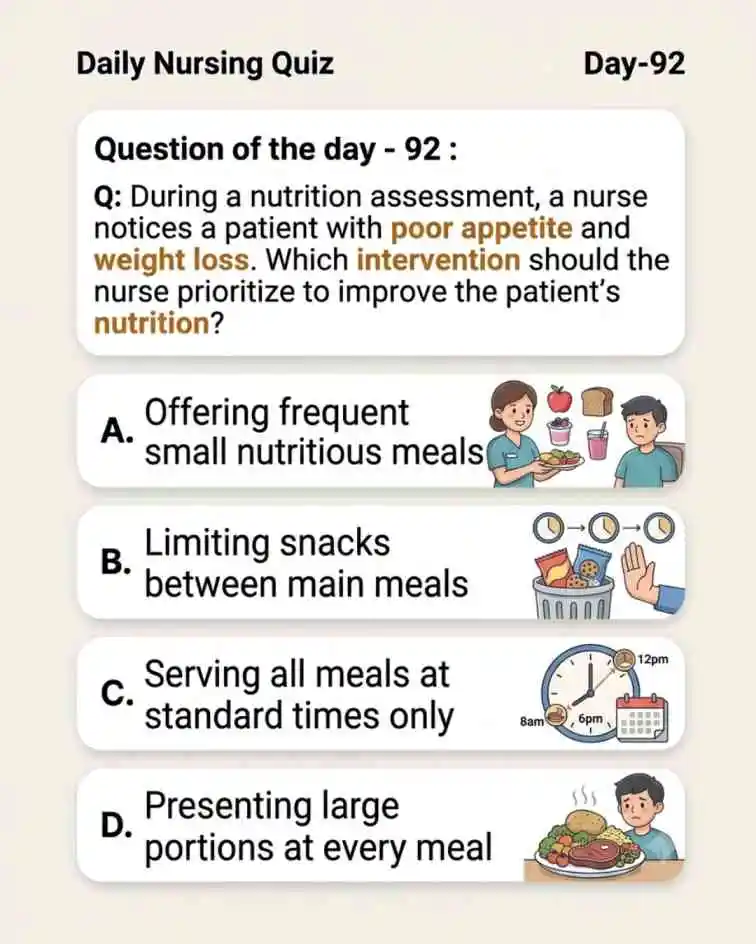
📝 Today’s Question:
Q: During a nutrition assessment, a nurse notices a patient with poor appetite and weight loss. Which intervention should the nurse prioritize to improve the patient’s nutrition?
👆 Comment your answer and then tap an option to check your answer.
Don’t forget to Comment your answer below.
Nutrition Support for a Patient With Poor Appetite
🍽️ Why Small Frequent Meals Help
When a patient has a poor appetite, the main problem is often not the availability of food but the patient’s inability or unwillingness to eat enough at one time.
A large plate of food may look overwhelming to someone who has little appetite. The patient may eat only a few bites and leave the rest.
Instead, offering smaller portions several times during the day gives the patient repeated opportunities to eat. If each meal or snack contains nutritious foods, the total intake can gradually improve.
This approach is especially useful when the patient is experiencing weight loss, because the goal is to provide enough energy and protein to support the body’s needs.
🩺 Understanding the Medical Terms
Nutrition: Nutrition refers to the process by which the body obtains and uses nutrients from food. The word is related to the Latin nutrire, meaning to nourish or feed.
Appetite: Appetite is the desire or feeling that makes a person want to eat. It is different from hunger. A person may need nutrients but still have little desire to eat.
The word appetite comes from the Latin appetitus, meaning desire or longing.
Weight loss: Weight loss means a decrease in body weight. When it is unintentional, it can be an important sign of inadequate nutritional intake or an underlying illness.
Nutritious: A nutritious food provides useful nutrients such as protein, carbohydrates, fats, vitamins, minerals, or other substances needed by the body.
🥗 What Should “Small but Nutritious” Mean?
Small meals should not simply mean small amounts of low-nutrient food. They should provide as much useful nutrition as possible in a manageable portion.
Depending on the patient’s condition and dietary restrictions, examples may include foods rich in protein and calories, such as eggs, yogurt, milk, cheese, nut or seed preparations, pulses, or other nutrient-dense foods.
The patient’s medical condition, swallowing ability, allergies, cultural preferences, and prescribed diet should always be considered when selecting foods.
🔬 Why Weight Loss Matters
The body needs adequate energy and nutrients to maintain muscles, support immunity, heal wounds, and perform normal body functions.
If a patient consistently eats too little, the body may begin using stored energy and eventually break down muscle tissue. Continued inadequate intake can therefore contribute to weakness, delayed healing, and poorer recovery.
For this reason, a patient with poor appetite and unexplained weight loss should also be assessed for the underlying cause. Illness, pain, nausea, depression, medications, difficulty swallowing, dental problems, and gastrointestinal symptoms can all affect food intake.
❌ Why the Other Options Are Not Appropriate
Limiting snacks between main meals: This can further reduce the patient’s total nutritional intake. For a patient with poor appetite, appropriate nutritious snacks can provide valuable additional calories and protein.
Serving all meals at standard times only: Regular meal times can be helpful, but a patient with poor appetite may not eat enough if food is offered only at three traditional meal times. Additional small meals or snacks may be more effective.
Presenting large portions at every meal: Large portions may overwhelm a patient with poor appetite and can make the patient feel full quickly. Smaller portions are usually easier to tolerate.
👩⚕️ Nursing Points
- Monitor the patient’s weight and nutritional intake.
- Offer small, frequent meals rather than forcing large meals.
- Choose nutrient-dense foods appropriate for the patient’s condition.
- Identify factors such as pain, nausea, medications, or swallowing difficulty that may reduce intake.
- Provide a pleasant and comfortable environment during meals.
- Collaborate with a dietitian when significant weight loss or malnutrition is suspected.
“Poor appetite? Make the meal smaller, not the nutrition.”
Small portions + frequent feeding + good nutrition = better chance of adequate intake.
Concept clarity • Easy recall • Nursing success
Don’t forget to comment the answer below.