
🩺 Nursing Question of the Day
Challenge yourself with one exam-style nursing question every day.
✅ Think carefully • ✅ Choose your answer • ✅ Then scroll down to check the explanation.
📝 Today’s Question:
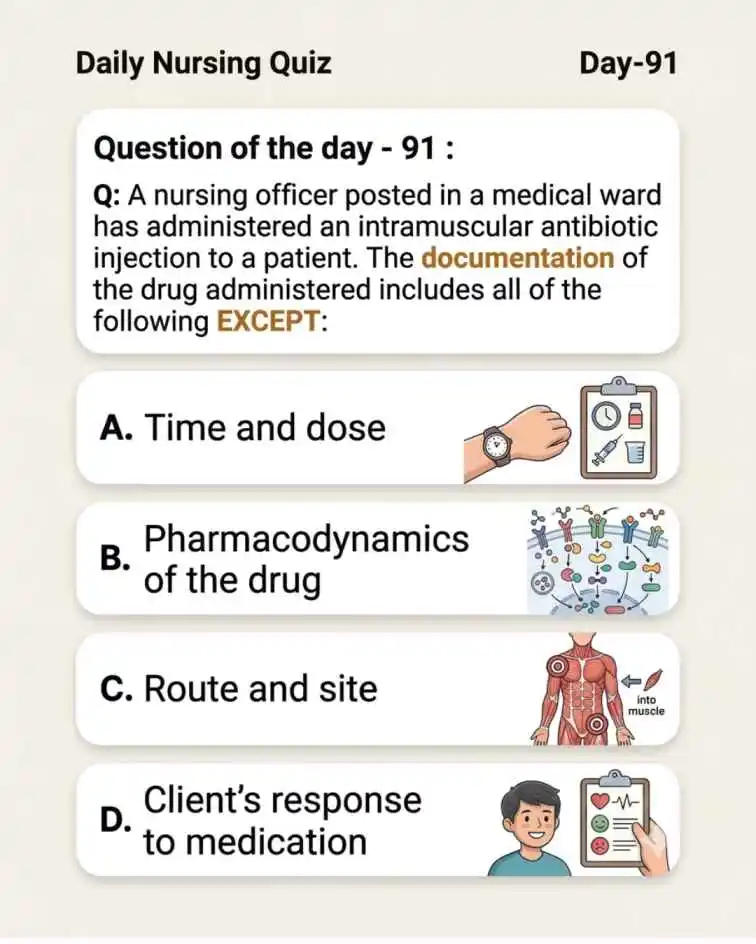
Q: A nursing officer posted in a medical ward has administered an intramuscular antibiotic injection to a patient. The documentation of the drug administered includes all of the following EXCEPT:
👆 Comment your answer and then tap an option to check your answer.
Don’t forget to Comment your answer below.
Documentation After an Intramuscular Medication
💊 What Should Be Documented?
When a nurse gives an intramuscular medication, documentation should clearly show what was given, how it was given, where it was given, and how the patient responded.
Important information commonly includes the medication name, dose, date and time, route, injection site, and relevant patient response. Any important adverse reaction should also be documented according to the facility’s policy.
This documentation provides a clear record of care and helps the healthcare team know what medication the patient received.
🩺 Understanding the Medical Terms
Documentation: The written or electronic recording of patient care, observations, treatments, and responses. The word comes from Latin documentum, meaning something that teaches or provides evidence.
Intramuscular (IM): This means that a medication is injected directly into a muscle. Intra means within, while muscular relates to muscle.
Route: The route is the way a medication enters the body, such as oral, intravenous, subcutaneous, or intramuscular.
Dose: The dose is the specific amount of medication given to the patient. It may be expressed in units such as milligrams (mg), micrograms (mcg), or milliliters (mL), depending on the medication.
Pharmacodynamics: This describes what the drug does to the body, including its effects on receptors, tissues, organs, and physiological functions.
The word pharmacodynamics comes from pharmakon, meaning drug, and dynamis, meaning power or force.
A simple way to remember it is: Pharmacodynamics = What the drug does to the body.
In contrast, pharmacokinetics describes what the body does to the drug—how the drug is absorbed, distributed, metabolized, and excreted.
📝 Why the Other Information Is Documented
Time and dose: These are essential parts of medication documentation. The time shows when the medication was administered, while the dose tells exactly how much was given.
Route and site: For an intramuscular injection, documenting the route and injection site is important. For example, the record may indicate that the medication was given by the IM route at a specified muscle site according to clinical practice and facility policy.
Client’s response: The patient’s response may need to be documented, particularly when assessing therapeutic effects or adverse reactions. For example, the nurse may document improvement in symptoms or the occurrence of a medication reaction.
❌ Why Pharmacodynamics Is the Exception
Pharmacodynamics is a scientific description of how the drug works in the body. It is important for understanding pharmacology, but the nurse does not normally enter the drug’s complete mechanism of action into the medication administration record after giving the injection.
For example, knowing that an antibiotic interferes with bacterial growth may be important for learning and clinical understanding. However, the medication record needs to establish that the correct drug was actually administered, in the correct dose, at the correct time, by the correct route and site, along with the relevant patient response.
👩⚕️ Nursing Documentation Points
- Document medication administration promptly according to facility policy.
- Record the medication, dose, route, and time.
- For injections, document the appropriate injection site when required.
- Record relevant therapeutic effects or adverse reactions.
- Keep documentation factual, accurate, and objective.
- Never document medication as given before it has actually been administered.
“Give it → Record it.”
Think about the actual administration: What? How much? When? Where? How? Response? The drug’s detailed mechanism of action is not part of routine medication administration documentation.
Concept clarity • Easy recall • Nursing success
Don’t forget to comment the answer below.