
🩺 Nursing Question of the Day
Challenge yourself with one exam-style nursing question every day.
✅ Think carefully • ✅ Choose your answer • ✅ Then scroll down to check the explanation.
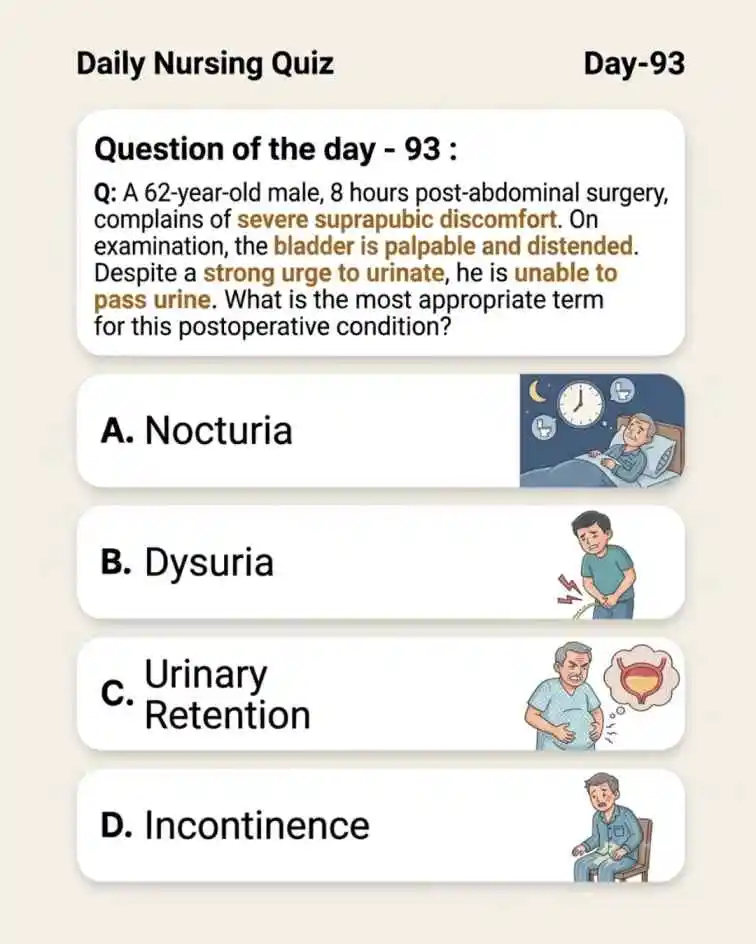
📝 Today’s Question:
Q: A 62-year-old male, 8 hours post-abdominal surgery, complains of severe suprapubic discomfort. On examination, the bladder is palpable and distended. Despite a strong urge to urinate, he is unable to pass urine. What is the most appropriate term for this postoperative condition?
👆 Comment your answer and then tap an option to check your answer.
Don’t forget to Comment your answer below.
Postoperative Urinary Retention
💡 What is Urinary Retention?
Urinary retention means the bladder contains urine, but the person is unable to empty it properly. In simple words: the urine is there, the bladder is full, but the patient cannot pass it.
The word urinary comes from the Latin word urina, meaning urine. The word retention comes from the Latin retinere, meaning “to hold back” or “to keep.” Therefore, urinary retention literally means urine being held back in the bladder.
🔍 Why does this happen after surgery?
Urinary retention is a common postoperative problem, particularly after abdominal, pelvic, or other major surgeries. Several factors can temporarily interfere with normal bladder emptying.
- Anesthesia: General or regional anesthesia can temporarily reduce bladder sensation and the normal contraction of the bladder.
- Opioid pain medicines: These medicines can reduce the normal urge and ability to empty the bladder.
- Pain: Pain and discomfort can interfere with normal urination.
- Reduced mobility: The patient may have difficulty getting up and going to the toilet.
- IV fluids: Large amounts of fluid given during or after surgery can increase urine production.
- Bladder dysfunction: Temporary disturbance of the nerves controlling the bladder can make emptying difficult.
🩺 Understanding the Important Signs
The most important clues in this patient are:
- Severe suprapubic discomfort
- Palpable, distended bladder
- Strong urge to urinate
- Unable to pass urine
- Recent surgery and anesthesia
Suprapubic means the area located above the pubic bone. “Supra” means above, while “pubic” refers to the pubic bone. When the bladder becomes very full, it can expand upward and become palpable in the lower abdomen.
A normal bladder stores urine and contracts when it is time to empty. During urinary retention, the bladder continues filling, but effective emptying does not occur. As urine accumulates, the bladder becomes increasingly distended and uncomfortable.
❌ Why the Other Terms Are Incorrect
Nocturia means waking up during the night to urinate. The word comes from Latin nox/noctis, meaning night, and uria, referring to urination. It is a problem of nighttime urination, not inability to empty a full bladder.
Dysuria means painful or difficult urination. The prefix dys- means abnormal, difficult, or painful. A patient with dysuria can usually pass urine but experiences pain or burning while doing so.
Urinary incontinence means involuntary leakage of urine. Here, the problem is the opposite: the patient wants to urinate but cannot empty the bladder.
🧠 A Simple Way to Remember
Think of urinary retention as a full tank with a blocked or ineffective outlet. The urine keeps collecting, but it cannot come out.
👩⚕️ Important Nursing Points
- Assess the patient’s ability and urge to void after surgery.
- Observe for suprapubic fullness, discomfort, and bladder distension.
- Monitor urine output and the time since the last void.
- Review medications, especially opioids, and the type of anesthesia used.
- Provide privacy and an appropriate position for urination when possible.
- If retention is suspected, assess bladder volume according to facility protocol, often using a bladder scanner.
- Significant retention may require catheterization as prescribed or according to protocol.
When you see “postoperative patient + strong urge to urinate + palpable/distended bladder + unable to void,” think immediately of urinary retention.
Concept clarity • Easy recall • Nursing success
Don’t forget to comment the answer below.