
🩺 Nursing Question of the Day
Challenge yourself with one exam-style nursing question every day.
✅ Think carefully • ✅ Choose your answer • ✅ Then scroll down to check the explanation.
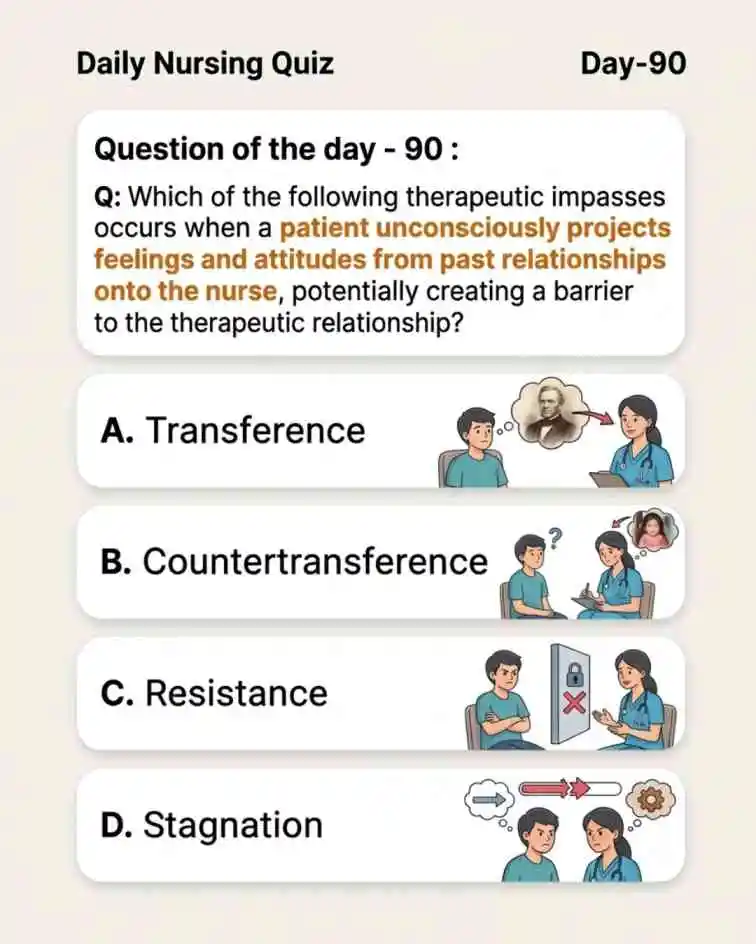
📝 Today’s Question:
Q: Which of the following therapeutic impasses occurs when a patient unconsciously projects feelings and attitudes from past relationships onto the nurse, potentially creating a barrier to the therapeutic relationship?
👆 Comment your answer and then tap an option to check your answer.
Don’t forget to Comment your answer below.
Transference in the Therapeutic Relationship
🧠 What Is Transference?
Imagine that a patient had a very strict or controlling parent in childhood. Later, the patient may meet a nurse who behaves completely professionally, but the patient may begin to feel that the nurse is also controlling or threatening.
The patient is not necessarily reacting only to the nurse’s actual behavior. Instead, feelings connected with the past relationship are being unconsciously transferred to the nurse.
The word transference comes from the Latin roots trans, meaning across or over, and ferre, meaning to carry. So, it can be remembered as “carrying feelings from one relationship into another.”
👩⚕️ A Simple Example
Suppose a patient previously had a very critical father who frequently scolded him. During hospitalization, the patient becomes unusually defensive whenever the nurse gives instructions, even though the nurse is speaking calmly and respectfully.
The patient’s reaction may be influenced by feelings associated with the previous relationship. The patient may unconsciously experience the nurse as if the nurse were the critical father.
This is an example of transference.
🔄 Transference vs Countertransference
These two terms are easy to confuse, so remember who is doing the transferring.
| Term | Who? | What happens? |
|---|---|---|
| Transference | Patient | Patient transfers past feelings onto the nurse. |
| Countertransference | Nurse | Nurse transfers personal feelings onto the patient. |
Easy rule: Transference = patient’s feelings toward the nurse. Countertransference = nurse’s feelings toward the patient.
🔍 Understanding the Other Terms
Resistance: Resistance occurs when a patient consciously or unconsciously avoids discussing certain thoughts, feelings, experiences, or problems. The patient may change the subject, remain silent, become defensive, or avoid participating in therapy.
The word resistance comes from Latin resistere, meaning to stand against. Think of it as the patient mentally “pushing back” against something.
Stagnation: Stagnation means that progress in the therapeutic relationship has stopped or become stuck. The word comes from Latin stagnare, meaning to stand still.
Stagnation describes a lack of movement or progress, but it does not specifically mean that the patient is transferring feelings from a previous relationship onto the nurse.
🚧 Why Can Transference Become a Barrier?
A therapeutic relationship depends on trust, accurate communication, and professional boundaries. When a patient sees the nurse through the lens of an earlier relationship, the nurse’s actual words or actions may be misunderstood.
For example, a simple nursing instruction may be interpreted as criticism because it reminds the patient of a critical parent from the past. This can lead to anger, mistrust, withdrawal, or difficulty cooperating with care.
The nurse should remain calm, maintain professional boundaries, avoid taking the reaction personally, and try to understand what may be contributing to the patient’s response.
👩⚕️ Nursing Points
- Recognize unusual or overly intense patient reactions toward the nurse.
- Maintain professional boundaries.
- Avoid arguing with the patient’s feelings.
- Use therapeutic communication and active listening.
- Do not respond emotionally or personally to the patient’s behavior.
- Seek supervision or support when the therapeutic relationship becomes difficult to manage.
“Patient → Past → Nurse = Transference.”
If the patient brings feelings from a past relationship and places them on the nurse, think TRANSFERENCE.
Concept clarity • Easy recall • Nursing success
Don’t forget to comment the answer below.