
🩺 Nursing Question of the Day
Challenge yourself with one exam-style nursing question every day.
✅ Think carefully • ✅ Choose your answer • ✅ Then scroll down to check the explanation.
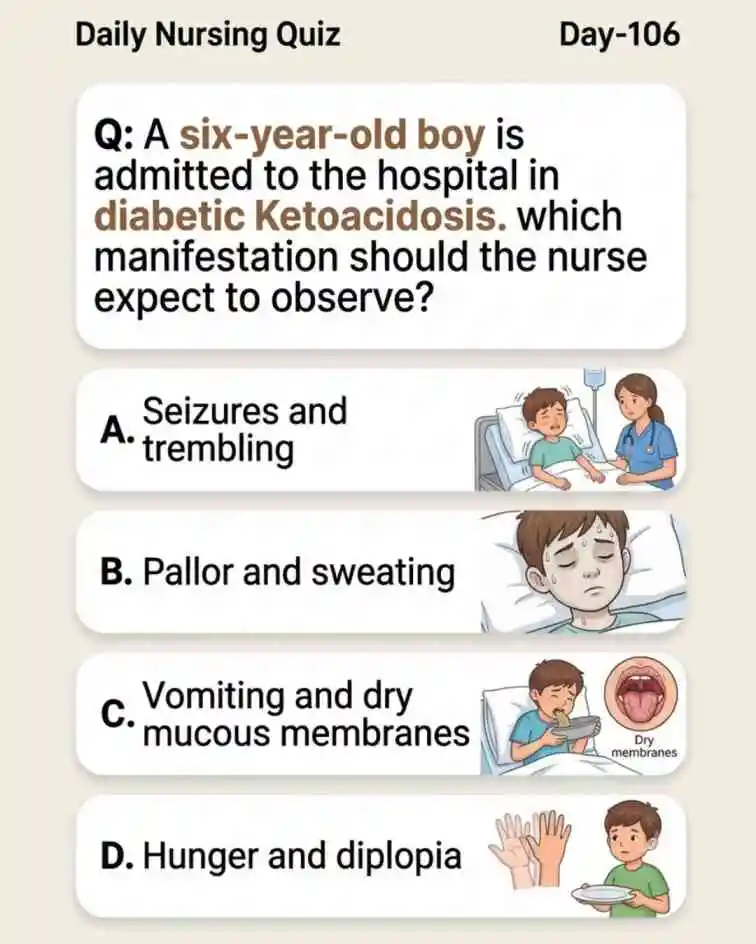
📝 Today’s Question:
Q: A six-year-old boy is admitted to the hospital in diabetic Ketoacidosis. which manifestation should the nurse expect to observe?
👆 Comment your answer and then tap an option to check your answer.
Don’t forget to Comment your answer below.
Recognizing Diabetic Ketoacidosis in a Child
Why is this the correct answer?
Diabetic ketoacidosis (DKA) is an acute and potentially life-threatening complication of diabetes. It occurs when there is not enough effective insulin to allow glucose to enter the body’s cells.
Because the cells cannot use glucose properly, the body begins breaking down fat for energy. This produces substances called ketones. When ketones build up, the blood becomes acidic.
At the same time, the very high blood glucose level causes the kidneys to remove extra glucose through the urine. Water follows the glucose, causing large amounts of urine to be produced. This leads to significant dehydration.
Therefore, a child with DKA may develop:
- Vomiting
- Dry mouth and dry mucous membranes
- Excessive thirst
- Frequent urination
- Weakness and fatigue
- Abdominal pain
- Deep, rapid breathing called Kussmaul respirations
- Fruity or acetone-like breath odor
- Altered level of consciousness in severe cases
In a child, vomiting is particularly important because it can make dehydration and electrolyte disturbances worse. The nurse should carefully monitor hydration status, blood glucose, electrolytes, neurological status, and urine output.
Understanding the Important Medical Terms
Diabetic: This word comes from diabetes, a term derived from Greek diabainein, meaning “to pass through,” referring historically to excessive urination. “Diabetic” simply means related to diabetes.
Ketoacidosis: This word can be broken into three ideas: keto refers to ketone bodies, acidosis means excessive acidity of the blood, and the condition occurs when ketones accumulate and lower blood pH.
Ketones: Ketones are chemical substances produced when the body breaks down fat for energy. Small amounts can occur normally, but large amounts during insulin deficiency can become dangerous.
Dehydration: “De” means loss or removal, while “hydration” relates to water. Dehydration means the body has lost more fluid than it has replaced.
Mucous membranes: These are moist tissues lining areas such as the mouth, nose, eyes, and gastrointestinal tract. When a child is dehydrated, the mouth and mucous membranes become noticeably dry.
Hyperglycemia: “Hyper” means high, “glyc” refers to glucose/sugar, and “emia” means a condition involving the blood. So, hyperglycemia means an abnormally high blood glucose level.
Why do dry mucous membranes occur?
Think of the process simply:
↓
Glucose spills into urine
↓
Water follows glucose
↓
Excessive urination
↓
Fluid loss and dehydration
↓
Dry mucous membranes + thirst + weakness
This is why the finding of vomiting together with dry mucous membranes fits DKA very well.
Why are the other options incorrect?
These findings are more suggestive of severe hypoglycemia. When blood glucose falls too low, the sympathetic nervous system is activated, causing sweating, trembling, palpitations, hunger, and sometimes seizures or loss of consciousness.
Pallor means unusual paleness of the skin. Sweating and pallor are classic autonomic responses to low blood glucose. They are therefore more closely associated with hypoglycemia than DKA.
These findings strongly support DKA. Vomiting may occur because of metabolic acidosis and abdominal irritation, while dry mucous membranes reflect the significant dehydration caused by osmotic diuresis.
Increased hunger, or polyphagia, can occur with diabetes because glucose cannot be effectively utilized by cells. However, it is not the characteristic acute manifestation of DKA. Diplopia means double vision and is not a classic finding of DKA.
What should the nurse watch for in a child with DKA?
- Level of consciousness
- Blood glucose level
- Serum electrolytes, especially potassium
- Hydration status and urine output
- Respiratory rate and depth
- Kussmaul respirations
- Vomiting and abdominal pain
- Heart rate and blood pressure
- Signs of worsening neurological status
One important pediatric concern is cerebral edema. Children with DKA require careful fluid and insulin management and frequent neurological assessment because cerebral edema can be a serious complication.
DKA = Dry + Ketones + Acidosis
Think: “DKA dries the child out.” Vomiting + dry mouth = think dehydration from DKA.
When you see DKA, look for dehydration, vomiting, abdominal pain, ketones, metabolic acidosis, and Kussmaul respirations. Findings such as sweating, trembling, pallor, and intense hunger point more toward hypoglycemia.
Concept clarity • Easy recall • Nursing success
Previous Nursing Questions
Missed a previous question? Try these exam-style nursing MCQs. Click below to see the correct answer and detailed explanation.
A client’s membranes rupture while her labor is being augmented with an oxytocin infusion. A nurse observes variable decelerations in the fetal heart rate on the fetal monitor strip. What action should the nurse take next?
See Answer & Explanation →A 38-year-old woman returns from a subtotal thyroidectomy for the treatment of hyperthyroidism. On assessment, which immediate priority should the nurse include?
See Answer & Explanation →What is the most appropriate initial nursing intervention for a hypertensive patient with obesity who reports difficulty eating balanced meals due to work?
See Answer & Explanation →The nurse is providing medication instructions to a client with breast cancer who is receiving cyclophosphamide. The nurse should tell the client to take which action?
See Answer & Explanation →A patient with chronic hypertension is found to have increased thickness of the left ventricular wall on echocardiogram. Which cellular adaptation best explains this finding?
See Answer & Explanation →A mother with severe preeclampsia gives birth to a premature infant. Which assessment finding should the nurse prioritize to identify potential complications associated with this high-risk scenario?
See Answer & Explanation →A nurse is reviewing documentation for a topical medication. Which entry would most likely indicate a potential error in the administration record?
See Answer & Explanation →Ready to Test Your Nursing Knowledge?
Practice nursing MCQs, take mock tests, attempt quizzes, and prepare for competitive nursing exams — all in one place.
Don’t forget to comment the answer below.