
🩺 Nursing Question of the Day
Challenge yourself with one exam-style nursing question every day.
✅ Think carefully • ✅ Choose your answer • ✅ Then scroll down to check the explanation.
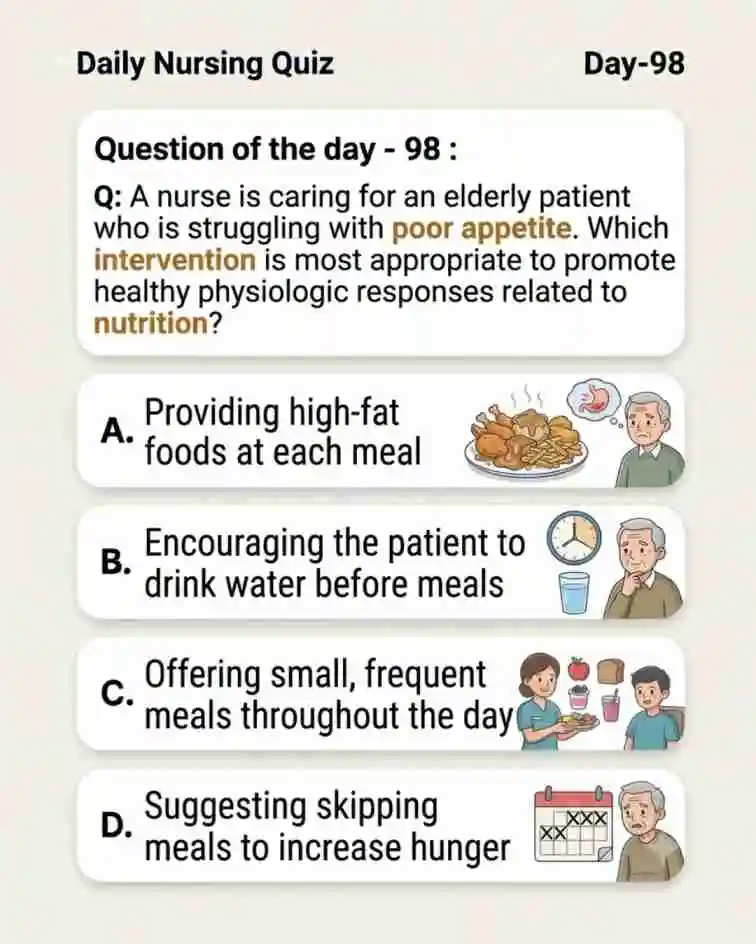
📝 Today’s Question:
Q: A nurse is caring for an elderly patient who is struggling with poor appetite. Which intervention is most appropriate to promote healthy physiologic responses related to nutrition?
👆 Comment your answer and then tap an option to check your answer.
Don’t forget to Comment your answer below.
🍽️ Helping an Older Patient Eat Better
When an elderly patient has a poor appetite, small, frequent, nutritious meals are easier to tolerate and can improve overall food intake.
🌱 Why Does This Work?
A person with a poor appetite may feel full after eating only a small amount. Giving a large meal at once can therefore feel overwhelming.
Instead, offering small meals several times during the day allows the patient to take in calories, protein, vitamins, and minerals without having to eat a large quantity at one time.
Poor appetite → Don’t make the meal bigger → Make the meals smaller and more frequent.
👵 Why Is This Important in Older Adults?
Appetite means the desire or natural interest in eating. The word comes from the Latin appetere, meaning “to seek or desire.”
Older adults may have reduced appetite because of illness, medications, changes in taste or smell, dental problems, difficulty swallowing, depression, or reduced activity.
If poor intake continues, the patient may lose weight and muscle and become deficient in important nutrients.
🥗 What Should “Nutritious” Mean?
A small meal should still provide good nutrition. Choose nutrient-dense foods when appropriate, such as eggs, yogurt, milk, cheese, pulses, fish, lean meat, nuts, or other foods suitable for the patient’s condition.
Nutrient-dense means a food provides a good amount of nutrients in a relatively small amount of food.
❌ Why the Other Options Are Not Best
High-fat foods are not automatically the best solution for poor appetite. Very fatty foods can make some patients feel full quickly and may not provide a balanced range of nutrients. The patient’s medical condition should also be considered.
Drinking a large amount of water immediately before eating may increase fullness and leave less room for food. Fluids are important, but timing and the patient’s overall intake matter.
Skipping meals reduces the opportunity to obtain calories and nutrients. It can make inadequate nutrition and weight loss worse.
👩⚕️ Nursing Care That Can Help
- Offer small meals and snacks at regular intervals.
- Choose foods the patient enjoys when medically appropriate.
- Provide attractive, appetizing meals.
- Encourage adequate fluids at appropriate times.
- Provide good oral care before meals.
- Assess dental problems and difficulty chewing or swallowing.
- Monitor weight and food intake.
- Look for underlying causes of persistent poor appetite.
Oral care can be particularly helpful because a clean, comfortable mouth can make eating more pleasant. Dental pain, dry mouth, or poorly fitting dentures can reduce food intake.
🧠 Easy Memory Trick
Don’t focus on making the patient eat a large plate. Instead, give small amounts more often and make each serving nutritious.
For an older patient with poor appetite, the best basic nursing intervention is small, frequent, nutritious meals. This improves the chance of adequate intake without overwhelming the patient with a large meal.
Concept clarity • Easy recall • Nursing success
Previous Nursing Questions
Missed a previous question? Try these exam-style nursing MCQs. Click below to see the correct answer and detailed explanation.
A neonate born to a diabetic mother shows an initial blood glucose value of less than 20 mg/dL. The lab test confirms the report. What should be the next course of action in this case?
See Answer & Explanation →A patient’s ABG result showed a pH of 7.28, HCO3− of 18 mEq/L, and a PaCO2 of 30 mmHg. What may be the most likely condition?
See Answer & Explanation →Which of the following is NOT classified as Group-2 pulmonary hypertension as per WHO criteria?
See Answer & Explanation →A 62-year-old male, 8 hours post-abdominal surgery, complains of severe suprapubic discomfort. On examination, the bladder is palpable and distended. Despite a strong urge to urinate, he is unable to pass urine. What is the most appropriate term for this postoperative condition?
See Answer & Explanation →During a nutrition assessment, a nurse notices a patient with poor appetite and weight loss. Which intervention should the nurse prioritize to improve the patient’s nutrition?
See Answer & Explanation →Ready to Test Your Nursing Knowledge?
Practice nursing MCQs, take mock tests, attempt quizzes, and prepare for competitive nursing exams — all in one place.
Don’t forget to comment the answer below.