
🩺 Nursing Question of the Day
Challenge yourself with one exam-style nursing question every day.
✅ Think carefully • ✅ Choose your answer • ✅ Then scroll down to check the explanation.
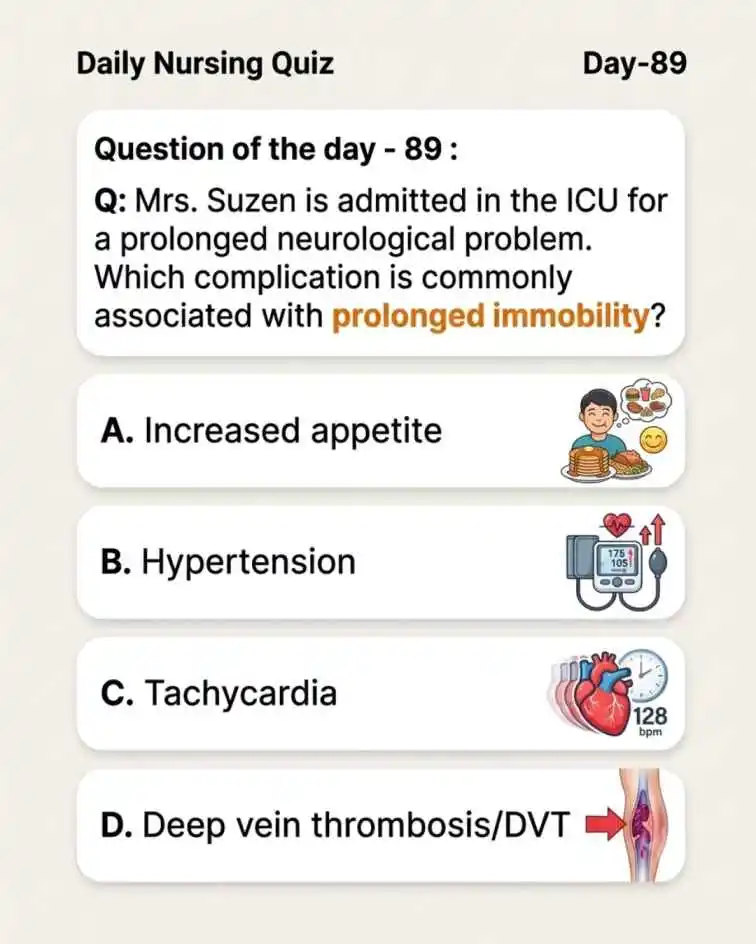
📝 Today’s Question:
Q: Mrs. Suzen is admitted in the ICU for a prolonged neurological problem. Which complication is commonly associated with prolonged immobility?
👆 Comment your answer and then tap an option to check your answer.
Don’t forget to Comment your answer below.
Deep Vein Thrombosis in Prolonged Immobility
🩸 What Is Deep Vein Thrombosis?
Deep vein thrombosis, commonly called DVT, is the formation of a blood clot inside a deep vein, most often in the lower limb.
The word thrombosis comes from the Greek word thrombos, meaning clot. The suffix -osis means a condition or abnormal process.
A deep vein is a vein located deeper inside the body, usually alongside major arteries and muscles. These veins carry deoxygenated blood back toward the heart.
🦵 Why Does Immobility Increase the Risk?
Normally, when we walk or move our legs, the calf muscles repeatedly contract. These muscle contractions squeeze nearby veins and help move blood upward toward the heart. This is sometimes called the calf muscle pump.
When a patient is immobilized for a prolonged period, this muscle pump becomes much less active. Blood flow in the legs becomes slower and venous stasis can occur.
Venous stasis means that blood is moving too slowly or becoming stagnant inside the veins. Slow-moving blood makes clot formation more likely.
The risk is particularly important in ICU patients because they may have several additional risk factors, such as severe illness, dehydration, surgery, trauma, inflammation, or the presence of central venous catheters.
🔬 The Three Factors That Promote Clot Formation
A useful way to understand DVT is through Virchow’s triad. It describes three major factors that increase the tendency for a blood clot to form:
- Venous stasis: blood flow becomes slow or stagnant.
- Vessel wall injury: damage occurs to the inner lining of a blood vessel.
- Hypercoagulability: the blood has an increased tendency to clot.
Prolonged immobility mainly contributes to venous stasis, which is why an immobile patient is at increased risk of DVT.
⚠️ Why DVT Is Important
A DVT can sometimes cause swelling, warmth, tenderness, or pain in the affected leg. However, some patients may have few or no obvious symptoms.
The major danger occurs when part of the clot breaks away and travels through the bloodstream to the lungs. This is called a pulmonary embolism (PE).
Embolism refers to blockage of a blood vessel by material that travels through the bloodstream. When the material blocks a blood vessel in the lungs, it is called a pulmonary embolism.
❌ Why the Other Options Are Incorrect
Increased appetite: Prolonged immobility does not typically cause increased appetite. Critically ill patients may actually experience reduced appetite or altered nutritional needs.
Hypertension: High blood pressure is not the characteristic complication associated with prolonged immobility. Immobility is much more strongly associated with venous stasis, DVT, pressure injuries, muscle wasting, and respiratory complications.
Tachycardia: Tachycardia means an abnormally fast heart rate. It can occur for many reasons in critically ill patients, but it is not the classic complication directly caused by prolonged immobility.
👩⚕️ Nursing Care for Preventing DVT
- Encourage early and safe mobilization when the patient’s condition allows.
- Perform prescribed range-of-motion exercises for immobile patients.
- Use prescribed compression devices or stockings when appropriate.
- Administer prescribed anticoagulant prophylaxis when indicated.
- Monitor the legs for swelling, warmth, tenderness, or changes in appearance.
- Watch for sudden dyspnea, chest pain, hypoxemia, or unexplained tachycardia, which may suggest pulmonary embolism.
“No movement → No muscle pump → Slow blood → DVT.”
Concept clarity • Easy recall • Nursing success
Don’t forget to comment the answer below.