
🩺 Nursing Question of the Day
Challenge yourself with one exam-style nursing question every day.
✅ Think carefully • ✅ Choose your answer • ✅ Then scroll down to check the explanation.
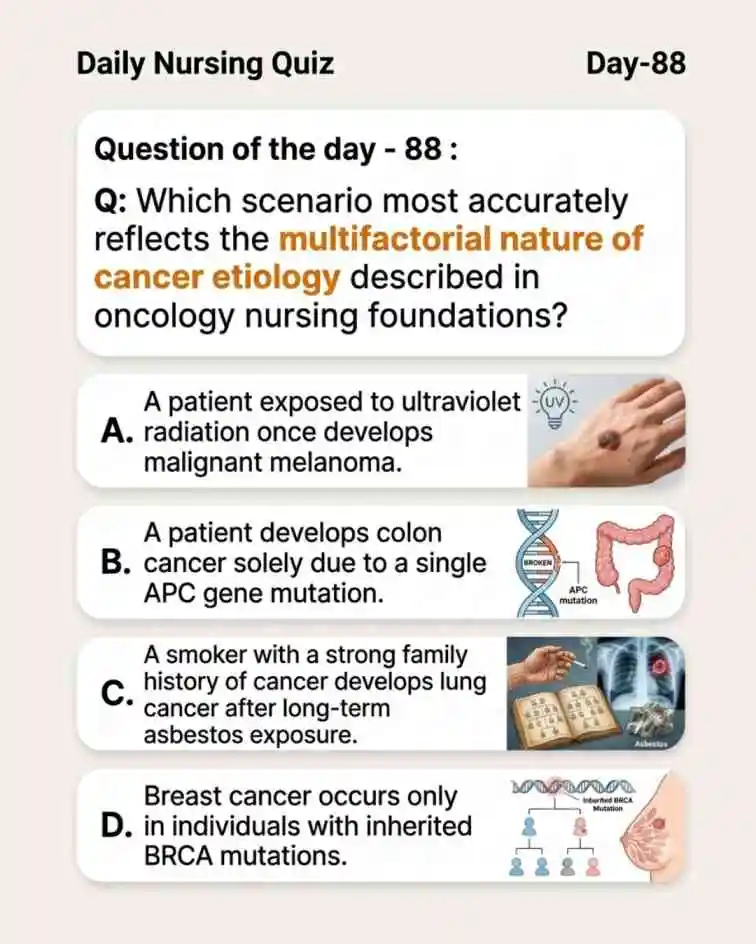
📝 Today’s Question:
Q: Which scenario most accurately reflects the multifactorial nature of cancer etiology described in oncology nursing foundations?
👆 Comment your answer and then tap an option to check your answer.
Don’t forget to Comment your answer below.
Multifactorial Nature of Cancer Etiology
🎯 What Does “Multifactorial” Mean?
Multifactorial simply means that many factors work together. In cancer, a person’s risk may be influenced by inherited genes, environmental exposures, lifestyle, age, infections, hormones, and random changes that occur in cells.
The word multi comes from Latin and means many, while factor means something that contributes to a result.
So, when we say that cancer has a multifactorial etiology, we mean that cancer generally develops through the interaction of several contributing factors rather than from one isolated cause.
🧬 Understanding Cancer Etiology
Etiology means the cause or causes of a disease. The word comes from the Greek words aitia, meaning cause, and logia, meaning study.
Cancer begins when cells acquire changes that allow them to grow and divide in an uncontrolled way. These changes can accumulate over many years.
Several different influences may contribute to this process, including:
- Genetic factors: inherited or acquired changes in genes.
- Smoking: exposes cells to many cancer-causing chemicals.
- Radiation: can damage cellular DNA.
- Occupational exposures: some substances, such as asbestos, increase cancer risk.
- Age: genetic damage can accumulate as a person gets older.
- Environmental factors: certain chemicals, pollutants, and other exposures can contribute to cancer risk.
🔬 Why the Correct Scenario Fits
In the correct scenario, several risk factors are present at the same time:
Smoking is an important risk factor for lung cancer because tobacco smoke contains numerous carcinogenic substances.
Asbestos exposure is another important occupational carcinogenic exposure. Long-term exposure is particularly associated with diseases such as mesothelioma and lung cancer.
A family history can indicate increased genetic susceptibility. It does not necessarily mean that cancer will definitely occur, but it may contribute to a person’s overall risk.
Therefore, this scenario demonstrates exactly what multifactorial cancer etiology means: several factors can interact to increase cancer risk.
🩺 Important Medical Terms
Carcinogen: A substance, exposure, or agent capable of increasing the risk of cancer. The word comes from Greek karkinos, meaning crab, and -gen, meaning producing or causing.
Malignant: Describes a cancerous growth that can invade surrounding tissues and potentially spread to distant parts of the body. The word comes from Latin malignus, meaning evil or harmful.
Mutation: A change in the DNA sequence. Some mutations have no important effect, while others can contribute to uncontrolled cell growth.
Genetic susceptibility: A tendency for a person to have a higher risk of developing a disease because of genetic factors. Increased susceptibility does not mean that disease is guaranteed.
Asbestos: A group of naturally occurring fibrous minerals that were widely used in construction and industry. Inhalation of asbestos fibers can cause serious diseases of the lungs and surrounding tissues.
❌ Why the Other Scenarios Are Incorrect
Ultraviolet radiation once causing melanoma: Ultraviolet radiation is an important risk factor for skin cancer, but a single exposure does not mean that melanoma will definitely develop. Cancer usually involves accumulated cellular damage and multiple contributing factors.
Colon cancer solely because of one APC mutation: APC mutations are important in colorectal cancer development, especially in familial adenomatous polyposis and the adenoma-carcinoma sequence. However, cancer development is more complicated than attributing every case to one single mutation.
Breast cancer occurring only with inherited BRCA mutations: BRCA1 and BRCA2 mutations can substantially increase the risk of breast and ovarian cancers, but most breast cancer cases are not simply explained by an inherited BRCA mutation. Other genetic, hormonal, environmental, and age-related factors can contribute.
👩⚕️ Nursing Importance
Nurses should avoid thinking of cancer as a disease caused by only one factor. A proper cancer history may include smoking, alcohol use, occupational exposure, radiation exposure, family history, previous cancers, infections, medications, reproductive history, and lifestyle factors.
This understanding is also important when educating patients. Having a family history of cancer does not mean that cancer is inevitable, and having no family history does not mean that a person has no risk.
“Cancer = Many Roads, One Disease.”
Think of genes + environment + lifestyle + time. When several factors come together, cancer risk can increase.
Concept clarity • Easy recall • Nursing success
Don’t forget to comment the answer below.