
🩺 Nursing Question of the Day
Challenge yourself with one exam-style nursing question every day.
✅ Think carefully • ✅ Choose your answer • ✅ Then scroll down to check the explanation.
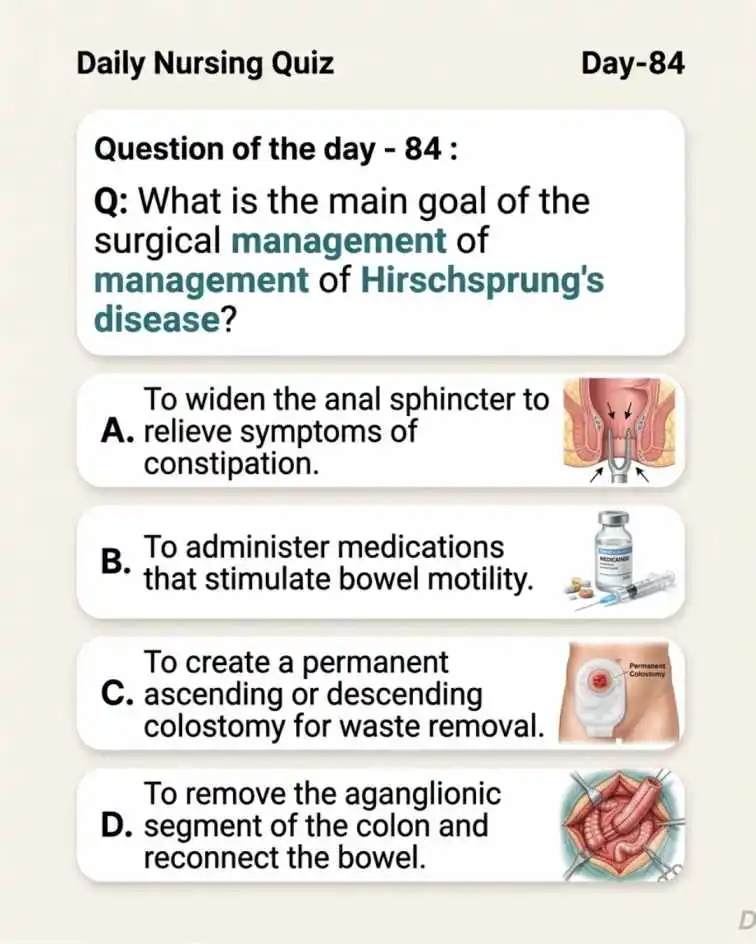
📝 Today’s Question:
Q: What is the main goal of the surgical management of Hirschsprung’s disease?
👆 Comment your answer and then tap an option to check your answer.
Don’t forget to Comment your answer below.
Surgical Management of Hirschsprung’s Disease
🩺 Why is Surgery Needed?
Hirschsprung’s disease is a congenital condition in which a portion of the large intestine does not contain normal ganglion cells. These nerve cells normally help coordinate the movement of the intestine.
Because the affected segment cannot relax and push stool forward normally, stool builds up behind it. This can cause constipation, abdominal distension, vomiting, and intestinal obstruction.
Surgery therefore focuses on removing the problem rather than simply treating the symptoms. The surgeon removes the aganglionic segment and brings healthy, normally innervated bowel down to the anus. This is commonly called a pull-through procedure.
In simple words: remove the bowel that cannot work properly and connect the healthy bowel so stool can pass.
🔬 Understanding the Medical Terms
Hirschsprung’s disease: A congenital disorder of the intestine in which ganglion cells are absent from part of the bowel. It is named after the Danish physician Harald Hirschsprung, who described the condition in the late 19th century.
Congenital: Present at birth. The word comes from Latin congenitus, meaning born together or born with.
Aganglionic: This means without ganglion cells. A- means without, while a ganglion is a collection of nerve-cell bodies. Therefore, an aganglionic bowel segment lacks the nerve cells needed for normal intestinal movement.
Ganglion cells: Specialized nerve cells located within the enteric nervous system of the intestinal wall. They help control coordinated intestinal contractions.
Colon: The major part of the large intestine. The word comes from Greek kolon, referring to the large intestine.
Motility: The ability of the gastrointestinal tract to move its contents forward. The term comes from Latin motilis, meaning movable.
Pull-through procedure: A surgical technique in which the diseased bowel is removed and healthy bowel is brought down and connected to the anus.
🧠 What Happens in Hirschsprung’s Disease?
The aganglionic segment remains abnormally contracted. The bowel above it may become enlarged because stool and intestinal contents accumulate behind the narrowed, non-relaxing segment.
Removing this abnormal segment eliminates the main mechanical and functional problem. Once healthy bowel is connected to the anus, intestinal contents can move through the functioning bowel.
❌ Why Are the Other Options Incorrect?
The main problem is not simply a narrow anal opening. The underlying problem is the absence of ganglion cells in a section of the intestine. Therefore, simply widening the anal sphincter does not correct the disease.
Medications may sometimes be used to manage symptoms or support bowel function, but they do not replace the missing ganglion cells. Definitive surgical treatment addresses the abnormal bowel segment itself.
A colostomy may sometimes be required temporarily in selected patients, particularly when there is severe obstruction, enterocolitis, or other complications. However, the usual definitive goal is to remove the aganglionic bowel and restore bowel continuity rather than create a permanent colostomy.
This directly treats the underlying problem by removing the bowel without ganglion cells and connecting normally innervated bowel to the anus.
👶 Important Nursing Points
- Monitor abdominal distension, bowel movements, vomiting, and feeding tolerance.
- Watch for signs of intestinal obstruction.
- Be alert for Hirschsprung-associated enterocolitis, which may cause fever, abdominal distension, diarrhea, and systemic illness.
- After surgery, monitor stool passage and the condition of the surgical site.
- Provide careful skin care around the anus because frequent loose stools after surgery can irritate the skin.
“Hirschsprung = No nerves → No normal movement → Remove the bad segment.”
The surgery removes the aganglionic bowel and brings healthy bowel down to restore normal stool passage.
Whenever you see Hirschsprung’s disease + definitive surgical treatment, think: remove the aganglionic segment and connect healthy bowel to the anus.
Concept clarity • Easy recall • Nursing success
Don’t forget to comment the answer below.