
🩺 Nursing Question of the Day
Challenge yourself with one exam-style nursing question every day.
✅ Think carefully • ✅ Choose your answer • ✅ Then scroll down to check the explanation.
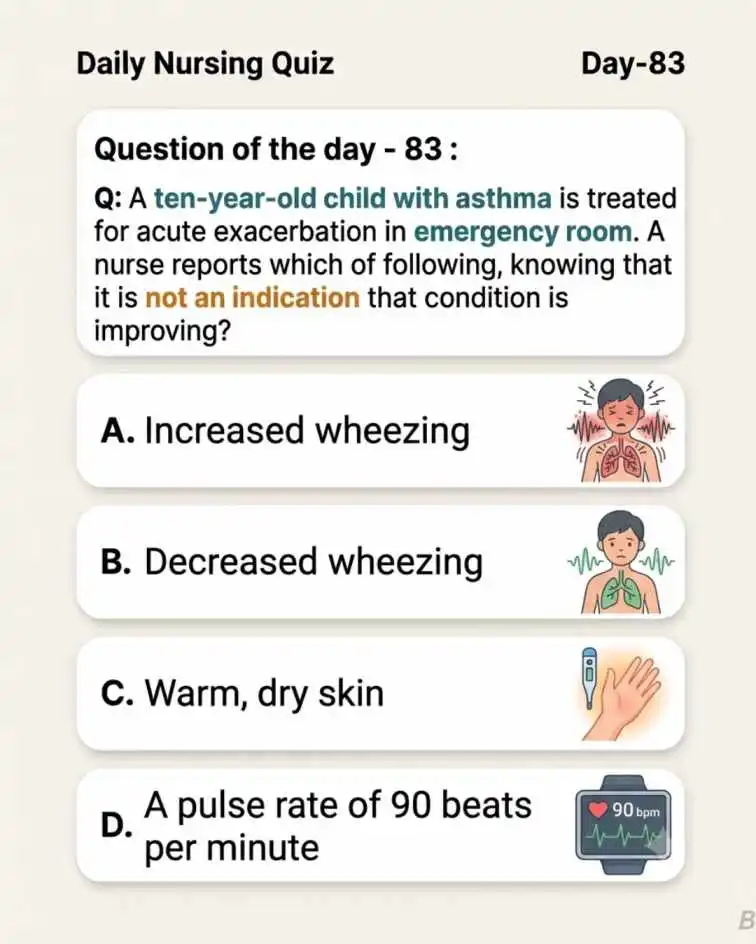
📝 Today’s Question:
Q: A ten-year-old child with asthma is treated for acute exacerbation in emergency room. A nurse reports which of following, knowing that it is not an indication that condition is improving?
👆 Comment your answer and then tap an option to check your answer.
Don’t forget to Comment your answer below.
Asthma Exacerbation: Recognizing Improvement
🫁 Why Can Decreased Wheezing Be Dangerous?
During an acute asthma exacerbation, the small airways become narrowed because of bronchospasm, airway swelling, and increased mucus. This makes it harder for air to move in and out of the lungs.
When air is still moving through narrowed airways, it can produce a musical sound called a wheeze. If treatment is working and airflow improves, wheezing may decrease.
However, there is an important difference in a child with a severe asthma attack. If the airways become extremely narrowed, the amount of air moving through them may become so small that the wheezing becomes quieter or disappears.
This is sometimes called a silent chest. It is a serious finding because the absence of wheezing does not necessarily mean that the child is breathing better. The nurse must look at the child’s entire respiratory status.
Less wheezing + worsening respiratory effort = danger, not improvement.
Always assess air movement, respiratory effort, oxygen saturation, mental status, and other clinical findings rather than judging improvement from the wheeze alone.
🔬 Understanding the Important Medical Terms
Asthma: A condition in which the airways become inflamed and overly sensitive, causing episodes of airway narrowing and difficulty breathing. The word comes from the Greek asthma, meaning panting or difficult breathing.
Exacerbation: A worsening or increase in the severity of a disease or its symptoms. It comes from the Latin exacerbare, meaning to make more severe or harsh.
Bronchospasm: Tightening of the muscles surrounding the bronchi, causing the airway to become narrower. Bronch- refers to the bronchi, while -spasm means a sudden involuntary contraction.
Wheeze: A high-pitched musical breathing sound caused by air moving through narrowed airways. Wheezing is common during an asthma attack.
Airway obstruction: A blockage or narrowing that makes it difficult for air to move normally through the respiratory tract.
Silent chest: A very concerning finding in severe asthma in which breath sounds, including wheezing, become markedly reduced or absent because airflow is extremely poor.
❌ Why Are the Other Findings Less Concerning?
Increased wheezing generally indicates that airflow is occurring through narrowed airways and does not by itself show that the child is improving. However, the key point in this question is that decreased wheezing in a severely ill child can be a dangerous sign when airflow is falling.
Decreased wheezing may appear reassuring, but during a severe asthma exacerbation it can indicate reduced airflow. If the child is still struggling to breathe, a quieter chest can indicate worsening obstruction.
Warm, dry skin can be seen as the child becomes more stable and is not the classic warning sign described by this question. The nurse should still assess the child’s overall respiratory condition.
A pulse rate of 90 beats/minute can be appropriate for a 10-year-old child, depending on the child’s overall condition. A falling heart rate in a severely distressed child, especially with fatigue or altered consciousness, would be much more concerning.
👩⚕️ What Should the Nurse Look For?
The nurse should never use wheezing alone to decide whether an asthma attack is improving. Look at the whole child.
- Respiratory rate and pattern
- Work of breathing and use of accessory muscles
- Ability to speak normally
- Oxygen saturation
- Air entry and breath sounds
- Level of consciousness and fatigue
- Heart rate and overall clinical appearance
“No wheeze does not always mean no problem.”
In severe asthma, a very quiet or silent chest can mean very poor air movement.
If an asthma patient is getting quieter but is still showing signs of respiratory distress, do not assume the asthma is improving. Think about decreased air movement and possible severe airway obstruction.
Concept clarity • Easy recall • Nursing success
Don’t forget to comment the answer below.