
🩺 Nursing Question of the Day
Challenge yourself with one exam-style nursing question every day.
✅ Think carefully • ✅ Choose your answer • ✅ Then scroll down to check the explanation.
📝 Today’s Question:
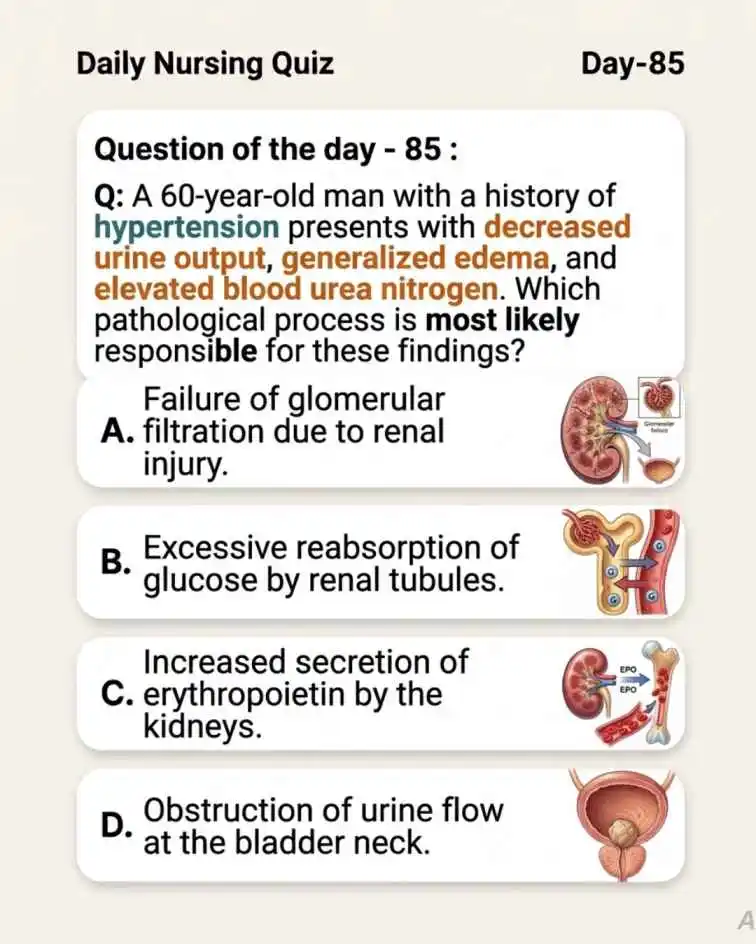
Q: A 60-year-old man with a history of hypertension presents with decreased urine output, generalized edema, and elevated blood urea nitrogen. Which pathological process is most likely responsible for these findings?
👆 Comment your answer and then tap an option to check your answer.
Don’t forget to Comment your answer below.
Renal Failure and Reduced Glomerular Filtration
🩺 Why is this the correct answer?
The kidneys have an important job: they filter the blood, remove waste products, control fluid balance, and help maintain the body’s internal environment.
The first major step in urine formation is glomerular filtration. Blood enters tiny filtering structures in the kidney called glomeruli. Water and small dissolved substances are filtered from the blood into the nephron, while blood cells and most large proteins remain in the bloodstream.
If the kidneys are injured, especially after long-standing hypertension, the filtering ability of the glomeruli can decrease. As a result, less fluid is filtered and less urine may be produced.
At the same time, waste products such as urea remain in the blood instead of being removed efficiently. This causes the blood urea nitrogen (BUN) level to rise.
Reduced kidney function also causes the body to retain sodium and water. The extra fluid can move into body tissues, producing edema, or swelling.
Renal injury → ↓ glomerular filtration → ↓ urine formation + retention of waste and fluid → ↑ BUN + edema
🔬 Understanding the Medical Terms
Kidney: An organ that filters the blood and helps regulate fluid, electrolytes, acid-base balance, and waste removal. The word kidney is derived from Old English cwið and related Germanic terms referring to the organ.
Renal: Anything related to the kidney. The word comes from Latin renalis, meaning of the kidney.
Glomerulus: A tiny network of capillaries inside the nephron where blood filtration begins. The word comes from Latin glomerulus, meaning a small ball or little ball, describing its appearance.
Glomerular filtration: The process by which water and small substances are filtered from the blood through the glomerular capillaries into the nephron.
Nephron: The microscopic functional unit of the kidney. Each kidney contains a very large number of nephrons. The word comes from Greek nephros, meaning kidney.
Edema: Abnormal accumulation of excess fluid in the tissues, causing swelling. The word comes from Greek oidēma, meaning swelling.
Blood urea nitrogen (BUN): A blood measurement that reflects the amount of nitrogen present in the blood as urea. Urea is a waste product formed when the body breaks down proteins and is normally removed mainly by the kidneys.
Hypertension: Persistently high blood pressure. Hyper- means above or excessive, while -tension refers to pressure or tension.
❤️ How Can Hypertension Damage the Kidneys?
Long-standing hypertension places excessive pressure on the small blood vessels inside the kidneys. Over time, these vessels can become damaged and less able to supply and support normal kidney tissue.
Continued damage can impair the glomeruli and gradually reduce the kidney’s ability to filter blood. This is one reason why uncontrolled hypertension is an important risk factor for chronic kidney disease.
It is a good example of how one disease can slowly damage another organ: high blood pressure → vascular damage → kidney injury → reduced filtration.
❌ Why Are the Other Options Incorrect?
This explains all the major findings. Reduced filtration causes decreased urine formation and retention of waste products and fluid, leading to increased BUN and edema.
Glucose is normally reabsorbed by the renal tubules. Excessive glucose reabsorption is not the main mechanism responsible for decreased urine output, generalized edema, and elevated BUN. The findings point toward reduced filtration and kidney dysfunction.
Erythropoietin is a hormone produced mainly by the kidneys that stimulates red blood cell production. In chronic kidney disease, erythropoietin production generally decreases, which can contribute to anemia. It does not explain the main findings in this case.
A bladder-neck obstruction can reduce urine flow and cause urinary retention, but the combination of generalized edema and elevated BUN with a history of hypertension is more consistent with significant renal filtration failure.
💧 Why Does Edema Develop?
When the kidneys cannot remove enough sodium and water, fluid begins to accumulate in the body. Some of this excess fluid moves from the blood vessels into the surrounding tissues.
This produces edema. Depending on the severity and cause of kidney dysfunction, the patient may develop swelling in the legs, feet, hands, face, or more generalized swelling.
👩⚕️ Important Nursing Points
- Monitor urine output carefully.
- Monitor daily body weight to assess fluid changes.
- Assess for peripheral and generalized edema.
- Monitor BUN, creatinine, electrolytes, and other renal-function results.
- Monitor blood pressure because hypertension can both contribute to and result from kidney disease.
- Watch for signs of fluid overload, including increasing edema and respiratory difficulty.
“Kidney can’t filter → urine falls, waste rises, fluid stays.”
Think: ↓ filtration → ↓ urine + ↑ BUN + edema.
When decreased urine output occurs together with edema and elevated BUN, think about reduced renal filtration. In a patient with long-standing hypertension, chronic renal injury is an important possibility.
Concept clarity • Easy recall • Nursing success
Don’t forget to comment the answer below.