
🩺 Nursing Question of the Day
Challenge yourself with one exam-style nursing question every day.
✅ Think carefully • ✅ Choose your answer • ✅ Then scroll down to check the explanation.
📝 Today’s Question:
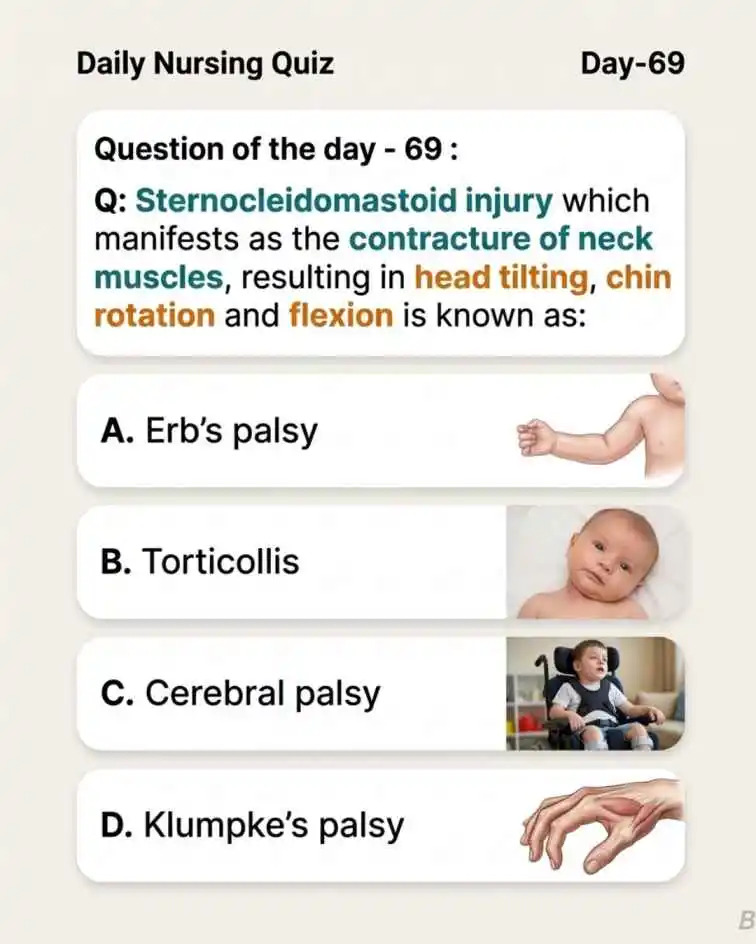
Q: Sternocleidomastoid injury which manifests as the contracture of neck muscles, resulting in head tilting, chin rotation and flexion is known as:
👆 Comment your answer and the tap an option to check your answer.
Don’t forget to Comment your answer below.
👶 Sternocleidomastoid Injury and Torticollis
Sternocleidomastoid injury which manifests as the contracture of neck muscles, resulting in head tilting, chin rotation and flexion is known as:
A. Erb’s palsy
B. Torticollis
C. Cerebral palsy
D. Klumpke’s palsy
🔍 Why is B correct?
Torticollis is a condition in which the neck becomes twisted or tilted because of abnormal contraction or shortening of the neck muscles. In infants, the sternocleidomastoid (SCM) muscle is commonly involved.
The sternocleidomastoid muscle is a large muscle on each side of the neck. It runs from the sternum and clavicle upward to the mastoid process behind the ear.
When one SCM muscle becomes shortened or contracts abnormally, it pulls the head toward that side and affects the position of the chin.
Affected SCM contracts → head tilts toward the affected side → chin rotates toward the opposite side.
🧒 Congenital Muscular Torticollis
In infants, this condition is often called congenital muscular torticollis. It may be associated with injury or abnormal positioning of the SCM around birth. The infant may have difficulty turning the head normally.
A firm swelling or mass may sometimes be felt within the SCM during early infancy. Over time, persistent muscle shortening can lead to an abnormal head position and limited neck movement.
Early recognition is important because treatment such as gentle stretching, positioning, and physical therapy can help improve range of motion and prevent persistent deformity.
🧠 Understanding the other options
Erb’s palsy is an upper brachial plexus injury, typically involving the C5–C6 nerve roots. It mainly affects the upper limb and may produce the classic “waiter’s tip” posture. It is not the name for SCM contracture causing head tilting.
Torticollis literally describes an abnormal twisted or tilted position of the neck. When caused by SCM shortening or contracture in an infant, it is commonly called muscular torticollis.
Cerebral palsy is a group of permanent disorders affecting movement and posture due to abnormal development or injury of the developing brain. It can cause abnormal muscle tone and posture, but it is not the specific term for isolated SCM contracture.
Klumpke’s palsy is a lower brachial plexus injury, typically involving C8–T1. It primarily affects the intrinsic muscles of the hand and can cause a claw-hand deformity. It does not describe SCM contracture.
📊 Quick Comparison
| Condition | Main Problem |
|---|---|
| Torticollis | Neck muscle contracture → head tilt/rotation |
| Erb’s palsy | Upper brachial plexus injury → C5–C6 weakness |
| Klumpke’s palsy | Lower brachial plexus injury → C8–T1 hand weakness |
| Cerebral palsy | Developing-brain injury/disorder → movement and posture problems |
👩⚕️ Nursing Points
- Observe the infant’s head and neck position.
- Assess the range of neck movement.
- Check for asymmetry or a palpable SCM mass when appropriate.
- Monitor developmental progress.
- Encourage prescribed positioning and stretching exercises.
- Refer for physical therapy when ordered or indicated.
- Teach parents to perform exercises gently and exactly as instructed.
“Torti = Twisted neck.”
Torticollis → twisted/tilted neck → think SCM contracture.
If the question mentions SCM contracture + head tilt + chin rotation, the answer is torticollis. Do not confuse it with Erb’s or Klumpke’s palsy, which are brachial plexus injuries affecting the upper limb.
Concept clarity • Easy recall • Nursing success
Don’t forget to comment the answer below.