
🩺 Nursing Question of the Day
Challenge yourself with one exam-style nursing question every day.
✅ Think carefully • ✅ Choose your answer • ✅ Then scroll down to check the explanation.
📝 Today’s Question:
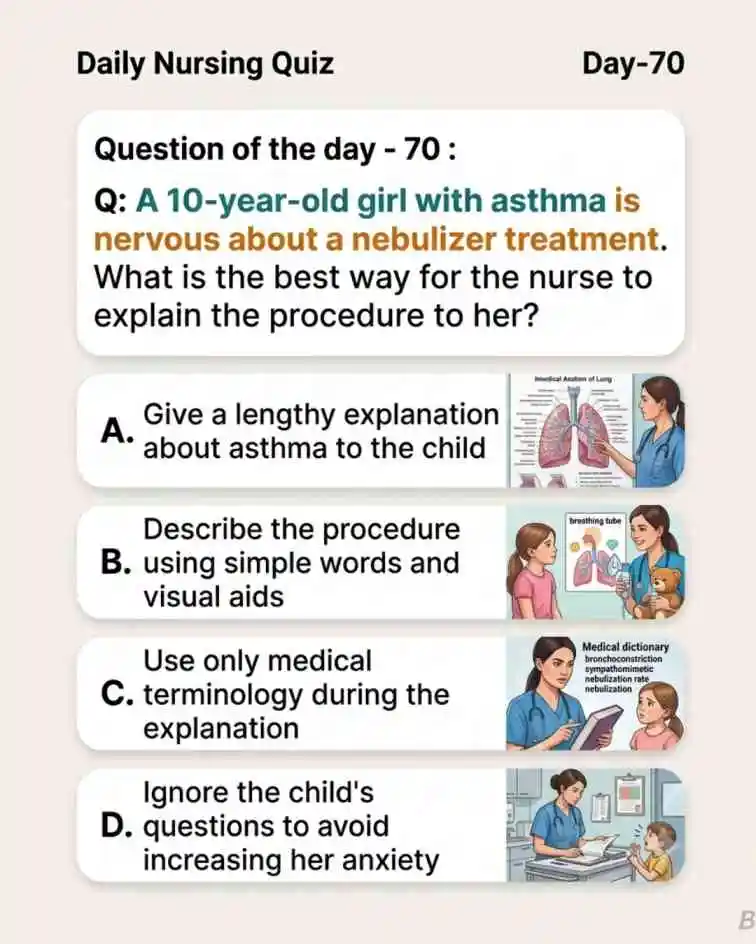
Q: A 10-year-old girl with asthma is nervous about a nebulizer treatment. What is the best way for the nurse to explain the procedure to her?
👆 Comment your answer and the tap an option to check your answer.
Don’t forget to Comment your answer below.
🫁 Explaining a Nebulizer Treatment to a Child
A 10-year-old girl with asthma is nervous about a nebulizer treatment. What is the best way for the nurse to explain the procedure to her?
A. Give a lengthy explanation about asthma to the child
B. Describe the procedure using simple words and visual aids
C. Use only medical terminology during the explanation
D. Ignore the child’s questions to avoid increasing her anxiety
🔍 Why is B correct?
A 10-year-old child can understand much more than a very young child, but the nurse should still explain a procedure in a way that is simple, clear, age-appropriate, and reassuring.
A nebulizer may look or sound unfamiliar to a child. The child may worry that the mask will hurt, that the machine will make breathing worse, or that something frightening is going to happen. A calm explanation can reduce fear and improve cooperation.
The nurse can show the child the nebulizer and mask, explain what will happen step by step, and allow her to ask questions. Visual aids or demonstration make the procedure easier to understand because the child can see what will happen instead of imagining something worse.
“This little machine makes your medicine into a mist. You will breathe the mist through the mask. Just sit comfortably and breathe normally while the medicine goes into your lungs.”
👧 Why should the explanation be age-appropriate?
Children understand information according to their developmental level. Using complicated medical language can make a child more confused or frightened.
For a 10-year-old, the nurse can give a little more detail than would be given to a preschool child, but the explanation should still avoid unnecessary technical terms.
The nurse can also use show-and-tell:
- Show the nebulizer machine.
- Show the mask or mouthpiece.
- Explain what the mist will feel like.
- Demonstrate how to sit and breathe.
- Invite the child to ask questions.
- Check understanding before starting.
🫁 What happens during nebulizer treatment?
A nebulizer converts liquid medication into a fine mist that can be inhaled into the respiratory tract. The child breathes the medication through a mask or mouthpiece.
Liquid medication
↓
Nebulizer creates a fine mist
↓
Child inhales the mist
↓
Medication reaches the airways
Depending on the medication prescribed, the treatment may help relax narrowed airways and improve breathing. The nurse should administer the medication exactly as prescribed and monitor the child’s response.
🧠 Understanding the other options
A long explanation is not necessary before a simple procedure. Too much information at once may overwhelm an anxious child. The nurse should focus on what the child needs to know about the procedure and answer questions as they arise.
This is the best approach. It matches the child’s developmental level, makes the unfamiliar equipment less frightening, encourages cooperation, and gives the child an opportunity to understand and ask questions.
Medical terminology can be confusing and may increase anxiety. The nurse should use language the child can understand and explain unfamiliar terms when they are necessary.
Ignoring questions can increase fear rather than reduce it. The nurse should listen to the child’s concerns and answer honestly in a calm, reassuring manner.
👩⚕️ How the Nurse Can Reduce Anxiety
- Speak calmly and at the child’s level.
- Use short, understandable explanations.
- Show the equipment before using it.
- Allow the child to ask questions.
- Give the child appropriate choices when possible, such as sitting in a preferred chair.
- Use distraction or relaxation techniques if helpful.
- Praise cooperation without making unrealistic promises.
- Use teach-back or ask the child to explain what will happen.
“Child + Procedure = Simple + Show + Explain.”
Use simple language, demonstrate the procedure, and allow the child to ask questions.
When a question asks how to explain a procedure to a child, choose the response that is age-appropriate, simple, honest, reassuring, and supported by demonstration or visual aids. Avoid complicated terminology, excessive information, or ignoring the child’s concerns.
Concept clarity • Easy recall • Nursing success
Don’t forget to comment the answer below.