
🩺 Nursing Question of the Day
Challenge yourself with one exam-style nursing question every day.
✅ Think carefully • ✅ Choose your answer • ✅ Then scroll down to check the explanation.
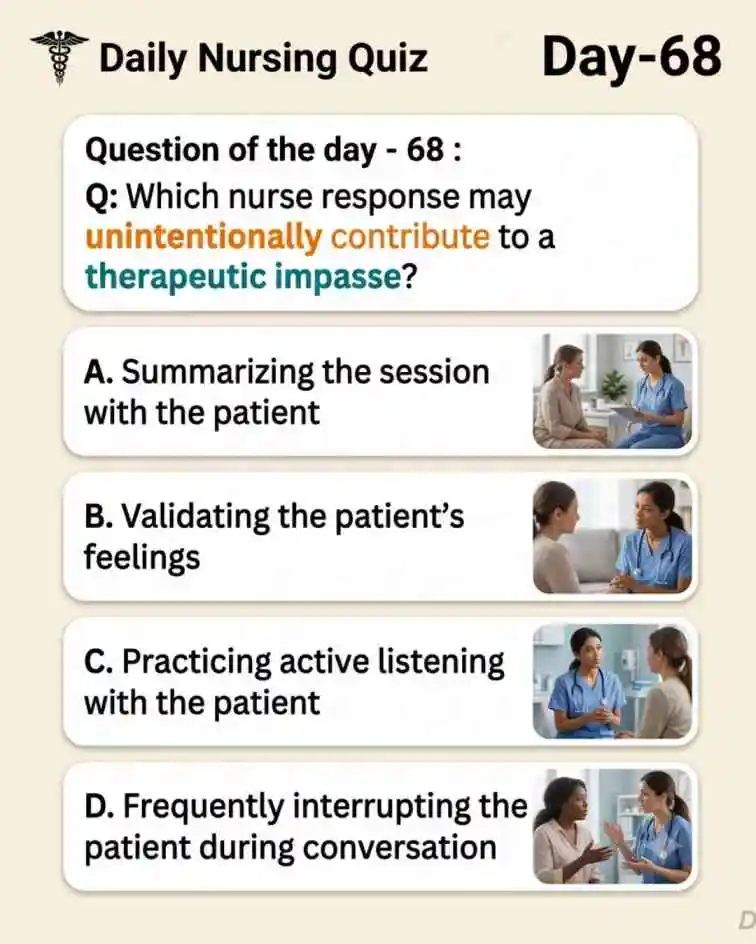
📝 Today’s Question:
Q: Which nurse response may unintentionally contribute to a therapeutic impasse?
👆 Comment your answer and the tap an option to check your answer.
Don’t forget to Comment your answer below.
🧠 Therapeutic Communication and Impasse
Which nurse response may unintentionally contribute to a therapeutic impasse?
A. Summarizing the session with the patient
B. Validating the patient’s feelings
C. Practicing active listening with the patient
D. Frequently interrupting the patient during conversation
🔍 Why is D correct?
A therapeutic impasse occurs when the nurse-patient relationship becomes stuck and meaningful communication or progress is difficult. The patient may stop sharing information, become frustrated, withdraw, or feel that the nurse does not understand or respect them.
Frequently interrupting the patient can unintentionally create this problem. When the nurse repeatedly cuts the patient off, the patient may feel unheard or rushed. Important feelings and information may also be missed.
Therapeutic communication requires the nurse to give the patient enough time to express thoughts and feelings. The nurse should listen carefully, allow appropriate pauses, and respond after understanding what the patient is trying to communicate.
Patient talks → Nurse listens → Patient feels heard → Trust develops.
But frequent interruption → Patient feels unheard → Communication may break down.
💬 What is a therapeutic impasse?
An impasse means that the therapeutic relationship has reached a point where communication or progress is no longer moving forward effectively.
It can happen for different reasons, including poor communication, lack of trust, resistance, unrealistic expectations, or behaviors from either the nurse or patient that interfere with the relationship.
The nurse should recognize these barriers rather than simply continuing the same communication pattern. Maintaining a calm, respectful, nonjudgmental approach can help the relationship move forward.
🧠 Understanding the other options
Summarizing is a therapeutic communication technique. It brings together the important points discussed and helps both the nurse and patient confirm that they understood the conversation correctly. It generally supports communication rather than creating an impasse.
Validation means acknowledging that the patient’s feelings or experience are real and important. It does not necessarily mean agreeing with everything the patient says. Validation can increase trust and help the patient feel understood.
Active listening is an important therapeutic skill. It involves paying attention, using appropriate verbal and nonverbal responses, clarifying information, and showing genuine interest in what the patient is saying.
Frequent interruption is nontherapeutic because it can make the patient feel ignored, rushed, or misunderstood. It can also prevent the patient from expressing important concerns and may contribute to a communication barrier or therapeutic impasse.
👩⚕️ Therapeutic vs. Nontherapeutic Communication
| Therapeutic | Nontherapeutic |
|---|---|
| Active listening | Frequent interruption |
| Validation | Judging the patient |
| Clarification | Giving unnecessary advice |
| Summarizing | Changing the subject |
| Using appropriate silence | Repeatedly cutting the patient off |
📌 A Better Nursing Response
Instead of interrupting, the nurse should allow the patient to finish speaking and then respond appropriately. If clarification is needed, the nurse can gently ask a question such as:
This approach gives the patient space to communicate while maintaining a supportive therapeutic relationship.
“Interrupt = Interaction stops.”
Frequent interruption can make the patient feel unheard and may create a barrier to therapeutic communication.
In therapeutic communication questions, be careful with behaviors that stop or block the patient’s expression. Frequent interruption, changing the subject, judging, giving false reassurance, and excessive advice can interfere with effective nurse-patient communication.
Concept clarity • Easy recall • Nursing success
Don’t forget to comment the answer below.