
🩺 Nursing Question of the Day
Challenge yourself with one exam-style nursing question every day.
✅ Think carefully • ✅ Choose your answer • ✅ Then scroll down to check the explanation.
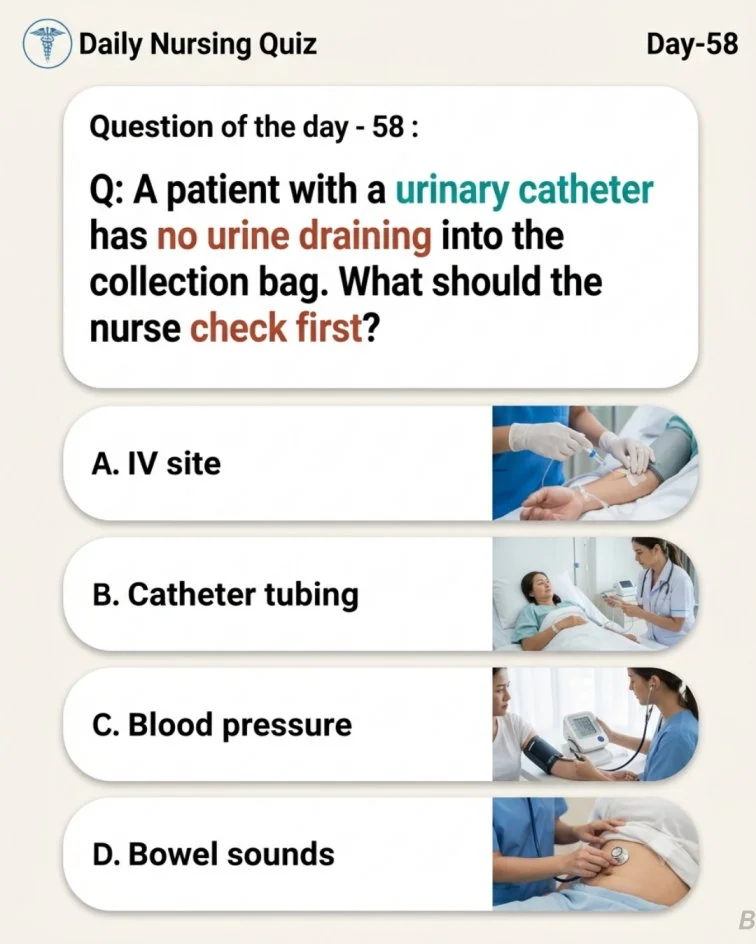
📝 Today’s Question:
A patient with a urinary catheter has no urine draining into the collection bag. What should the nurse check first?
👆 Comment your answer and the tap an option to check your answer.
Don’t forget to Comment your answer below.
🩺 Urinary Catheter: No Urine Drainage
A patient with a urinary catheter has no urine draining into the collection bag. What should the nurse check first?
🔎 Why should the nurse check the catheter tubing first?
When a patient with an indwelling urinary catheter suddenly has no urine entering the collection bag, the nurse should first check for a simple mechanical obstruction.
The catheter tubing can become kinked, compressed, twisted, or positioned incorrectly. Any of these problems can prevent urine from flowing from the bladder into the drainage bag.
No urine in bag → check drainage system → look for kink/obstruction → correct the problem → reassess urine flow
🧪 What should the nurse inspect?
The nurse should trace the tubing from the patient toward the collection bag and check whether it is:
- ❌ Kinked or sharply bent
- ❌ Compressed underneath the patient
- ❌ Twisted
- ❌ Obstructed by dependent loops
- ❌ Disconnected from the drainage system
- ❌ Positioned in a way that prevents gravity-dependent drainage
The collection bag should remain below the level of the bladder so urine can drain by gravity. The tubing should also have a clear, unobstructed path.
🚨 What if the tubing is not blocked?
If the tubing and drainage system are patent but urine output remains absent or markedly reduced, the nurse should assess the patient further. Possible causes include urinary retention, catheter obstruction, dehydration, or reduced kidney perfusion/urine production.
The patient’s overall condition, bladder distention, intake/output, vital signs, and other relevant findings should be assessed. Further intervention should follow the clinical situation and facility protocol.
❌ Why are the other options incorrect?
A. IV site — Incorrect.
The IV site is important for assessing complications such as infiltration or phlebitis, but it does not
directly explain why urine is not draining through the urinary catheter.
C. Blood pressure — Incorrect.
Blood pressure can provide information about the patient’s hemodynamic status and renal perfusion,
but it is not the first thing to check when a catheter drainage system suddenly stops producing urine.
A mechanical obstruction should be ruled out first.
D. Bowel sounds — Incorrect.
Bowel sounds are relevant when assessing gastrointestinal function, but they do not directly evaluate
urinary catheter patency.
📋 Quick Comparison
| Finding | What to think about |
|---|---|
| No urine in bag | Check catheter tubing/system first |
| Kinked tubing | Mechanical obstruction |
| Bag above bladder | Poor gravity drainage; also increases reflux risk |
| Patent system + persistent oliguria/anuria | Assess patient for retention, dehydration, renal causes, etc. |
Do not immediately assume that the kidneys have stopped producing urine. First determine whether urine is being produced but simply cannot drain through the catheter system.
“No urine in the bag? Check the tube before the body.”
First check for a kink, compression, disconnection, or obstruction in the catheter drainage system.
For a catheterized patient with suddenly absent urine drainage, think: “Check the tubing first.”
Always remember the basic principle: patent tubing + bag below bladder + unobstructed drainage.
Concept clarity • Easy recall • Nursing success
Don’t forget to comment the answer below.