
🩺 Nursing Question of the Day
Challenge yourself with one exam-style nursing question every day.
✅ Think carefully • ✅ Choose your answer • ✅ Then scroll down to check the explanation.
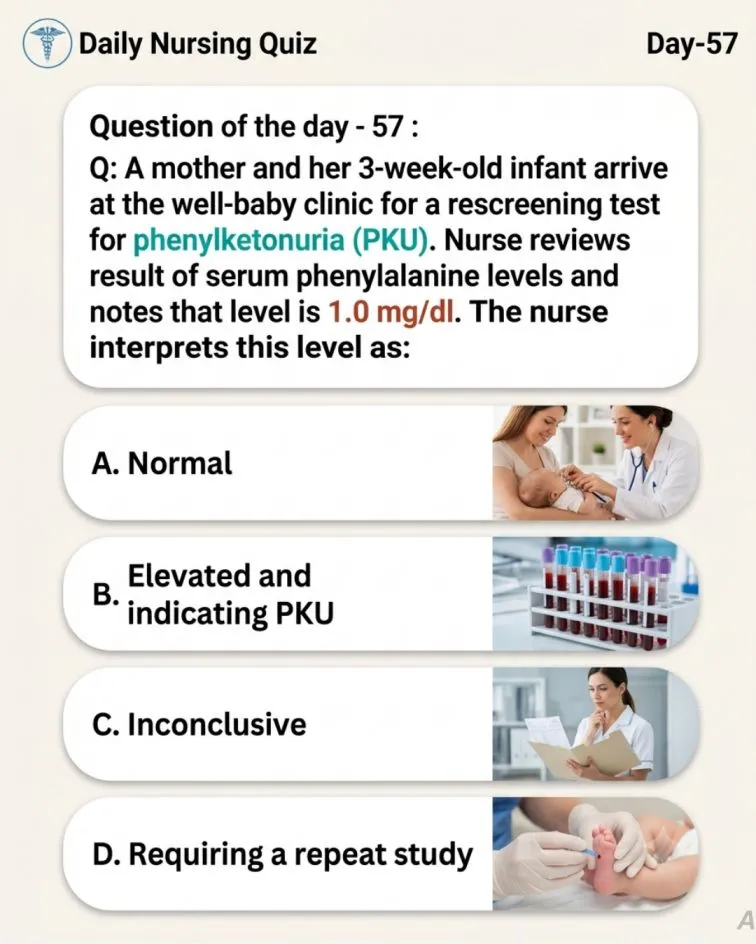
📝 Today’s Question:
A mother and her 3-week-old infant arrive at the well-baby clinic for a rescreening test for phenylketonuria (PKU). Nurse reviews result of serum phenylalanine levels and notes that level is 1.0 mg/dl. The nurse interprets this level as:
👆 Comment your answer and the tap an option to check your answer.
Don’t forget to Comment your answer below.
👶 Phenylketonuria (PKU) Screening in a Newborn
A mother and her 3-week-old infant arrive at the well-baby clinic for a rescreening test for phenylketonuria (PKU). The nurse reviews the serum phenylalanine level and notes that the level is 1.0 mg/dL. The nurse interprets this level as:
🔎 Why is 1.0 mg/dL considered normal?
Phenylketonuria (PKU) is an inherited metabolic disorder in which the body cannot properly metabolize the amino acid phenylalanine, most commonly because of deficient phenylalanine hydroxylase.
When this enzyme is deficient, phenylalanine accumulates in the blood. Therefore, the serum phenylalanine level is used when evaluating an infant for PKU.
A phenylalanine level of 1.0 mg/dL is within the normal range and does not indicate PKU. An elevated level would require appropriate follow-up and confirmatory evaluation.
Normal phenylalanine level → phenylalanine is not significantly accumulating → PKU is not indicated by this result.
🧬 What happens in PKU?
Normally, phenylalanine is converted into tyrosine by the enzyme phenylalanine hydroxylase.
In PKU, this metabolic pathway is impaired:
Early identification is important because untreated PKU can cause significant intellectual and neurological impairment. With early diagnosis and appropriate dietary management, these complications can largely be prevented.
🩸 Why is newborn screening important?
Newborn screening is performed early in life because an infant with PKU may appear completely healthy initially. The goal is to identify the metabolic disorder before neurological damage develops.
Screening is generally performed after the newborn has received enough protein through feeding for the test to be informative. If a screening result is abnormal, additional testing is required to confirm the diagnosis.
❌ Why are the other options incorrect?
B. Elevated and indicating PKU — Incorrect.
A level of 1.0 mg/dL is not an elevated phenylalanine level indicating PKU.
PKU is associated with increased phenylalanine concentration in the blood.
C. Inconclusive — Incorrect.
The value provided is a measurable result that falls within the normal range. There is no reason
from this value alone to classify it as inconclusive.
D. Requiring a repeat study — Incorrect.
A normal phenylalanine level does not by itself require a repeat PKU study. Repeat or confirmatory
testing is generally considered when the initial screening is abnormal, inadequate, or obtained under
circumstances that make interpretation unreliable.
📋 Quick Comparison
| Finding | Interpretation |
|---|---|
| Phenylalanine 1.0 mg/dL | Normal |
| Markedly elevated phenylalanine | Suggests PKU/needs diagnostic follow-up |
| Abnormal screening result | Requires appropriate follow-up/confirmatory testing |
“PKU = Phenylalanine Keeps Up.”
In PKU, phenylalanine keeps accumulating because its normal metabolism is impaired. Therefore, high phenylalanine = think PKU.
When a neonatal PKU question gives a phenylalanine value, first ask: “Is the phenylalanine elevated?”
Here, 1.0 mg/dL is normal → Answer A.
Concept clarity • Easy recall • Nursing success
Don’t forget to comment the answer below.
Answer A
very Nice that is correct. Keep learning with us.