
🩺 Nursing Question of the Day
Challenge yourself with one exam-style nursing question every day.
✅ Think carefully • ✅ Choose your answer • ✅ Then scroll down to check the explanation.
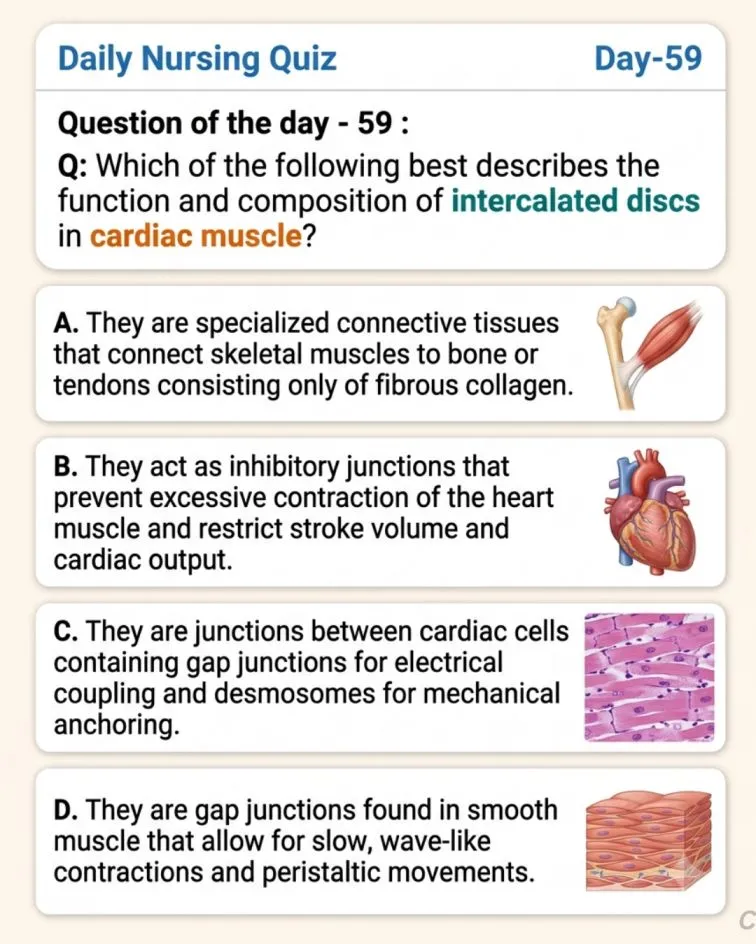
📝 Today’s Question:
Which of the following best describes the function and composition of intercalated discs in cardiac muscle?
👆 Comment your answer and the tap an option to check your answer.
Don’t forget to Comment your answer below.
❤️ Intercalated Discs in Cardiac Muscle
Which of the following best describes the function and composition of intercalated discs in cardiac muscle?
A. They are specialized connective tissues that connect skeletal muscles to bone or tendons consisting only of fibrous collagen.
B. They act as inhibitory junctions that prevent excessive contraction of the heart muscle and restrict stroke volume and cardiac output.
C. They are junctions between cardiac cells containing gap junctions for electrical coupling and desmosomes for mechanical anchoring.
D. They are gap junctions found in smooth muscle that allow for slow, wave-like contractions and peristaltic movements.
🔬 What are intercalated discs?
Intercalated discs are specialized junctional structures that connect neighboring cardiac muscle cells (cardiomyocytes).
The heart must contract repeatedly and continuously. Therefore, cardiac cells need to be connected in two important ways:
- They must be mechanically attached so the cells do not pull apart during contraction.
- They must be electrically connected so an impulse can spread rapidly from one cardiac cell to the next.
Intercalated discs provide both functions.
⚡ What do they contain?
| Structure | Main function |
|---|---|
| Gap junctions | Allow ions and electrical signals to pass between cardiac cells. |
| Desmosomes | Provide strong mechanical attachment between neighboring cells. |
| Adherens junctions | Help anchor actin filaments and transmit contractile force between cells. |
So, when one cardiac cell is electrically activated, the impulse can spread through gap junctions to neighboring cells. At the same time, strong mechanical junctions keep the cells attached while they contract.
One cardiac cell depolarizes → ions pass through gap junctions → neighboring cells depolarize → coordinated contraction.
Mechanical coupling:
Cardiac cells contract → desmosomes/adherens junctions hold cells together → force is transmitted across the tissue.
🫀 Why are intercalated discs important?
Cardiac muscle works as a coordinated unit. The heart cannot effectively pump blood if individual cardiac cells contract independently and become mechanically separated.
Intercalated discs help cardiac muscle behave as a functional unit by providing rapid electrical communication and strong mechanical attachment.
This contributes to synchronized contraction of the myocardium and efficient pumping of blood.
❌ Why are the other options wrong?
This describes a tendon, not an intercalated disc. Tendons are composed largely of dense regular connective tissue rich in collagen and connect muscle to bone. Intercalated discs occur between cardiac muscle cells.
Intercalated discs do not function to inhibit cardiac contraction or deliberately restrict stroke volume. Their major role is to provide electrical and mechanical coupling.
Correct. Gap junctions provide electrical coupling, while desmosomes provide mechanical attachment. This combination is essential for coordinated cardiac contraction.
Gap junctions can indeed be present in smooth muscle, especially single-unit smooth muscle, where they help spread electrical activity. However, an intercalated disc is a specialized structure of cardiac muscle, not smooth muscle.
📚 Quick Comparison
| Structure | Where? | Main role |
|---|---|---|
| Intercalated disc | Cardiac muscle | Electrical + mechanical coupling |
| Gap junction | Various tissues | Cell-to-cell electrical/ionic communication |
| Desmosome | Many tissues | Strong mechanical attachment |
| Tendon | Skeletal muscle | Connects muscle to bone |
“Intercalated = Interconnected.”
Think: Gap = electrical connection + Desmosome = strong physical connection.
If an MCQ asks about intercalated discs, immediately remember: cardiac muscle + gap junctions + desmosomes + synchronized contraction.
Gap junction → electrical coupling
Desmosome → mechanical anchoring
Concept clarity • Easy recall • Nursing success
Don’t forget to comment the answer below.