
🩺 Nursing Question of the Day
Challenge yourself with one exam-style nursing question every day.
✅ Think carefully • ✅ Choose your answer • ✅ Then scroll down to check the explanation.
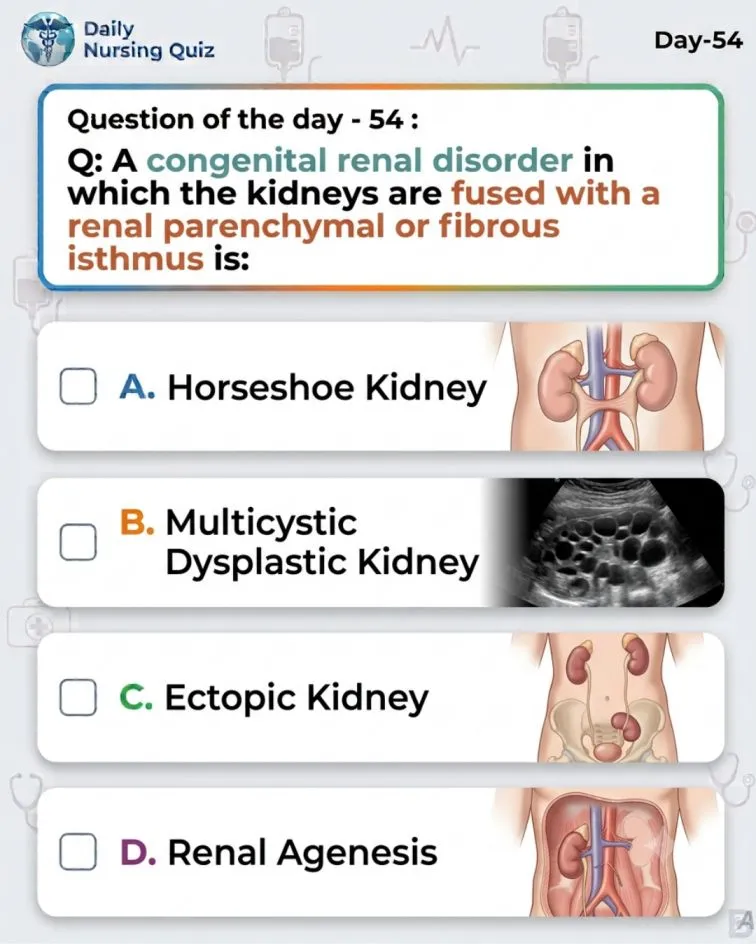
📝 Today’s Question:
A congenital renal disorder in which the kidneys are fused with a renal parenchymal or fibrous isthmus is:
👆 Comment your answer and the tap an option to check your answer.
Don’t forget to Comment your answer below.
🩺 Congenital Renal Anomaly: Horseshoe Kidney
A congenital renal disorder in which the kidneys are fused with a renal parenchymal or fibrous isthmus is:
🔎 Why is Horseshoe Kidney correct?
A horseshoe kidney is a congenital renal fusion anomaly in which the two kidneys become connected by an isthmus. The isthmus may consist of functioning renal parenchyma or, in some cases, fibrous tissue.
Instead of remaining as two completely separate kidneys, the lower portions are commonly joined together, producing a shape that resembles a horseshoe.
Two kidneys → fusion → connecting isthmus → horseshoe-shaped renal mass
🧬 Why does it happen?
During embryonic development, the kidneys normally move upward from the pelvis toward their final position in the abdomen. In a horseshoe kidney, the developing kidneys become fused, usually at their lower poles, and their normal upward movement is limited.
Therefore, the fused kidney is often found in a lower-than-normal position. The isthmus may lie anterior to major abdominal vessels.
🩺 Clinical significance
Many people with a horseshoe kidney may have no symptoms and the condition may be discovered incidentally. However, abnormal anatomy can predispose the patient to complications such as urinary obstruction, hydronephrosis, urinary tract infection, and renal stones.
The altered position and drainage of the kidneys can interfere with normal urine flow, which helps explain why urinary complications may occur.
❌ Why are the other options incorrect?
B. Multicystic Dysplastic Kidney — Incorrect.
This is a developmental abnormality in which the kidney is replaced by
multiple cysts and abnormal, nonfunctional renal tissue. The defining feature
is cystic dysplasia, not fusion of the two kidneys by an isthmus.
C. Ectopic Kidney — Incorrect.
An ectopic kidney is a kidney located in an abnormal position, often remaining
in the pelvis because it did not ascend normally during development. The key feature is
abnormal location, not fusion.
D. Renal Agenesis — Incorrect.
Renal agenesis means that a kidney fails to develop. There is no normally
formed kidney on the affected side, so there is no renal isthmus connecting two kidneys.
📋 Quick Comparison
| Disorder | Key Feature |
|---|---|
| Horseshoe kidney | Two kidneys fused by an isthmus |
| Multicystic dysplastic kidney | Multiple cysts + abnormal renal development |
| Ectopic kidney | Kidney in an abnormal location |
| Renal agenesis | Kidney fails to develop |
“Horseshoe = joined kidneys.”
If the question says two kidneys + fusion + isthmus, think Horseshoe Kidney.
The word “isthmus” is the major clue. In renal anatomy questions, renal isthmus connecting the two kidneys = Horseshoe kidney. Also remember that the isthmus is commonly formed between the lower poles.
Concept clarity • Easy recall • Nursing success
Don’t forget to comment the answer below.