
🩺 Nursing Question of the Day
Challenge yourself with one exam-style nursing question every day.
✅ Think carefully • ✅ Choose your answer • ✅ Then scroll down to check the explanation.
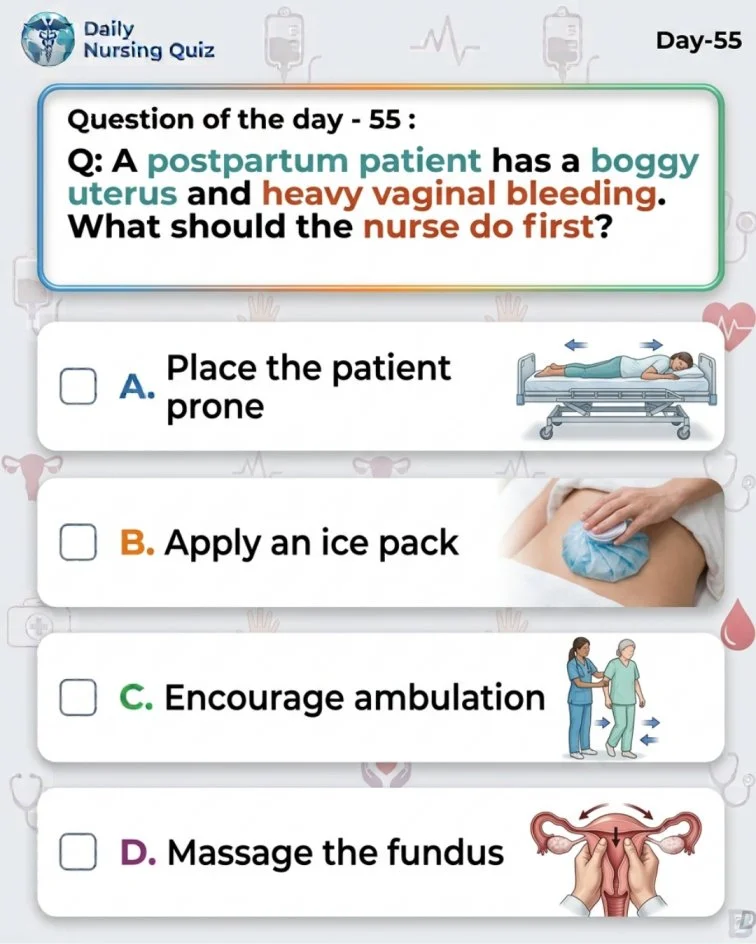
📝 Today’s Question:
A postpartum patient has a boggy uterus and heavy vaginal bleeding. What should the nurse do first?
👆 Comment your answer and the tap an option to check your answer.
Don’t forget to Comment your answer below.
🤰 Postpartum Hemorrhage: Boggy Uterus
A postpartum patient has a boggy uterus and heavy vaginal bleeding. What should the nurse do first?
🔎 Why is Fundal Massage the correct answer?
A boggy uterus means the uterus feels soft, relaxed, and poorly contracted. After delivery, the uterus should contract firmly to compress the blood vessels at the placental site.
If the uterus remains relaxed, these blood vessels can continue to bleed. This is a common mechanism of postpartum hemorrhage (PPH) due to uterine atony.
Uterine atony → soft/boggy fundus → placental-site vessels remain insufficiently compressed → heavy bleeding → postpartum hemorrhage
Therefore, the nurse should massage the uterine fundus to stimulate contraction. A firm, contracted uterus helps compress the bleeding vessels and reduce blood loss.
🩸 Why is this an emergency?
Heavy postpartum bleeding can rapidly lead to hypovolemia and shock. A boggy uterus provides an important clue that uterine atony may be responsible.
After initiating the immediate intervention, the nurse should continue assessing the patient’s bleeding, vital signs, uterine tone, and overall condition and follow the facility’s postpartum hemorrhage protocol. Additional measures may include uterotonic medications and escalation of care as ordered.
❌ Why are the other options incorrect?
A. Place the patient prone — Incorrect.
Prone positioning does not correct uterine atony or promote effective uterine contraction.
It also does not address the source of the heavy bleeding.
B. Apply an ice pack — Incorrect.
An ice pack may be useful for certain forms of postpartum perineal discomfort or swelling,
but it does not treat a boggy uterus caused by uterine atony.
C. Encourage ambulation — Incorrect.
A patient with heavy postpartum bleeding should not be encouraged to ambulate as the first
intervention. Significant blood loss can cause weakness, dizziness, and hemodynamic instability.
Immediate management of the bleeding takes priority.
🧠 Understand the word “Boggy”
Think of boggy = soft. A normal postpartum fundus should become firm and contracted.
| Fundus | What it suggests |
|---|---|
| Firm | Effective uterine contraction |
| Boggy/soft | ⚠️ Uterine atony; increased bleeding risk |
A boggy uterus accompanied by heavy bleeding should be treated as a potentially serious postpartum hemorrhage situation. Do not delay assessment and escalation while waiting for spontaneous improvement.
“Boggy → Massage → Firm.”
If the postpartum fundus is soft and bleeding is heavy, think uterine atony and massage the fundus.
In postpartum questions, the combination of heavy bleeding + boggy uterus strongly points toward uterine atony. The immediate nursing action is fundal massage while continuing urgent assessment and management.
Concept clarity • Easy recall • Nursing success
Don’t forget to comment the answer below.
Ans is D
Great That is correct. Thanks for your answer.