
🩺 Nursing Question of the Day
Challenge yourself with one exam-style nursing question every day.
✅ Think carefully • ✅ Choose your answer • ✅ Then scroll down to check the explanation.
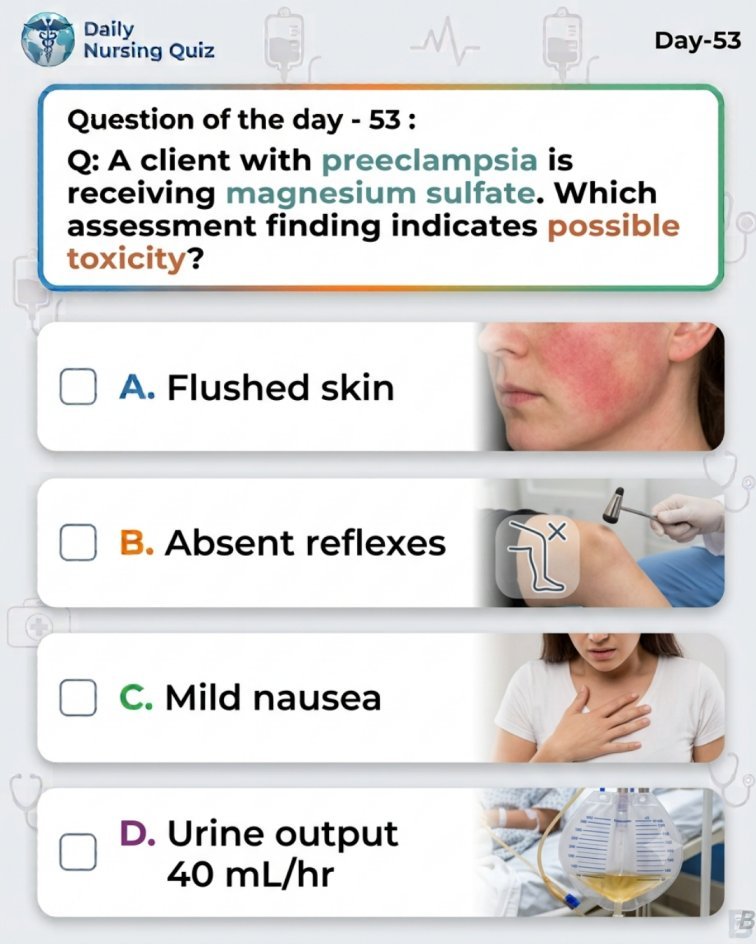
📝 Today’s Question:
A client with preeclampsia is receiving magnesium sulfate. Which assessment finding indicates possible toxicity?
👆 Comment your answer and the tap an option to check your answer.
Don’t forget to Comment your answer below.
🤰 Magnesium Sulfate Toxicity in Preeclampsia
A client with preeclampsia is receiving magnesium sulfate. Which assessment finding indicates possible toxicity?
🔎 Why is Absent Reflexes the correct answer?
Magnesium sulfate is commonly given to clients with severe preeclampsia to prevent seizures. Magnesium depresses neuromuscular transmission. If the serum magnesium level becomes excessively high, this effect becomes too strong.
One of the earliest and most important bedside signs of magnesium toxicity is loss or marked reduction of deep tendon reflexes, especially the patellar reflex.
↑ Magnesium level → neuromuscular depression → ↓ deep tendon reflexes → respiratory depression → cardiac arrest
💊 What else should the nurse monitor?
Because magnesium is primarily eliminated by the kidneys, renal function and urine output are very important. Decreased urine output can cause magnesium to accumulate and increase the risk of toxicity.
| Assessment | Why it matters |
|---|---|
| Deep tendon reflexes | Loss of reflexes → possible toxicity |
| Respiratory rate | Respiratory depression is a serious toxicity sign |
| Urine output | Poor renal excretion can cause magnesium accumulation |
| Level of consciousness | Increasing CNS depression may occur with toxicity |
❌ Why are the other options incorrect?
A. Flushed skin — Incorrect.
Flushing, warmth, and a feeling of heat are relatively common effects of magnesium sulfate,
particularly during administration. They do not by themselves indicate magnesium toxicity.
C. Mild nausea — Incorrect.
Mild nausea can occur as an adverse effect but is not the classic clinical indicator of
magnesium toxicity. The nurse should pay much more attention to reflexes, respiratory status,
and urine output.
D. Urine output 40 mL/hr — Incorrect.
A urine output of 40 mL/hr is generally adequate for an adult and does not indicate
oliguria. A commonly used minimum target is about 30 mL/hr. Decreased urine output
would increase concern because magnesium could accumulate.
🚨 What happens in severe magnesium toxicity?
Magnesium toxicity can progress from neuromuscular depression to potentially life-threatening respiratory and cardiovascular effects.
Loss of deep tendon reflexes → respiratory depression → hypotension/bradycardia → cardiac arrest
If significant toxicity is suspected, the nurse should stop the magnesium infusion and immediately notify the appropriate provider while assessing airway, breathing, circulation, and obtaining urgent assistance according to the clinical setting/protocol.
Calcium gluconate is the commonly available antidote used to counteract the serious effects of magnesium toxicity.
“Magnesium makes muscles relax.”
Too much magnesium → too much relaxation → reflexes disappear → breathing can become depressed.
For a patient receiving magnesium sulfate, remember the three major bedside checks: Reflexes + Respirations + Renal function.
Absent DTRs = classic warning sign of magnesium toxicity.
Concept clarity • Easy recall • Nursing success
Don’t forget to comment the answer below.