
🩺 Nursing Question of the Day
Challenge yourself with one exam-style nursing question every day.
✅ Think carefully • ✅ Choose your answer • ✅ Then scroll down to check the explanation.
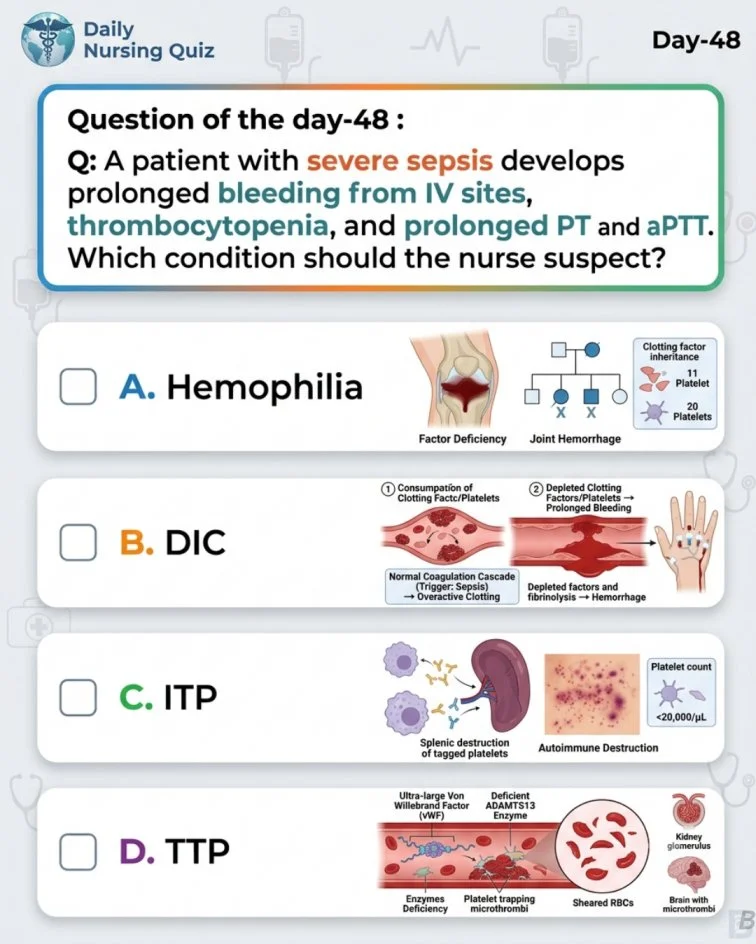
📝 Today’s Question:
A patient with severe sepsis develops prolonged bleeding from IV sites, thrombocytopenia, and prolonged PT and aPTT. Which condition should the nurse suspect?
👆 Comment your answer and the tap an option to check your answer.
Don’t forget to Comment your answer below.
🩸 Disseminated Intravascular Coagulation (DIC)
A patient with severe sepsis develops prolonged bleeding from IV sites, thrombocytopenia, and prolonged PT and aPTT. Which condition should the nurse suspect?
B. DIC
C. ITP
D. TTP
📖 What is DIC?
Disseminated Intravascular Coagulation (DIC) is a serious acquired disorder in which the body’s clotting system becomes activated throughout the circulation.
In simple terms, the patient starts forming many tiny blood clots inside small blood vessels. This consumes platelets and clotting factors. Eventually, the body does not have enough clotting components left to control bleeding.
🔬 The DIC process
Widespread coagulation activation ↓
Microvascular clots form ↓
Platelets + clotting factors are consumed ↓
Thrombocytopenia + prolonged PT/aPTT ↓
Abnormal bleeding
🦠 Why can severe sepsis cause DIC?
Severe infection can trigger an intense inflammatory response. This response can activate the coagulation system and cause widespread clot formation.
As clotting continues, large amounts of platelets, fibrinogen, and other coagulation factors are consumed. This is why DIC is sometimes described as a “consumptive coagulopathy.”
The body is using up its clotting supplies everywhere to form abnormal clots. Once those supplies become depleted, the patient cannot form normal clots at places where bleeding is actually occurring.
🧪 Classic laboratory findings in DIC
| Test | Typical DIC finding | Why? |
|---|---|---|
| Platelets | ↓ | Consumed in widespread clotting |
| PT | ↑ | Clotting factors are consumed |
| aPTT | ↑ | Clotting factors are depleted |
| Fibrinogen | ↓ | Consumed during fibrin formation |
| D-dimer | ↑ | Increased fibrin clot breakdown |
🩸 Why does the patient bleed from IV sites?
Normally, when a blood vessel is injured, platelets and clotting factors work together to stop bleeding.
In DIC, these components have already been extensively consumed throughout the body. Therefore, even a small puncture, such as an IV insertion or venipuncture site, may continue to ooze blood.
Oozing from IV sites + thrombocytopenia + prolonged PT + prolonged aPTT in a patient with severe sepsis = think DIC.
⚠️ DIC can cause both clotting AND bleeding
A common exam trap is thinking that DIC causes only bleeding. It can actually produce both thrombosis and hemorrhage.
Small clots can reduce blood flow to organs and contribute to kidney injury, respiratory problems, neurologic changes, tissue ischemia, and organ dysfunction.
❌ Why are the other options incorrect?
A. Hemophilia ❌
Hemophilia is an inherited coagulation-factor deficiency, classically involving
factor VIII or IX. It typically causes
prolonged aPTT, while PT is usually normal.
The combination of severe sepsis, thrombocytopenia, prolonged PT and prolonged
aPTT strongly favors DIC.
C. ITP ❌
Immune thrombocytopenia (ITP) primarily causes isolated
thrombocytopenia because platelets are destroyed by an immune mechanism.
PT and aPTT are generally normal.
D. TTP ❌
Thrombotic thrombocytopenic purpura (TTP) causes thrombocytopenia
and microvascular thrombosis, but the coagulation studies
PT and aPTT are usually normal.
TTP is more strongly associated with findings such as
microangiopathic hemolytic anemia and neurologic or renal abnormalities.
📊 DIC vs ITP vs TTP vs Hemophilia
| Condition | Platelets | PT | aPTT | Classic clue |
|---|---|---|---|---|
| DIC | ↓ | ↑ | ↑ | Sepsis + bleeding |
| ITP | ↓ | Normal | Normal | Isolated platelet destruction |
| TTP | ↓ | Normal | Normal | Microthrombi + hemolysis |
| Hemophilia | Normal | Normal | ↑ | Factor VIII/IX deficiency |
DIC = “Everything Gets Consumed.”
D = Disseminated clotting
I = Increased clotting activation
C = Consumes platelets + clotting factors
So remember:
Platelets ↓ + PT ↑ + aPTT ↑ = DIC
If the question gives you severe sepsis + bleeding from IV sites + low platelets + prolonged PT and aPTT, the best answer is DIC.
The key distinction is: DIC affects multiple coagulation components, so both PT and aPTT become prolonged.
Concept clarity • Easy recall • Nursing success
Don’t forget to comment the answer below.