
🩺 Nursing Question of the Day
Challenge yourself with one exam-style nursing question every day.
✅ Think carefully • ✅ Choose your answer • ✅ Then scroll down to check the explanation.
📝 Today’s Question:
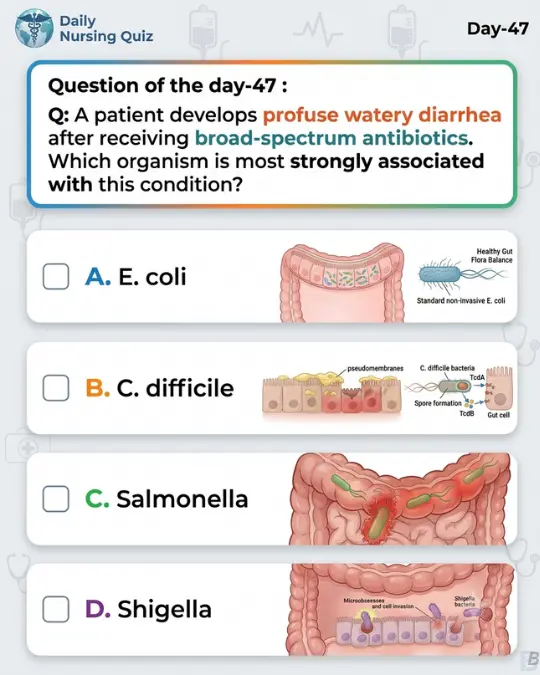
A patient develops profuse watery diarrhea after receiving broad-spectrum antibiotics. Which organism is most strongly associated with this condition?
👆 Comment your answer and the tap an option to check your answer.
Don’t forget to Comment your answer below.
🦠 Antibiotic-Associated Diarrhea
A patient develops profuse watery diarrhea after receiving broad-spectrum antibiotics. Which organism is most strongly associated with this condition?
B. C. difficile
C. Salmonella
D. Shigella
📖 What is the key concept?
Clostridioides difficile (C. difficile) is the organism most strongly associated with antibiotic-associated diarrhea, especially when the patient develops profuse watery diarrhea after broad-spectrum antibiotic therapy.
Antibiotics do not only kill harmful bacteria. They can also destroy many of the normal protective bacteria in the intestine. When this normal intestinal flora is disturbed, C. difficile can multiply excessively.
🔬 How does C. difficile cause diarrhea?
The sequence is:
Normal intestinal flora decreases ↓
C. difficile overgrowth ↓
Toxin production ↓
Colonic inflammation and mucosal injury ↓
Watery diarrhea
☣️ Important C. difficile toxins
C. difficile produces toxins that damage the intestinal mucosa. The two major toxins are:
- Toxin A: Mainly an enterotoxin that promotes intestinal fluid secretion and contributes to diarrhea.
- Toxin B: A potent cytotoxin that damages intestinal epithelial cells.
Severe inflammation can produce characteristic plaques of inflammatory material over the colon, resulting in pseudomembranous colitis.
💧 Why is the diarrhea watery?
Toxin-induced injury and inflammation interfere with normal intestinal absorption and secretion. This causes increased fluid within the intestinal lumen, producing frequent, loose or watery stools.
The diarrhea may be severe and can be accompanied by abdominal cramping, fever, leukocytosis, and dehydration.
⚠️ Important risk factors
- Recent use of broad-spectrum antibiotics
- Recent hospitalization or healthcare exposure
- Previous history of C. difficile infection
- Older age
- Prolonged antibiotic exposure
- Immunocompromised state
Antibiotics commonly associated with C. difficile infection include clindamycin, broad-spectrum penicillins, cephalosporins, and fluoroquinolones.
🩺 Clinical features to recognize
- Profuse or frequent watery diarrhea
- Abdominal cramping
- Fever
- Leukocytosis
- Dehydration
- Abdominal tenderness
- Possible pseudomembranous colitis in severe disease
❌ Why are the other options incorrect?
A. E. coli ❌
Some strains of E. coli cause infectious diarrhea, including watery or
traveler’s diarrhea, but the classic association with
diarrhea following broad-spectrum antibiotic use is
C. difficile.
C. Salmonella ❌
Salmonella commonly causes gastroenteritis associated with contaminated
food or water. It is not the classic organism responsible for antibiotic-associated
pseudomembranous colitis.
D. Shigella ❌
Shigella commonly causes inflammatory diarrhea that may include
fever, abdominal cramps, and blood or mucus in the stool.
The antibiotic-associated pattern in this question points to
C. difficile.
📊 Quick comparison
| Organism | Classic clue |
|---|---|
| C. difficile | Antibiotics → watery diarrhea |
| E. coli | Traveler’s/food-associated diarrhea |
| Salmonella | Foodborne gastroenteritis |
| Shigella | Inflammatory/bloody diarrhea |
👩⚕️ Important Nursing Point
If a patient develops significant diarrhea after antibiotic therapy, the nurse should consider C. difficile infection and follow infection-control precautions according to facility policy.
Because C. difficile forms spores, soap-and-water hand hygiene is particularly important because alcohol-based hand rubs are less effective against spores.
Patients with suspected or confirmed infection generally require contact precautions according to institutional policy.
“C. diff = C. difficile after C. (course) of antibiotics.”
Think: Antibiotics → Flora destroyed → C. difficile → Watery diarrhea.
When an exam question gives you the combination “recent broad-spectrum antibiotics + profuse watery diarrhea”, immediately think of C. difficile and antibiotic-associated pseudomembranous colitis.
Concept clarity • Easy recall • Nursing success
Don’t forget to comment the answer below.
C Difícil
Yes, C — “Difícil” — is correct. Good job! Keep practicing and keep up the good work.