
🩺 Nursing Question of the Day
Challenge yourself with one exam-style nursing question every day.
✅ Think carefully • ✅ Choose your answer • ✅ Then scroll down to check the explanation.
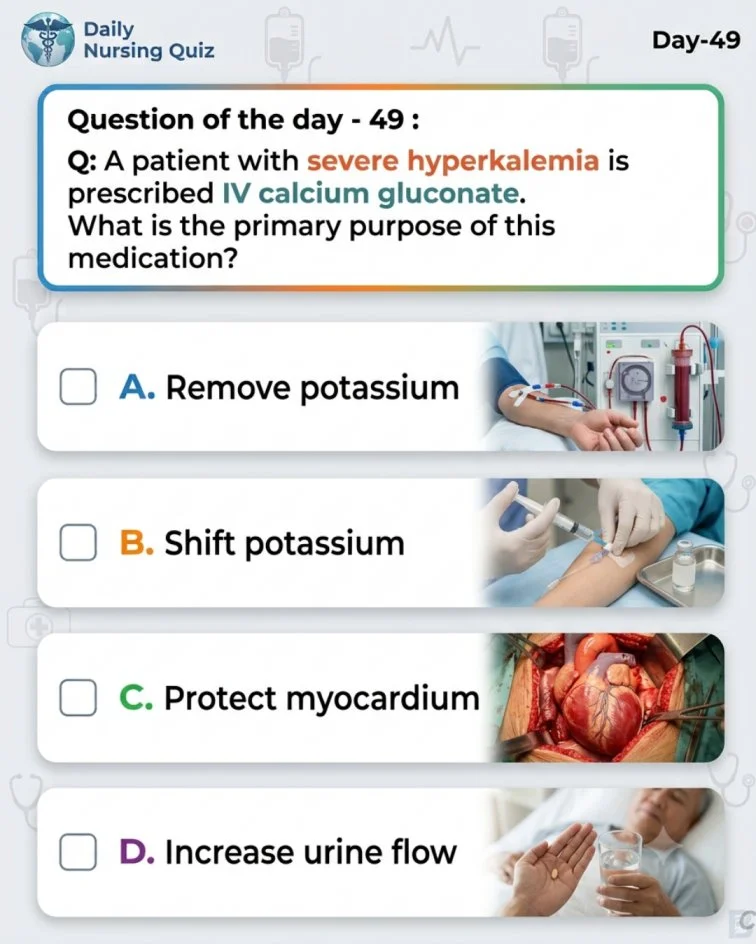
📝 Today’s Question:
A patient with severe hyperkalemia is prescribed IV calcium gluconate. What is the primary purpose of this medication?
👆 Comment your answer and the tap an option to check your answer.
Don’t forget to Comment your answer below.
❤️ IV Calcium Gluconate in Severe Hyperkalemia
A patient with severe hyperkalemia is prescribed IV calcium gluconate. What is the primary purpose of this medication?
B. Shift potassium
C. Protect myocardium
D. Increase urine flow
📖 What is the main purpose of IV calcium gluconate?
In severe hyperkalemia, the greatest immediate danger is cardiac dysrhythmia and cardiac arrest.
IV calcium gluconate does not lower the serum potassium level. Instead, it helps stabilize the cardiac cell membrane and reduces the risk of dangerous ventricular dysrhythmias caused by hyperkalemia.
↓
Cardiac membrane instability
↓
Risk of dysrhythmia
↓
💉 IV Calcium Gluconate
↓
Stabilizes myocardium
❤️ Why does calcium help the heart?
Potassium has an important role in maintaining the electrical activity of cardiac cells. When potassium becomes severely elevated, the normal electrical properties of the cardiac membrane become disturbed.
This can produce ECG changes such as:
- Tall, peaked T waves
- Prolonged PR interval
- Widened QRS complex
- Loss of P waves in severe cases
- Progression toward a sine-wave pattern
- Ventricular dysrhythmias or cardiac arrest
IV calcium acts rapidly to stabilize the excitable cardiac membrane, buying time for therapies that actually lower the potassium concentration.
⚠️ The most important exam distinction
Calcium protects the heart, but it does NOT remove potassium.
Think of calcium as a “cardiac membrane stabilizer.” Other medications are needed to shift potassium into cells or remove potassium from the body.
🔄 Three different goals in hyperkalemia treatment
| Treatment | Main action | Effect on K⁺ |
|---|---|---|
| IV calcium gluconate | Stabilizes myocardium | Does not lower K⁺ |
| Insulin + glucose | Shifts K⁺ into cells | ↓ Serum K⁺ temporarily |
| Beta₂-agonist | Shifts K⁺ into cells | ↓ Serum K⁺ temporarily |
| Diuretics | Promote renal K⁺ excretion | Removes K⁺ when renal function permits |
| Dialysis | Removes K⁺ from blood | Definitively lowers K⁺ |
❌ Why are the other options incorrect?
A. Remove potassium ❌
Calcium gluconate does not remove potassium from the bloodstream.
Potassium removal requires therapies such as renal excretion, potassium-binding
strategies, or dialysis depending on the clinical situation.
B. Shift potassium ❌
Calcium does not move potassium from the blood into cells.
Insulin with glucose and beta₂-agonists are examples of therapies
that temporarily shift potassium intracellularly.
D. Increase urine flow ❌
Calcium gluconate is not a diuretic and does not directly increase urine output.
Diuretics may promote potassium excretion when appropriate renal function is present.
👩⚕️ Nursing priorities
Severe hyperkalemia is a potentially life-threatening emergency. The nurse should prioritize:
- Continuous cardiac monitoring
- Assessing for ECG changes
- Administering prescribed emergency therapy promptly
- Monitoring serum potassium levels
- Monitoring renal function and urine output
- Reassessing the patient’s response to treatment
If IV calcium is prescribed for severe hyperkalemia with cardiac risk, its purpose is to provide rapid cardiac membrane stabilization while definitive potassium-lowering treatment is initiated.
“Calcium = Cardiac protection.”
Calcium does NOT remove K⁺.
Calcium does NOT shift K⁺ into cells.
Calcium PROTECTS the heart.
When an exam question asks about IV calcium gluconate in severe hyperkalemia, look for “protect the heart” or “stabilize the myocardium.”
A very useful way to remember the emergency sequence is: Protect the heart → Shift potassium → Remove potassium.
Concept clarity • Easy recall • Nursing success
Don’t forget to comment the answer below.