
🩺 Nursing Question of the Day
Challenge yourself with one exam-style nursing question every day.
✅ Think carefully • ✅ Choose your answer • ✅ Then scroll down to check the explanation.
Added on Dated 12.08.2026.
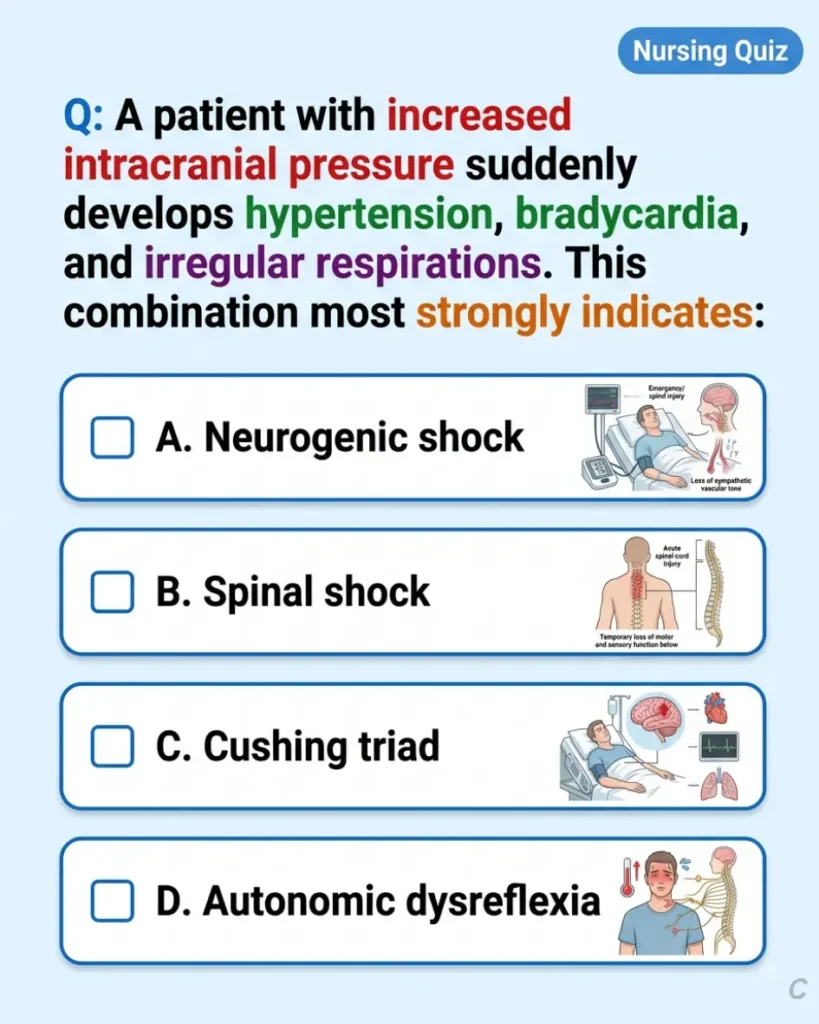
📝 Today’s Question:
A patient with increased intracranial pressure suddenly develops hypertension, bradycardia, and irregular respirations. This combination most strongly indicates:
👆 Comment your answer and the tap an option to check your answer.
Don’t forget to Comment your answer below.
🧠 Increased Intracranial Pressure & Cushing Triad
✅ Answer: (C) Cushing Triad
📖 What is Cushing Triad?
Cushing = Named after Harvey Cushing, a neurosurgeon who described important signs associated with increased intracranial pressure.
Triad = A group of three characteristic clinical findings.
👉 Cushing triad is a late and concerning sign of significantly increased intracranial pressure and impending brain herniation.
🩺 The Three Components
Especially an increase in systolic blood pressure with a widened pulse pressure.
2️⃣ Bradycardia
A decreased heart rate.
3️⃣ Irregular Respirations
Abnormal or irregular breathing pattern due to brainstem dysfunction.
👉 The combination of these three findings is the classic Cushing triad.
📖 Why Does It Occur?
As intracranial pressure rises, cerebral perfusion can become compromised. The body attempts to maintain blood flow to the brain by increasing arterial pressure.
The increased blood pressure triggers a baroreceptor-mediated slowing of the heart rate. Progressive pressure on the brainstem can then produce irregular respirations.
❌ Why Other Options Are Wrong?
(A) Neurogenic Shock
❌ Usually involves hypotension and bradycardia due to loss of sympathetic vascular tone, often after spinal cord injury.
(B) Spinal Shock
❌ Characterized by temporary loss of motor, sensory, and reflex activity below the level of spinal cord injury. It is not defined by hypertension, bradycardia, and irregular respirations.
(C) Cushing Triad
✅ Correct. The classic triad is hypertension + bradycardia + irregular respirations, particularly in the setting of increased ICP.
(D) Autonomic Dysreflexia
❌ Causes sudden severe hypertension, usually in patients with spinal cord injury above T6, often accompanied by headache, sweating, and flushing above the injury. It is not the classic triad described here.
📝 Quick Comparison
| Condition | Key Clue |
|---|---|
| Cushing Triad | Hypertension + Bradycardia + Irregular respirations |
| Neurogenic Shock | Hypotension + Bradycardia |
| Spinal Shock | Loss of reflexes and motor/sensory function below injury |
| Autonomic Dysreflexia | Sudden hypertension after spinal cord injury |
“High Pressure + Slow Pulse + Abnormal Breathing = Cushing.”
🩸 High BP + ❤️ Low HR + 🫁 Irregular RR
= 🧠 Cushing Triad
📌 Exam Tip: In a patient with increased intracranial pressure, the sudden appearance of hypertension, bradycardia, and irregular respirations is a serious late warning sign of worsening intracranial pressure and possible brain herniation. It requires immediate intervention.
Concept clarity • Easy recall • Nursing success
Don’t forget to comment the answer below.