
🩺 Nursing Question of the Day
Challenge yourself with one exam-style nursing question every day.
✅ Think carefully • ✅ Choose your answer • ✅ Then scroll down to check the explanation.
Added on Dated 11.08.2026.
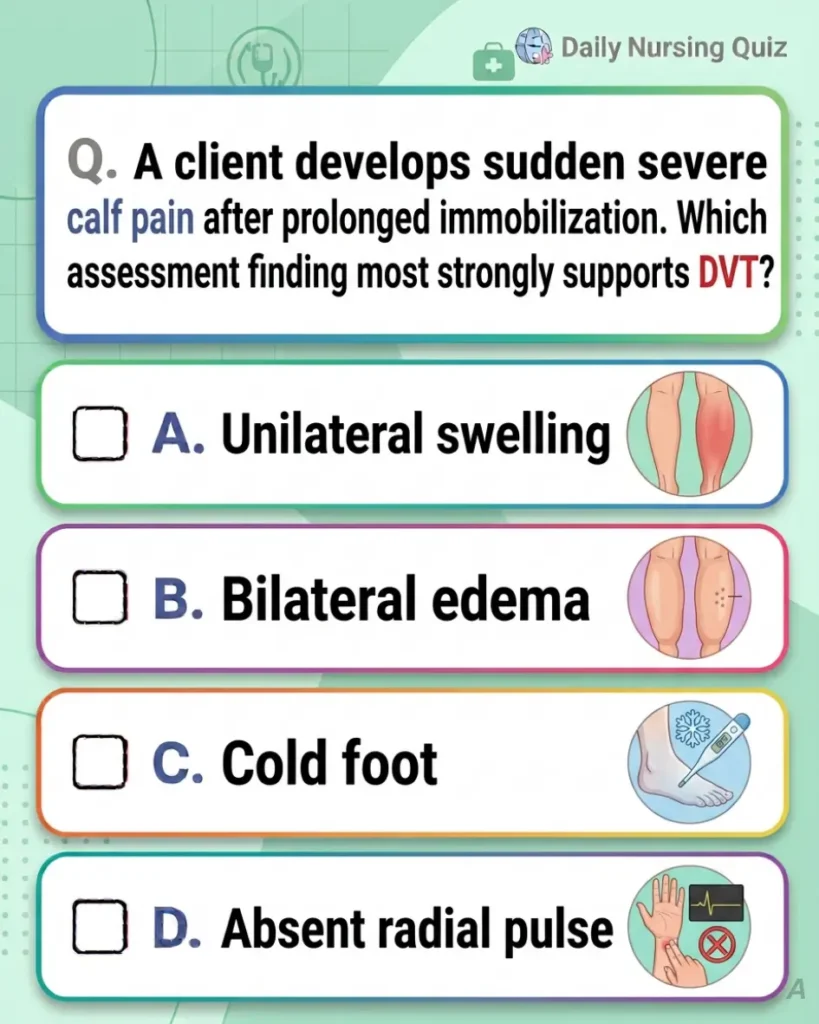
📝 Today’s Question:
A client develops sudden severe calf pain after prolonged immobilization. Which assessment finding most strongly supports DVT?
👆 Comment your answer and the tap an option to check your answer.
Don’t forget to Comment your answer below.
🩸 Deep Vein Thrombosis — Key Finding
✅ Answer: (A) Unilateral Swelling
📖 What is DVT?
DVT = Deep Vein Thrombosis
Deep = Located beneath the surface of the body.
Vein = Blood vessel that carries blood back toward the heart.
Thrombosis = Formation of a blood clot (thrombus) inside a blood vessel.
👉 DVT occurs when a blood clot forms in a deep vein, most commonly in the lower extremity.
🩺 Why is Option (A) Correct?
The client has an important risk factor: prolonged immobilization. Immobility slows venous blood flow and increases the risk of clot formation.
A DVT commonly produces symptoms in one leg, such as:
- ✔ Unilateral swelling
- ✔ Calf pain or tenderness
- ✔ Warmth
- ✔ Redness or discoloration
👉 Therefore, unilateral swelling strongly supports the possibility of DVT.
📖 What is Unilateral?
Uni = One.
Lateral = Side.
👉 Unilateral means affecting one side of the body.
This is an important clue because DVT usually affects one limb, although bilateral DVT can occur.
❌ Why Other Options Are Wrong?
(B) Bilateral Edema
❌ Swelling in both legs is more commonly associated with systemic causes such as heart failure, renal disease, or venous insufficiency.
(C) Cold Foot
❌ A cold, pale foot suggests arterial insufficiency or acute limb ischemia rather than DVT.
(D) Absent Radial Pulse
❌ The radial pulse is assessed at the wrist and has no specific relationship to a lower-extremity DVT.
📝 DVT vs Arterial Occlusion
| Finding | DVT | Arterial Occlusion |
|---|---|---|
| Temperature | Often warm | Cold |
| Swelling | Common, usually unilateral | Usually not prominent initially |
| Pulse | Usually present | May be absent |
| Typical Pain | Calf pain/tenderness | Severe ischemic pain |
🦵 DVT → One leg + Swelling + Pain + Warmth
❄️ Cold + Pulseless → Think arterial problem
📌 Exam Tip: Prolonged immobility is a major risk factor for DVT. Suspect DVT when there is new unilateral leg swelling, pain, warmth, or tenderness. Avoid relying on Homan’s sign because it is neither sufficiently sensitive nor specific for diagnosing DVT.
Concept clarity • Easy recall • Nursing success
Don’t forget to comment the answer below.