
🩺 Nursing Question of the Day
Challenge yourself with one exam-style nursing question every day.
✅ Think carefully • ✅ Choose your answer • ✅ Then scroll down to check the explanation.
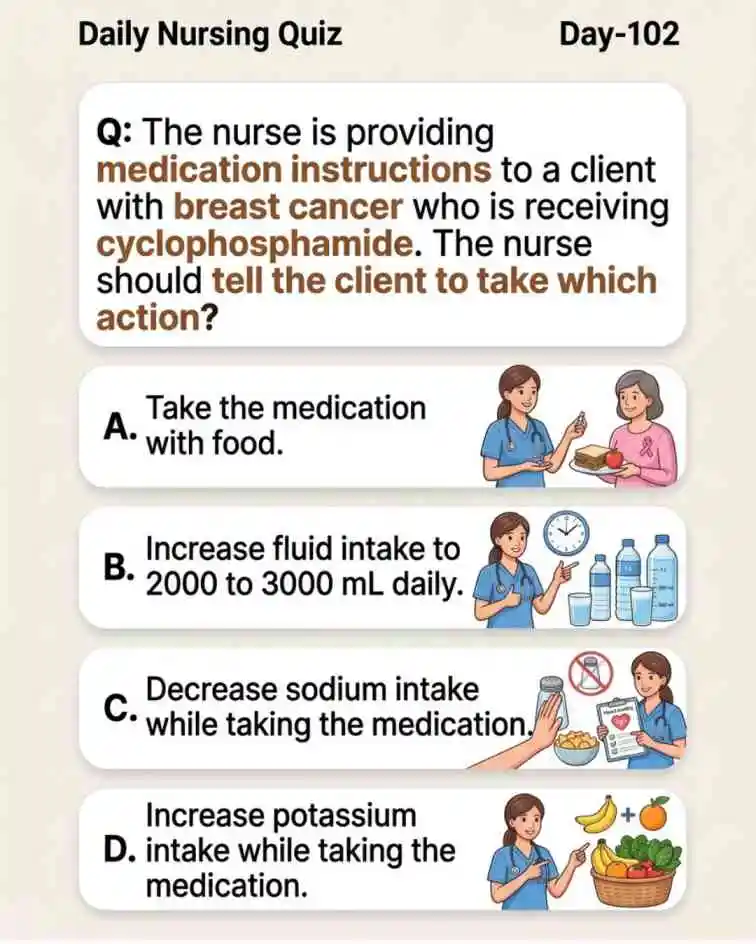
📝 Today’s Question:
Q: The nurse is providing medication instructions to a client with breast cancer who is receiving cyclo-phosphamide. The nurse should tell the client to take which action?
👆 Comment your answer and then tap an option to check your answer.
Don’t forget to Comment your answer below.
💊 Cyclophosphamide: The Important Nursing Advice
The client should drink plenty of fluids while receiving cyclophosphamide. Good hydration helps protect the urinary bladder from one of its important toxic effects.
💧 Why So Much Fluid?
Cyclophosphamide is a chemotherapy drug used to treat several cancers, including breast cancer.
One of its breakdown products is called acrolein. It can irritate the lining of the bladder and cause hemorrhagic cystitis.
Drinking about 2–3 liters of fluid daily, when not contraindicated, helps increase urine flow and reduces the time these irritating substances remain in contact with the bladder.
Cyclophosphamide → Bladder irritation → Drink more water 🚰
🔎 Know the Medical Terms
Cyclophosphamide: A cytotoxic medication that interferes with DNA replication and damages rapidly dividing cells.
Acrolein: A toxic metabolite produced during cyclophosphamide metabolism. It can irritate the bladder.
Cystitis: cyst refers to the bladder and -itis means inflammation. So, cystitis means inflammation of the bladder.
Hemorrhagic: Related to bleeding. Therefore, hemorrhagic cystitis means bladder inflammation associated with bleeding.
⚠️ What Should the Nurse Watch For?
The client should report blood in the urine, painful urination, urinary frequency, urgency, or bladder discomfort.
Adequate hydration and regular urination are important during treatment. In some treatment protocols, mesna may also be prescribed to protect the bladder.
❌ Why Not the Other Options?
Option A – Take with food: Food is not the key teaching point being tested here. The major concern is preventing bladder toxicity.
Option C – Decrease sodium: Sodium restriction does not prevent cyclophosphamide-related bladder irritation.
Option D – Increase potassium: Extra potassium is not routinely required because of cyclophosphamide therapy. Potassium intake should depend on the client’s individual condition.
Whenever you see cyclophosphamide, immediately remember bladder toxicity. Think: “Cyclophosphamide → Water → Protect the bladder.”
Concept clarity • Easy recall • Nursing success
Previous Nursing Questions
Missed a previous question? Try these exam-style nursing MCQs. Click below to see the correct answer and detailed explanation.
A patient with chronic hypertension is found to have increased thickness of the left ventricular wall on echocardiogram. Which cellular adaptation best explains this finding?
See Answer & Explanation →A mother with severe preeclampsia gives birth to a premature infant. Which assessment finding should the nurse prioritize to identify potential complications associated with this high-risk scenario?
See Answer & Explanation →A nurse is reviewing documentation for a topical medication. Which entry would most likely indicate a potential error in the administration record?
See Answer & Explanation →A nurse is caring for an elderly patient who is struggling with poor appetite. Which intervention is most appropriate to promote healthy physiologic responses related to nutrition?
See Answer & Explanation →The nurse is watching the cardiac monitor, and a client’s rhythm suddenly changes. There are no P waves; instead, there are fibrillatory waves before each QRS complex. How should the nurse correctly interpret the client’s heart rhythm?
See Answer & Explanation →A neonate born to a diabetic mother shows an initial blood glucose value of less than 20 mg/dL. The lab test confirms the report. What should be the next course of action in this case?
See Answer & Explanation →Ready to Test Your Nursing Knowledge?
Practice nursing MCQs, take mock tests, attempt quizzes, and prepare for competitive nursing exams — all in one place.
Don’t forget to comment the answer below.