
🩺 Nursing Question of the Day
Challenge yourself with one exam-style nursing question every day.
✅ Think carefully • ✅ Choose your answer • ✅ Then scroll down to check the explanation.
📝 Today’s Question:
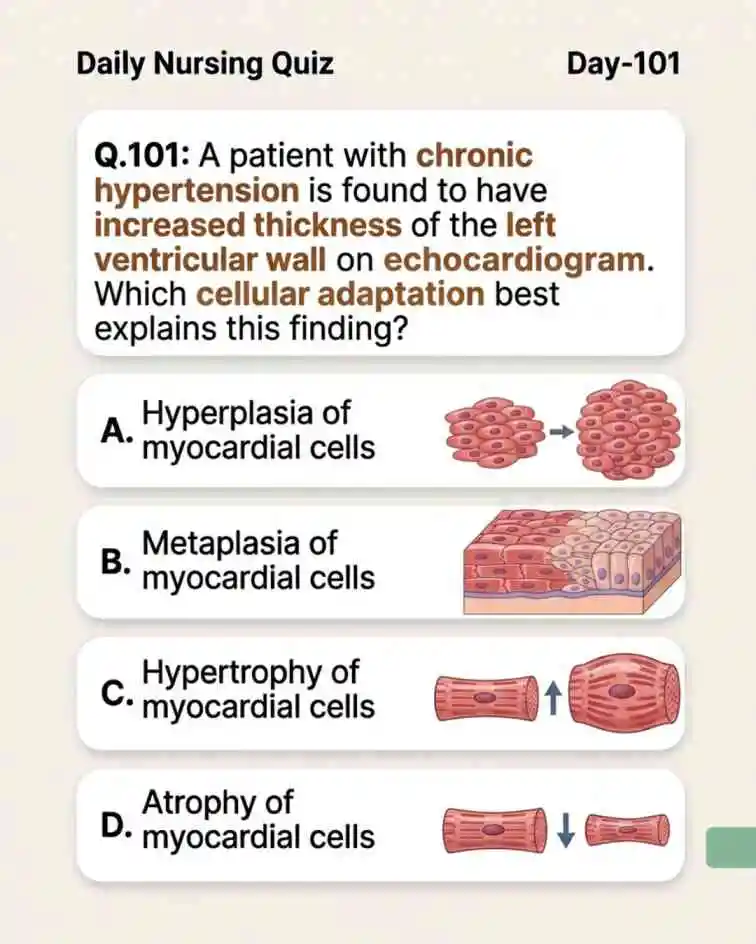
Q: A patient with chronic hypertension is found to have increased thickness of the left ventricular wall on echocardiogram. Which cellular adaptation best explains this finding?
👆 Comment your answer and then tap an option to check your answer.
Don’t forget to Comment your answer below.
❤️ Why Does the Left Ventricular Wall Become Thick?
Long-term high blood pressure makes the left ventricle work harder. The heart muscle cells become larger, making the ventricular wall thicker. This is called hypertrophy.
💡 Let’s Understand It Simply
Chronic hypertension means blood pressure stays high for a long time. The left ventricle must push blood against this increased pressure.
So, the heart muscle works harder and harder. Like a muscle that becomes bigger after repeated resistance exercise, the heart muscle cells become larger.
The result is a thickened left ventricular wall, called left ventricular hypertrophy (LVH).
Hypertension → More workload → Bigger heart cells → Hypertrophy
🔎 Know the Medical Terms
Hypertrophy comes from Greek: hyper = excessive or more, and trophē = nourishment or growth. It means an increase in the size of individual cells.
Myocardial means related to the heart muscle. Myo = muscle and card = heart.
Left ventricle is the heart chamber that pumps oxygen-rich blood into the aorta and then to the rest of the body.
❌ Why Not the Other Options?
Hyperplasia: This means an increase in the number of cells. Cardiac muscle cells have very limited ability to divide, so this is not the explanation for LV wall thickening.
Metaplasia: This means one mature cell type changes into another mature cell type. It does not explain a thickened heart wall.
Atrophy: This means cells become smaller, usually because of reduced workload, poor nutrition, or other causes. It would not produce a thickened ventricular wall.
🫀 What Can Happen Later?
At first, hypertrophy helps the heart handle the extra workload. But over time, the thick muscle can become stiff and may not relax properly.
This can contribute to diastolic dysfunction and eventually heart failure if the underlying hypertension remains uncontrolled.
If you see chronic hypertension + thickened ventricular wall, think hypertrophy — the cells become bigger, not more numerous.
Concept clarity • Easy recall • Nursing success
Previous Nursing Questions
Missed a previous question? Try these exam-style nursing MCQs. Click below to see the correct answer and detailed explanation.
A mother with severe preeclampsia gives birth to a premature infant. Which assessment finding should the nurse prioritize to identify potential complications associated with this high-risk scenario?
See Answer & Explanation →A nurse is reviewing documentation for a topical medication. Which entry would most likely indicate a potential error in the administration record?
See Answer & Explanation →A nurse is caring for an elderly patient who is struggling with poor appetite. Which intervention is most appropriate to promote healthy physiologic responses related to nutrition?
See Answer & Explanation →The nurse is watching the cardiac monitor, and a client’s rhythm suddenly changes. There are no P waves; instead, there are fibrillatory waves before each QRS complex. How should the nurse correctly interpret the client’s heart rhythm?
See Answer & Explanation →A neonate born to a diabetic mother shows an initial blood glucose value of less than 20 mg/dL. The lab test confirms the report. What should be the next course of action in this case?
See Answer & Explanation →A patient’s ABG result showed a pH of 7.28, HCO3− of 18 mEq/L, and a PaCO2 of 30 mmHg. What may be the most likely condition?
See Answer & Explanation →Ready to Test Your Nursing Knowledge?
Practice nursing MCQs, take mock tests, attempt quizzes, and prepare for competitive nursing exams — all in one place.
Don’t forget to comment the answer below.