
🩺 Nursing Question of the Day
Challenge yourself with one exam-style nursing question every day.
✅ Think carefully • ✅ Choose your answer • ✅ Then scroll down to check the explanation.
📝 Today’s Question:
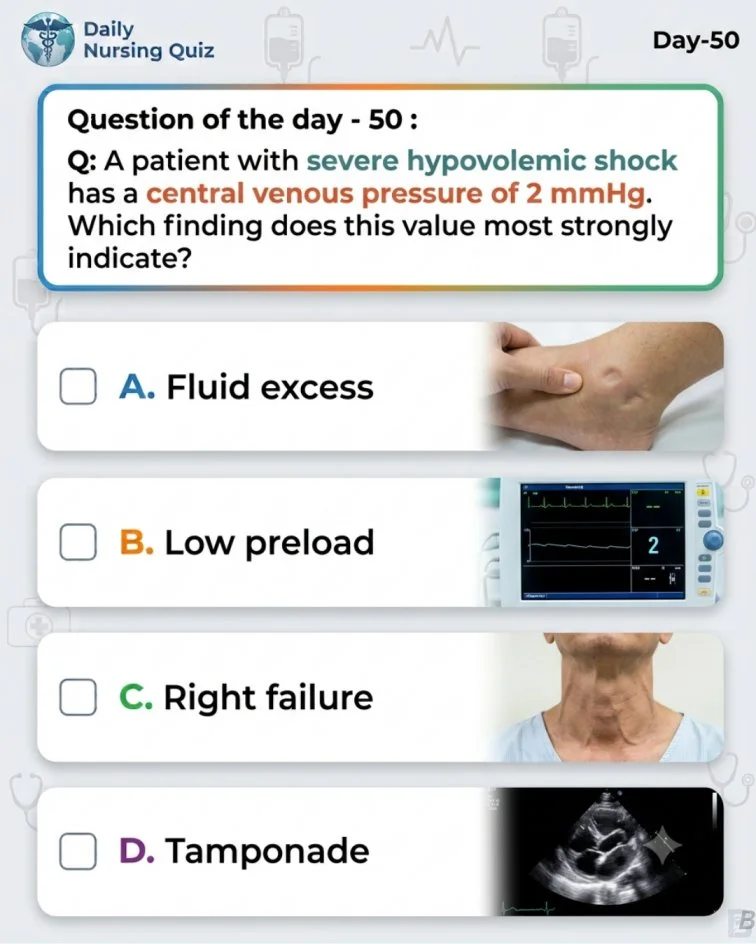
A patient with severe hypovolemic shock has a central venous pressure of 2 mmHg. Which finding does this value most strongly indicate?
👆 Comment your answer and the tap an option to check your answer.
Don’t forget to Comment your answer below.
💧 Central Venous Pressure in Hypovolemic Shock
A patient with severe hypovolemic shock has a central venous pressure of 2 mmHg. Which finding does this value most strongly indicate?
B. Low preload
C. Right failure
D. Tamponade
📖 What is CVP?
Central venous pressure (CVP) is the pressure measured in the central venous circulation near the right atrium. It provides an estimate of right-sided filling pressure and helps assess the patient’s preload.
In simple terms, CVP helps us understand how much blood is returning to the right side of the heart.
Right atrial filling ↓
Preload ↓
CVP reflects right-sided filling pressure
📏 What does a CVP of 2 mmHg mean?
A CVP of 2 mmHg is low. In the setting of severe hypovolemic shock, this strongly suggests that there is insufficient circulating blood volume returning to the heart.
Less venous return means less ventricular filling. Therefore, preload decreases.
🔬 The pathophysiology
↓ Circulating volume ↓
↓ Venous return ↓
↓ Right-sided filling ↓
↓ Preload ↓
Low CVP
❤️ What is preload?
Preload refers to the degree of ventricular filling or stretch of the ventricular muscle fibers at the end of diastole, before contraction.
Think of the ventricle as a container. If less blood enters the container, it has less filling before it contracts.
Less circulating volume → less venous return → lower preload
🚨 Why is this expected in hypovolemic shock?
Hypovolemic shock occurs when there is a significant loss of blood or intravascular fluid.
Common causes include:
- Severe hemorrhage
- Major fluid loss
- Severe vomiting or diarrhea
- Extensive burns
- Significant third-spacing
Because there is less circulating volume, venous return falls and the heart receives less blood to pump. Therefore, preload and CVP decrease.
🩺 Other findings you may see
- Hypotension
- Tachycardia
- Weak, rapid pulse
- Cool, clammy skin
- Delayed capillary refill
- Decreased urine output
- Altered mental status in severe shock
- Low CVP
❌ Why are the other options incorrect?
A. Fluid excess ❌
Excess intravascular fluid generally increases venous filling and can produce
an elevated CVP. A CVP of 2 mmHg does not support fluid overload
in this clinical setting.
C. Right failure ❌
Right-sided heart failure can cause blood to back up in the systemic venous
circulation, usually producing increased right-sided filling pressure
and elevated CVP, not a markedly low CVP.
D. Tamponade ❌
Cardiac tamponade involves fluid accumulation in the pericardial sac that
restricts cardiac filling. It is generally associated with
elevated venous pressure/CVP, along with findings such as
hypotension and muffled heart sounds. A very low CVP in severe hypovolemia
points instead toward inadequate circulating volume.
📊 CVP: Think High vs Low
| Condition | CVP | Main concept |
|---|---|---|
| Hypovolemia | ↓ | Low circulating volume → low preload |
| Fluid overload | ↑ | Increased venous filling |
| Right-sided heart failure | ↑ | Venous congestion |
| Cardiac tamponade | ↑ | Restricted cardiac filling |
⭐ Important Exam Distinction
Hypovolemic shock = “empty tank.”
The patient has too little circulating volume, so there is less blood returning to the heart. Therefore, the heart has low preload and the CVP is typically low.
“Low volume → Low return → Low preload → Low CVP.”
Or simply remember:
Hypovolemia = Empty tank = Low CVP.
When you see hypovolemic shock + very low CVP, think decreased venous return and decreased preload.
A useful shortcut: Low CVP = think “not enough blood coming back to the heart.”
Concept clarity • Easy recall • Nursing success
Don’t forget to comment the answer below.