
🩺 Nursing Question of the Day
Challenge yourself with one exam-style nursing question every day.
✅ Think carefully • ✅ Choose your answer • ✅ Then scroll down to check the explanation.
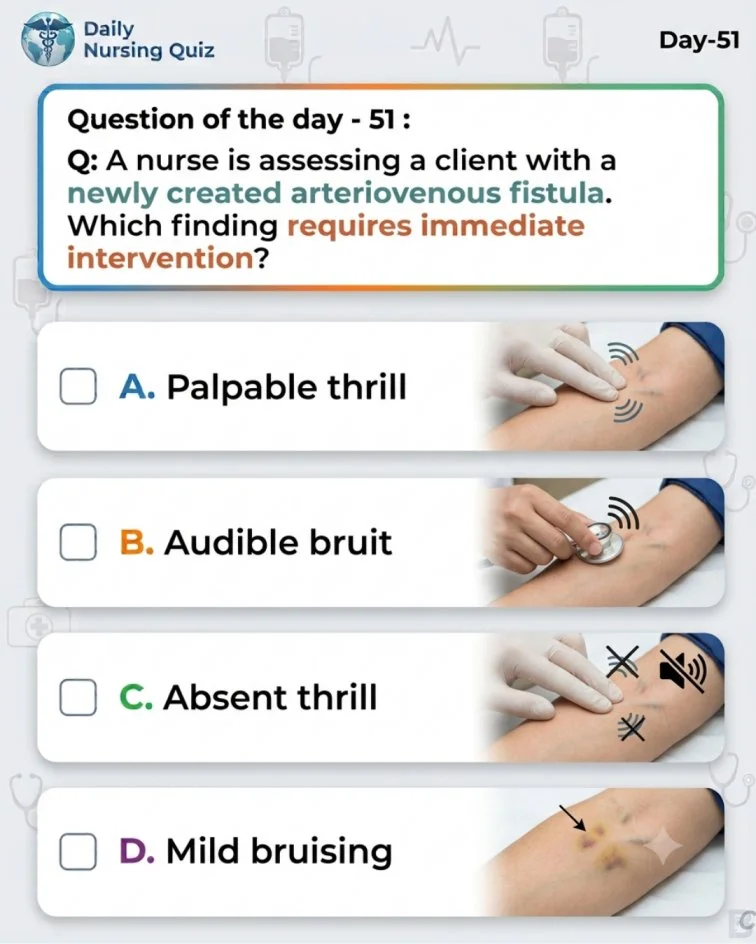
📝 Today’s Question:
A nurse is assessing a client with a newly created arteriovenous fistula. Which finding requires immediate intervention?
👆 Comment your answer and the tap an option to check your answer.
Don’t forget to Comment your answer below.
🩸 Arteriovenous Fistula: Assessing for Patency
A nurse is assessing a client with a newly created arteriovenous fistula. Which finding requires immediate intervention?
B. Audible bruit
C. Absent thrill
D. Mild bruising
📖 What is an arteriovenous fistula?
An arteriovenous (AV) fistula is a surgically created connection between an artery and a vein. It is commonly created in patients who require long-term hemodialysis.
The connection allows arterial blood to flow directly into the vein. Over time, this makes the vein larger, stronger, and more suitable for repeated dialysis needle access.
👋 What are “thrill” and “bruit”?
Two important assessments are performed to check whether blood is flowing through the AV fistula:
🔵 Thrill:
A palpable vibration or buzzing sensation felt over the fistula.
It is produced by the turbulent flow of blood through the artery-to-vein connection.
🟢 Bruit:
A whooshing sound heard with a stethoscope over the fistula.
It also indicates blood flow through the access.
🚨 Why is an absent thrill an emergency finding?
A functioning AV fistula should have detectable blood flow. If the thrill suddenly disappears, the nurse should suspect that blood flow through the fistula has been significantly reduced or stopped.
One important cause is thrombosis (clot formation) within the fistula. Other problems, such as severe obstruction or vascular compromise, may also interfere with flow.
Because the AV fistula is the patient’s dialysis access, loss of blood flow can threaten the function of the access and may require urgent intervention.
🩺 Why is this especially important in a newly created fistula?
A newly created AV fistula must remain patent while it matures. The nurse should regularly assess the access for signs of adequate blood flow and complications.
The presence of a thrill and bruit is reassuring because it demonstrates blood movement through the newly created vascular connection. Their absence requires prompt attention.
❌ Why are the other options incorrect?
A. Palpable thrill ❌
A palpable thrill is an expected finding. It indicates that
blood is flowing through the AV fistula.
B. Audible bruit ❌
An audible bruit is also an expected finding. The whooshing
sound indicates blood flow through the vascular access.
D. Mild bruising ❌
Mild bruising can occur around a recently created surgical site. It should be
monitored, but mild bruising alone is not as immediately concerning as the
sudden absence of fistula flow.
📊 AV Fistula Assessment: What Do the Findings Mean?
| Finding | Meaning | Nursing response |
|---|---|---|
| Palpable thrill | Blood flow present | Expected; continue assessment |
| Audible bruit | Blood flow present | Expected; continue assessment |
| Absent thrill | Possible loss of flow/patency | Immediate assessment & notification |
| Mild bruising | May occur after surgery | Monitor and assess |
🛡️ Important AV Fistula Precautions
- Check for a thrill and bruit regularly.
- Do not use the fistula arm for routine blood pressure measurements.
- Avoid unnecessary venipuncture in the fistula arm.
- Avoid tight clothing or anything that compresses the access.
- Assess the hand for circulation, color, temperature, sensation, and movement.
- Report a newly absent or changed thrill/bruit promptly.
The goal is to protect the vascular access and maintain adequate blood flow for future dialysis.
🎯 Common Exam Trap
Do not confuse “thrill” with a problem.
Thrill present = good blood flow.
Thrill absent = possible obstruction/thrombosis → investigate immediately.
“Thrill = Feel. Bruit = Hear.”
Feel a thrill → blood is flowing.
Hear a bruit → blood is flowing.
No thrill → Think clot or blocked flow.
In an AV fistula question, the key words are “thrill” and “bruit.”
Present thrill + present bruit = expected.
Absent thrill or absent bruit = possible access occlusion and requires prompt action.
Concept clarity • Easy recall • Nursing success
Don’t forget to comment the answer below.