
🩺 Nursing Question of the Day
Challenge yourself with one exam-style nursing question every day.
✅ Think carefully • ✅ Choose your answer • ✅ Then scroll down to check the explanation.
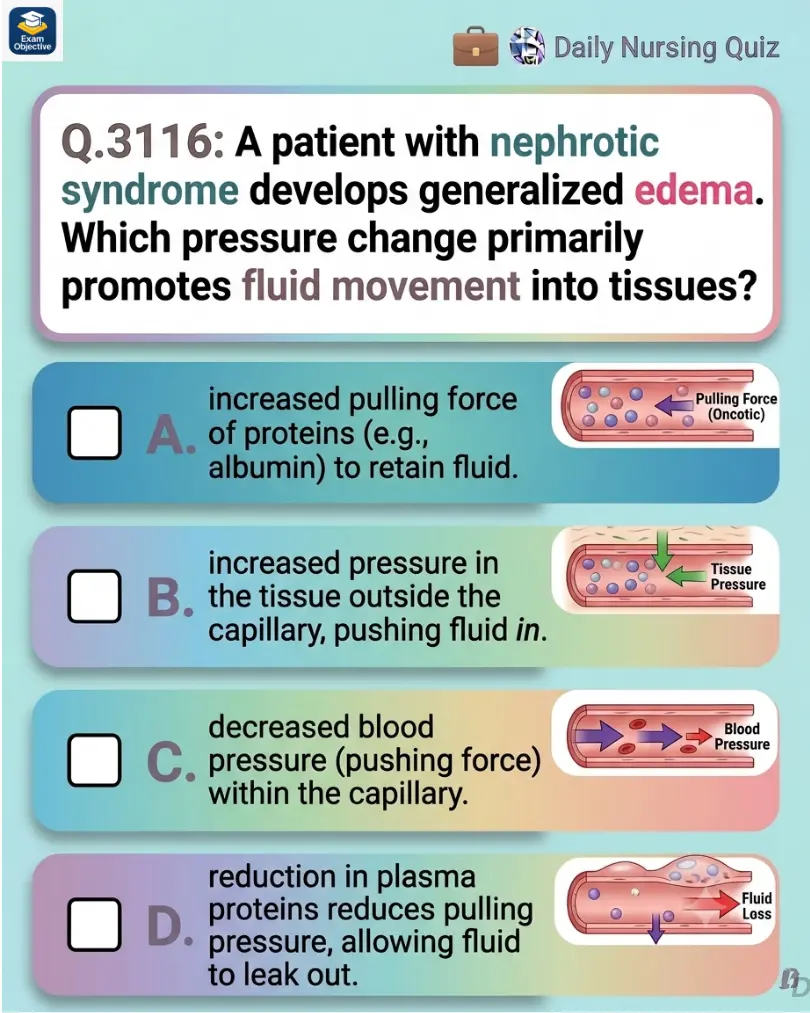
📝 Today’s Question:
A patient with nephrotic syndrome develops generalized edema. Which pressure change primarily promotes fluid movement into tissues?
👆 Comment your answer and the tap an option to check your answer.
Don’t forget to Comment your answer below.
🩺 Nephrotic Syndrome & Generalized Edema
B. ↑ Interstitial pressure
C. ↓ Hydrostatic pressure
D. ↓ Oncotic pressure
✅ Answer: (D) ↓ Oncotic pressure
📖 What Happens in Nephrotic Syndrome?
Nephrotic syndrome causes significant protein loss in the urine, especially albumin.
Because albumin is the major protein responsible for maintaining plasma colloid oncotic pressure, excessive albumin loss causes plasma oncotic pressure to fall.
⬇️
Albuminuria
⬇️
🩸 Plasma albumin ↓
⬇️
Plasma oncotic pressure ↓
⬇️
💧 Fluid moves into tissues
⬇️
Generalized edema
🩸 Why Does Low Oncotic Pressure Cause Edema?
Oncotic pressure is the osmotic pressure generated mainly by plasma proteins such as albumin. It helps pull water into the intravascular space.
When plasma albumin decreases, this inward pulling force becomes weaker. As a result, more fluid leaves the blood vessels and accumulates in the interstitial tissues.
👉 Therefore, decreased plasma oncotic pressure is the key pressure change in nephrotic syndrome that promotes edema.
❌ Why Are the Other Options Wrong?
A. ↑ Oncotic pressure
❌ Increased plasma oncotic pressure would tend to retain or draw fluid into the vascular compartment, opposing edema.
B. ↑ Interstitial pressure
❌ Increased interstitial pressure generally opposes further movement of fluid into the interstitial space.
C. ↓ Hydrostatic pressure
❌ Lower capillary hydrostatic pressure would reduce the force pushing fluid out of the blood vessels.
D. ↓ Oncotic pressure
✅ Correct. Loss of albumin lowers plasma oncotic pressure, favoring movement of fluid from the intravascular space into tissues.
📝 Quick Comparison
| Pressure | Effect on Fluid Movement |
|---|---|
| ↑ Capillary hydrostatic pressure | Pushes fluid out of vessels |
| ↓ Plasma oncotic pressure | Reduces fluid reabsorption into vessels |
| ↑ Plasma oncotic pressure | Pulls fluid into vessels |
| ↓ Hydrostatic pressure | Reduces outward fluid movement |
“Nephrotic = Protein lost → Albumin lost → Oncotic pressure falls → Edema.”
📌 Exam Tip: In nephrotic syndrome, severe proteinuria causes hypoalbuminemia. The resulting decrease in plasma oncotic pressure is a major mechanism contributing to generalized edema.
Concept clarity • Easy recall • Nursing success
Don’t forget to comment the answer below.