
🩺 Nursing Question of the Day
Challenge yourself with one exam-style nursing question every day.
✅ Think carefully • ✅ Choose your answer • ✅ Then scroll down to check the explanation.
📝 Today’s Question:
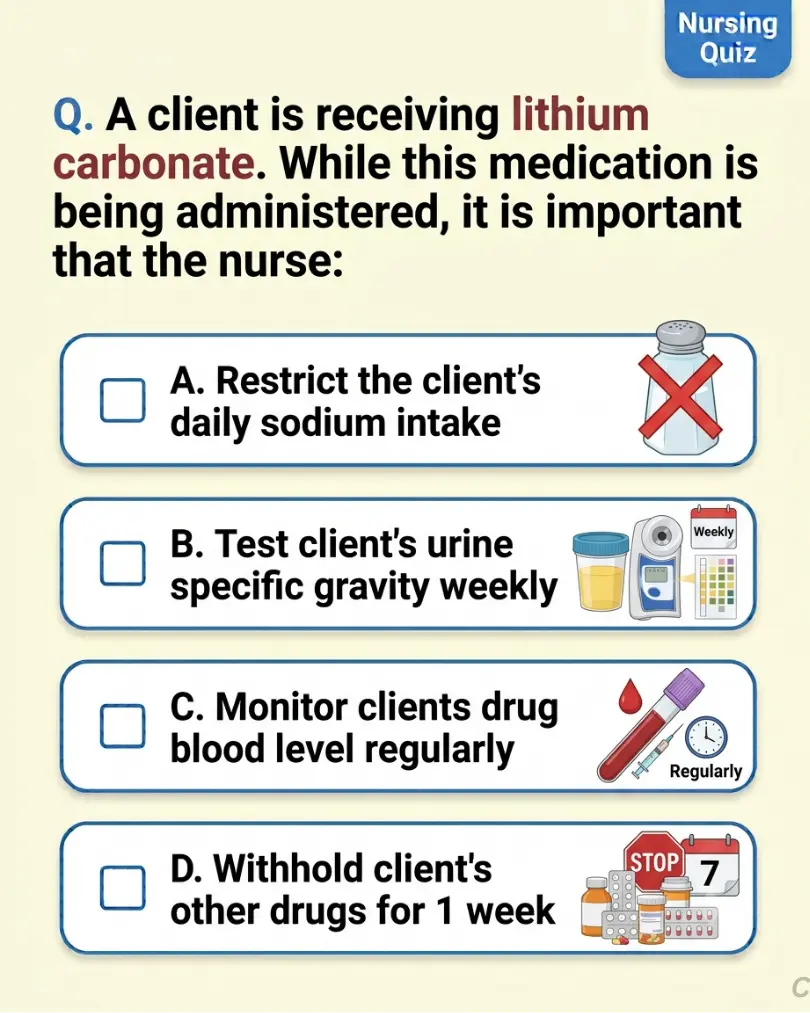
A client is receiving lithium carbonate. While this medication is being administered, it is important that the nurse:
👆 Comment your answer and the tap an option to check your answer.
Don’t forget to Comment your answer below.
💊 Lithium Therapy — Blood Level Monitoring
B. Test client’s urine specific gravity weekly
C. Monitor client’s drug blood level regularly
D. Withhold client’s other drugs for 1 week
✅ Answer: (C) Monitor client’s drug blood level regularly
📖 Why is Lithium Blood Level Monitoring Important?
Lithium has a narrow therapeutic index, meaning the difference between an effective dose and a toxic dose is relatively small.
Therefore, serum lithium concentrations need to be monitored regularly, particularly after starting treatment, changing the dose, or when factors that alter lithium levels occur.
⬇️
Narrow therapeutic range
⬇️
🩸 Regular serum lithium monitoring
⬇️
🛡️ Helps detect toxicity
⚠️ Lithium Toxicity
Excessive lithium levels can cause serious toxicity. Important manifestations include:
- 🤢 Nausea and vomiting
- 🤲 Coarse tremor
- 🚶 Ataxia and unsteady gait
- 🧠 Confusion
- 💪 Muscle weakness
- ⚠️ Severe cases may progress to seizures or impaired consciousness
👉 Regular serum-level monitoring helps the healthcare team maintain lithium within the therapeutic range and recognize potentially toxic levels.
🧂 Important Sodium & Fluid Point
Lithium handling by the kidneys is closely related to sodium and fluid balance. The patient should generally maintain a consistent sodium intake and adequate hydration.
Do not routinely restrict sodium while taking lithium, because significant sodium depletion can increase lithium reabsorption and potentially raise serum lithium levels.
Lithium + low sodium/dehydration → ↑ lithium level → toxicity risk
❌ Why Are the Other Options Wrong?
A. Restrict the client’s daily sodium intake
❌ Incorrect. Sodium restriction can increase the risk of lithium accumulation. The patient should maintain a consistent sodium intake.
B. Test client’s urine specific gravity weekly
❌ Not the primary monitoring requirement. Lithium can affect renal function and concentrating ability, but serum lithium levels are the key medication-specific monitoring parameter.
C. Monitor client’s drug blood level regularly
✅ Correct. Lithium has a narrow therapeutic index, so serum lithium levels must be monitored to maintain therapeutic treatment and prevent toxicity.
D. Withhold client’s other drugs for 1 week
❌ Incorrect. Other medications are not automatically withheld. However, the nurse should review medications because several drugs can alter lithium concentrations.
📝 Quick Recall
| Lithium Point | Remember |
|---|---|
| Therapeutic index | Narrow |
| Key monitoring | Serum lithium level |
| Sodium | Maintain consistent intake |
| Hydration | Maintain adequate fluid intake |
| Toxicity concern | GI symptoms, coarse tremor, ataxia, confusion |
“Lithium = Level must be checked.”
💊 Lithium → 🩸 Serum drug level monitoring
📌 Exam Tip: For lithium questions, the highest-yield point is its narrow therapeutic index. Regular serum lithium monitoring is essential, and patients should avoid major changes in sodium intake or hydration.
Concept clarity • Easy recall • Nursing success
Don’t forget to comment the answer below.