
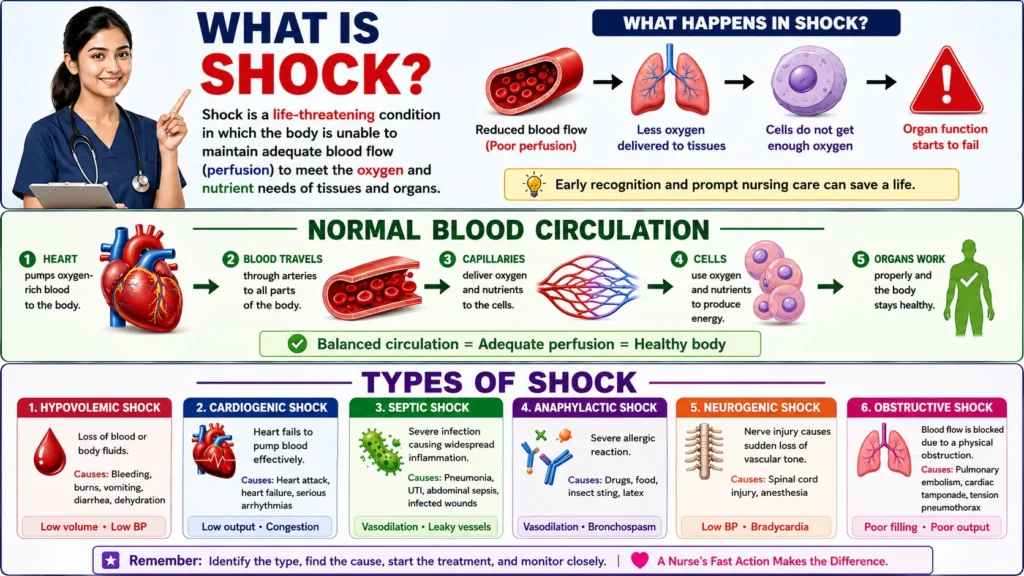
What is Shock? – Complete Nursing Notes for Exam Preparation
Shock is one of the most important emergency topics in nursing. It is frequently asked in NORCET, AIIMS, NCLEX, Staff Nurse, ESIC and other nursing examinations.
What is Shock?
Shock is a life-threatening condition in which the body’s tissues do not receive enough oxygenated blood. As a result, cells cannot produce sufficient energy, organs begin to fail, and without timely treatment the condition may become fatal.
The medical word Shock comes from the old French word choquer, meaning “to strike suddenly or collide.” Doctors later used this word to describe the sudden collapse of normal blood circulation.
Understanding Every Technical Term
Perfusion comes from the Latin word perfundere, meaning “to pour through.” In nursing, perfusion means the continuous flow of oxygen-rich blood through body tissues.
Tissue comes from the French word tissu, meaning “woven.” A tissue is a group of similar cells working together.
Oxygen comes from Greek words meaning “acid former.” Oxygen is essential for energy production inside cells.
Hypoxia = Hypo (less) + oxia (oxygen). It means reduced oxygen reaching tissues.
Hypoperfusion = Hypo (less) + Perfusion (blood flow). It means inadequate blood flow to organs.
Why Does Shock Happen?
Imagine your body as a large city. The heart is the water pump, blood vessels are pipelines, and blood is the water carrying oxygen and nutrients. If the pump becomes weak, pipes become blocked, pipes widen too much, or water leaks out, every house receives less water. Similarly, body cells receive less oxygen during shock.
Types of Shock
| Type | Meaning |
|---|---|
| Hypovolemic | Loss of blood or body fluids. |
| Cardiogenic | Heart fails to pump effectively. |
| Septic | Severe infection causes abnormal blood vessel dilation. |
| Anaphylactic | Severe allergic reaction. |
| Neurogenic | Loss of sympathetic nervous system control. |
| Obstructive | Physical obstruction prevents blood flow. |
Nursing Priorities
- Assess Airway, Breathing and Circulation (ABC).
- Administer oxygen as prescribed.
- Establish IV access.
- Monitor blood pressure, pulse, respiration and SpO₂.
- Observe urine output because it reflects kidney perfusion.
- Treat the underlying cause promptly.
Disclaimer
This article is for nursing education and examination preparation only. It does not replace standard nursing textbooks, institutional guidelines or clinical judgement.
📝 Ready to Test Yourself?
You have learned the basics of Shock. Now test your understanding with our Shock Nursing Mock Test. Solve exam-style MCQs, check your score instantly, and strengthen your preparation for NORCET, AIIMS, NCLEX, ESIC, RRB, and other nursing exams.
MOCK TEST FROM SHOCK
❌ Negative Marking: No
⏱️ Time: 30 Minute
Ideal for: Nursing recruitment exams practice and other nursing related exams.
This test is from the nursing topic Shock. Suitable for students, interns, and practicing nurses.
Practice MCQs for NCLEX-RN, NCLEX-PN, CGFNS, NMC Test of Competence, IELTS/OSCE, ANMAC Assessment, AIIMS/JIPMER/PGIMER Nursing Exams, SCFHS Nursing Licensing Exam, PRC Nursing Licensure Exam etc.
Don’t forget to comment your answer below.