
🩺 Nursing Question of the Day
Challenge yourself with one exam-style nursing question every day.
✅ Think carefully • ✅ Choose your answer • ✅ Then scroll down to check the explanation.
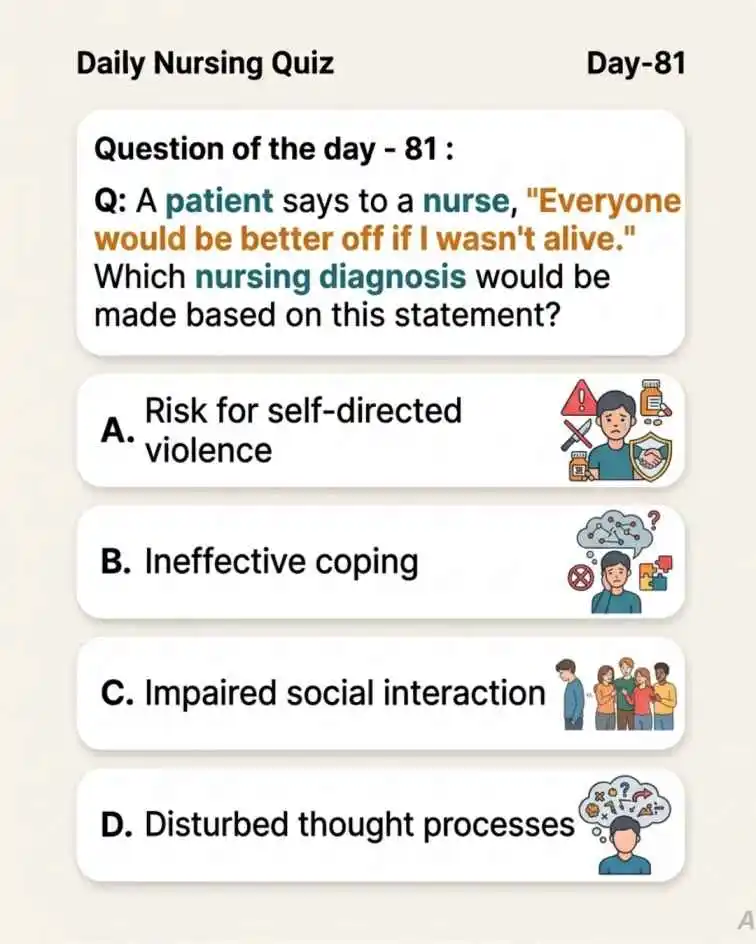
📝 Today’s Question:
Q: A patient says to a nurse, “Everyone would be better off if I wasn’t alive.” Which nursing diagnosis would be made based on this statement?
👆 Comment your answer and then tap an option to check your answer.
Don’t forget to Comment your answer below.
Recognizing Risk for Self-Directed Violence
🧠 Why is this the correct diagnosis?
When a patient says something like “Everyone would be better off if I wasn’t alive,” the nurse should not simply treat it as sadness or a normal expression of frustration. It may indicate suicidal ideation or thoughts related to death.
The patient may be feeling hopeless, worthless, like a burden, or unable to see a way out of the current situation. These feelings can increase the risk of self-harm or suicide.
Therefore, the most appropriate nursing diagnosis among the choices is Risk for self-directed violence.
In simple words: the patient’s words are giving the nurse a warning that the patient may be at risk of hurting themselves.
🔬 Understanding the Important Terms
Risk: The possibility that something harmful may happen. In a nursing diagnosis, “risk for” means that the patient has factors that increase the chance of a problem occurring, even if the actual problem has not yet occurred.
Self-directed: Something directed toward oneself. Self comes from Old English and refers to one’s own person, while directed means aimed toward something.
Violence: The use of physical force that can cause injury or harm. The word comes from Latin violentia, meaning force or vehemence.
Suicidal ideation: Thoughts, ideas, or wishes about dying or suicide. Suicide comes from Latin roots meaning approximately “to kill oneself.”
Hopelessness: A feeling that the future will not improve and that there is no solution to the current problem. A patient who feels hopeless may have difficulty seeing alternatives or reasons to continue living.
Worthlessness: A feeling of having little or no value. A patient may believe that they are a burden to family or other people.
⚠️ Why Should the Nurse Take This Statement Seriously?
Sometimes patients do not directly say, “I want to kill myself.” Instead, they may make indirect statements such as:
“There is no point in going on.”
“I wish I could just disappear.”
“Everyone would be better off without me.”
These statements should be taken seriously. The nurse should assess the patient directly for suicidal thoughts, intent, plan, access to means, previous attempts, and other risk factors.
Asking about suicide does not put the idea into the patient’s mind. A calm and direct assessment helps determine the level of danger and allows appropriate safety measures to be started.
❌ Why Are the Other Options Incorrect?
Ineffective coping means that a patient is having difficulty dealing with stress or a problem. The patient may indeed have poor coping, but the statement specifically raises concern about possible self-harm, making safety the priority.
This diagnosis involves difficulty developing or maintaining healthy relationships or social interactions. Nothing in the statement directly indicates a problem with social interaction.
Disturbed thought processes involve problems with thinking, such as disorganized thinking, confusion, or difficulty processing information. The patient’s statement alone does not show a disturbed thought process.
The statement suggests possible suicidal thinking and therefore requires immediate assessment of the patient’s safety and suicide risk.
👩⚕️ What Should the Nurse Do?
The first priority is patient safety. The nurse should stay calm, listen without judgment, and ask direct questions about suicidal thoughts.
- Ask whether the patient is thinking about suicide or self-harm.
- Assess for a specific plan and access to means.
- Assess previous suicide attempts and current risk factors.
- Do not leave a high-risk patient alone.
- Remove or secure potential means of self-harm according to policy.
- Notify the appropriate healthcare team and initiate safety precautions as indicated.
“Better off without me” → Think Safety First.
Statements suggesting that life would be better without the patient should make the nurse think about suicide risk.
When a psychiatric patient makes a statement suggesting that they would be better off dead or that others would be better off without them, do not choose a general communication or coping diagnosis first. Think about self-harm and patient safety.
Concept clarity • Easy recall • Nursing success
Don’t forget to comment the answer below.