
🩺 Nursing Question of the Day
Challenge yourself with one exam-style nursing question every day.
✅ Think carefully • ✅ Choose your answer • ✅ Then scroll down to check the explanation.
📝 Today’s Question:
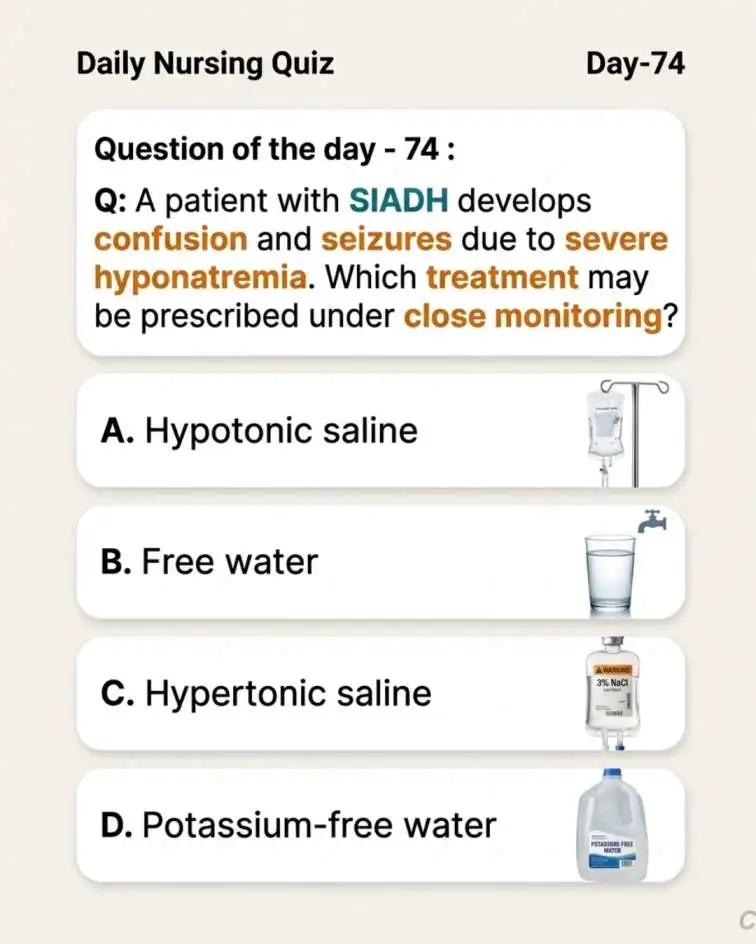
Q: A patient with SIADH develops confusion and seizures due to severe hyponatremia. Which treatment may be prescribed under close monitoring?
👆 Comment your answer and the tap an option to check your answer.
Don’t forget to Comment your answer below.
SIADH and Severe Hyponatremia
📖 First, What Is SIADH?
SIADH stands for Syndrome of Inappropriate Antidiuretic Hormone Secretion. In this condition, too much antidiuretic hormone (ADH) acts on the kidneys, causing the body to retain excessive water.
The important point is that the patient’s sodium becomes diluted by the extra water. Therefore, the patient develops dilutional hyponatremia.
↓
Too much water retained
↓
Sodium becomes diluted
↓
Hyponatremia
↓
Brain swelling / neurological symptoms
🔎 What Do These Medical Terms Mean?
SIADH
The word syndrome comes from Greek roots referring to a group of signs and symptoms occurring together. Inappropriate means unsuitable or occurring when it should not. Antidiuretic means something that reduces urine formation, and hormone comes from a Greek word meaning “to set in motion” or stimulate.
So, SIADH essentially means that antidiuretic hormone is being released or acting when the body does not appropriately need that amount of water retention.
ADH
Antidiuretic hormone is also called vasopressin. It helps the kidneys retain water. The word diuresis means urine production, while anti-diuretic means reducing the loss of water through urine.
Hyponatremia
Hypo- means “low,” natri- refers to sodium, and -emia means “in the blood.” Therefore, hyponatremia means an abnormally low sodium concentration in the blood.
Hypertonic
Hyper- means “above” or “excessive,” while tonic relates to concentration or osmotic pressure. A hypertonic solution has a higher concentration of dissolved substances compared with another solution. Hypertonic saline contains more sodium chloride than normal saline.
Saline
Saline simply means a solution containing salt, particularly sodium chloride dissolved in water. In nursing practice, different saline concentrations are used for different clinical purposes.
Seizure
The word is related to the idea of being “seized” or suddenly taken hold of. A seizure is a sudden episode of abnormal electrical activity in the brain. Severe hyponatremia can cause seizures because significant changes in blood sodium can disturb brain-cell function.
Neurological symptoms
Neuro- comes from the Greek word neuron, meaning “nerve.” Neurological symptoms are symptoms involving the brain, spinal cord, or nerves, such as confusion, altered consciousness, weakness, or seizures.
💧 Why Is Hypertonic Saline Used?
In severe symptomatic hyponatremia, the low sodium level can cause water to move into brain cells. This can contribute to cerebral edema, meaning swelling of the brain.
Hypertonic saline provides a concentrated sodium solution. When appropriately administered, it helps raise the serum sodium concentration and reduce the dangerous effects of severe hyponatremia.
However, this treatment requires very close monitoring. Serum sodium should not be corrected too rapidly because overly rapid correction can cause osmotic demyelination syndrome, a serious neurological complication.
Severe hyponatremia with seizures, confusion, or altered consciousness is an emergency. Hypertonic saline may be prescribed, but the sodium level must be monitored carefully and correction should follow the prescribed protocol.
❌ Why Are the Other Options Wrong?
Hypotonic saline
Hypo- means “lower.” Hypotonic fluids have a lower effective solute concentration and can contribute to movement of water into cells. They are therefore not appropriate for treating severe symptomatic hyponatremia caused by excess water.
Free water
Free water contains no significant electrolytes. Giving additional free water to a patient who already has excess water from SIADH can further dilute the serum sodium and worsen hyponatremia.
Potassium-free water
This does not correct the underlying sodium deficit. In SIADH with severe symptomatic hyponatremia, the immediate concern is the dangerously low sodium level and its neurological effects, not simply whether the fluid contains potassium.
🩺 Nursing Priorities
- Monitor neurological status closely.
- Monitor serum sodium as ordered.
- Observe for worsening confusion, headache, vomiting, or seizures.
- Maintain seizure precautions when indicated.
- Monitor fluid intake and output.
- Follow prescribed fluid restriction when appropriate for SIADH.
- Administer hypertonic saline carefully according to the prescribed protocol.
- Watch for overly rapid correction of sodium.
SIADH = Too much water → Sodium gets diluted.
If severe hyponatremia causes brain symptoms such as seizures or confusion, think hypertonic saline with careful monitoring.
When you see SIADH + severe hyponatremia + seizures/confusion, the key treatment clue is hypertonic saline. Do not choose hypotonic or free water because these can worsen the dilution of sodium.
Concept clarity • Easy recall • Nursing success
Don’t forget to comment the answer below.