
🩺 Nursing Question of the Day
Challenge yourself with one exam-style nursing question every day.
✅ Think carefully • ✅ Choose your answer • ✅ Then scroll down to check the explanation.
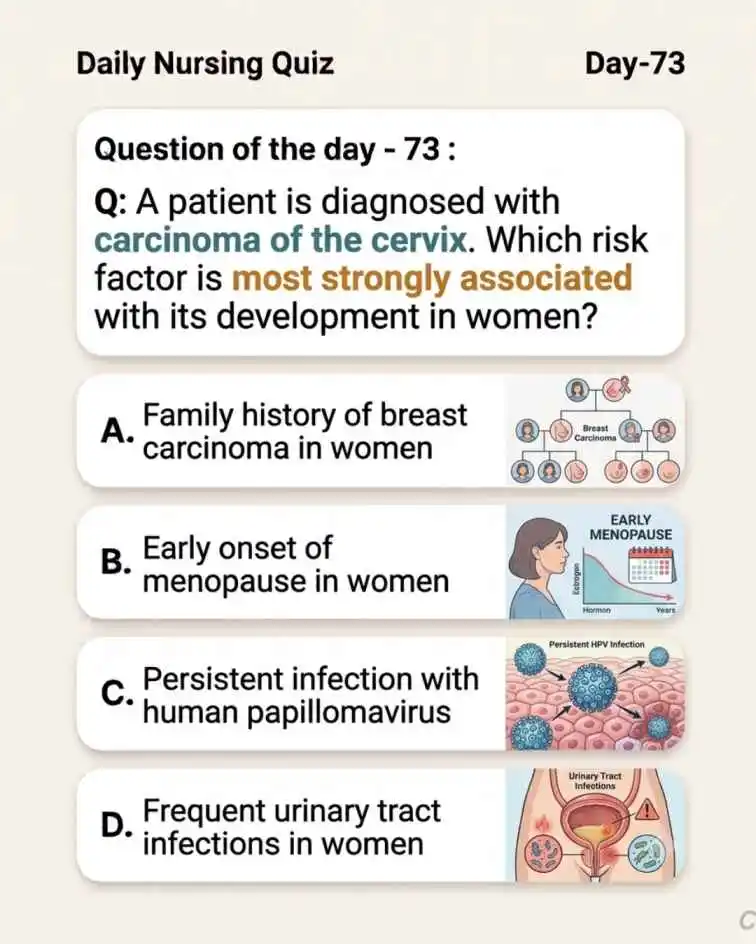
📝 Today’s Question:
Q: A patient is diagnosed with carcinoma of the cervix. Which risk factor is most strongly associated with its development in women?
👆 Comment your answer and the tap an option to check your answer.
Don’t forget to Comment your answer below.
Cervical Cancer: The Most Important Risk Factor
📖 First, What Is Cervical Cancer?
Carcinoma of the cervix means cancer that develops in the cervix, the lower, narrow part of the uterus that connects to the vagina.
Let’s understand the medical words in a simple way:
1. Carcinoma
The word comes from the Greek karkinos, meaning “crab,” and the suffix -oma, meaning a tumour or growth. In medicine, carcinoma is a cancer that begins in epithelial cells, which cover body surfaces and line organs.
2. Cervix
Cervix is a Latin word meaning “neck.” The cervix is called the neck of the uterus because it forms the narrow lower portion of the womb.
3. Human papillomavirus (HPV)
Papilloma refers to a wart-like growth, and virus refers to an infectious agent. HPV is a group of viruses that infect the skin and certain moist linings of the body, including the genital tract. Some types can cause genital warts, while certain high-risk types can cause cancer.
🔬 Why Does HPV Cause Cervical Cancer?
HPV is a very common virus, usually spread through intimate skin-to-skin contact, including sexual contact. Most HPV infections clear naturally because the immune system controls the virus.
The problem arises when a high-risk HPV infection persists for years. Persistent means that the infection remains in the body instead of clearing away.
These high-risk HPV types can interfere with the normal controls that regulate cell growth. Over time, infected cervical cells may develop abnormal changes called precancerous lesions. If these changes are not detected and managed, some may progress to cervical cancer.
↓
Abnormal cervical cell changes
↓
Precancerous lesions
↓
Possible cervical cancer
📚 Important Medical Terms and Their Meanings
Persistent infection
Persistent comes from Latin roots meaning to continue or remain. In this context, it means the HPV infection stays for a prolonged period rather than clearing naturally.
High-risk HPV
These are HPV types associated with a greater chance of causing cancer. HPV-16 and HPV-18 are particularly important in cervical cancer.
Precancerous lesion
Pre- means “before,” and lesion comes from Latin laesio, meaning injury or damage. A precancerous lesion is an area of abnormal cells that may develop into cancer, but it is not cancer itself.
Metaplasia
From Greek roots meaning “change in form.” It describes one mature cell type being replaced by another. Metaplasia can occur in the cervix, but it is not the same as cancer and is not the direct step that every cervical cancer follows.
Dysplasia
From Greek roots meaning “abnormal formation.” Cervical dysplasia means abnormal development of cervical cells. Some high-grade changes can progress to cancer if left untreated.
❌ Why Are the Other Risk Factors Incorrect?
Family history of breast carcinoma
A family history of breast cancer can be relevant to a person’s overall cancer-risk assessment, especially when inherited gene variants are involved. However, it is not the strongest established risk factor for cervical cancer. Persistent high-risk HPV infection is much more directly associated with cervical cancer development.
Early onset of menopause
Menopause is the permanent end of menstrual periods due to the loss of ovarian reproductive function. Early menopause is not an established major cause of cervical cancer.
Frequent urinary tract infections
A urinary tract infection (UTI) is an infection affecting part of the urinary system, such as the bladder or urethra. UTIs are commonly caused by bacteria and are not considered a major direct risk factor for cervical cancer.
🩺 Nursing Importance
- HPV vaccination: Helps prevent infection with important cancer-causing HPV types.
- Cervical screening: HPV testing and cervical cytology (Pap testing), according to local guidelines, can identify risk or abnormal cell changes.
- Follow-up: Abnormal screening results require appropriate evaluation and follow-up.
- Patient education: Explain that HPV is common, and an HPV infection does not mean a person has cancer or has been unfaithful.
HPV = High-risk Papillomavirus associated with cervical cancer.
For exams, remember: persistent infection with high-risk HPV is the key risk factor for cervical cancer.
If a question asks for the strongest risk factor for cervical cancer, select persistent high-risk HPV infection. HPV-16 and HPV-18 are especially important. Do not confuse cervical cancer risk factors with those associated with breast cancer or urinary tract infections.
Concept clarity • Easy recall • Nursing success
Don’t forget to comment the answer below.